
Gary A. Shaw
1013 Vernon Loop, Oviedo, FL 32765-6013
Safety Comes First
Answering questions about cyanoacrylate (CyA) glue: Of all the mail received in recent months, letters from individuals concerned about the chemical properties of CyA took the lead over other issues.
Although I was initially surprised (no prop stories?), a quick look at the postmarks—January, February, March—provided the following conclusion: no prop stories sent because it's winter up north.
Silly me. Since moving to Florida, it's been convenient to forget about winter and related building projects (it's March here, and we're still flying). My motto: Fly 'em if you got 'em!
Arriving just in time to pull me out of this verbal quagmire is a letter from veteran modeler George Wilson: "It would be well if we knew what the fumes are that come from cyanoacrylate glues. For the record, this question should be answered."
I searched the pages of a few conveniently located chemical reference books (my office). I made a couple of phone calls to the more popular glue manufacturers, and I reviewed appropriate Material Safety Data Sheets (MSDS).
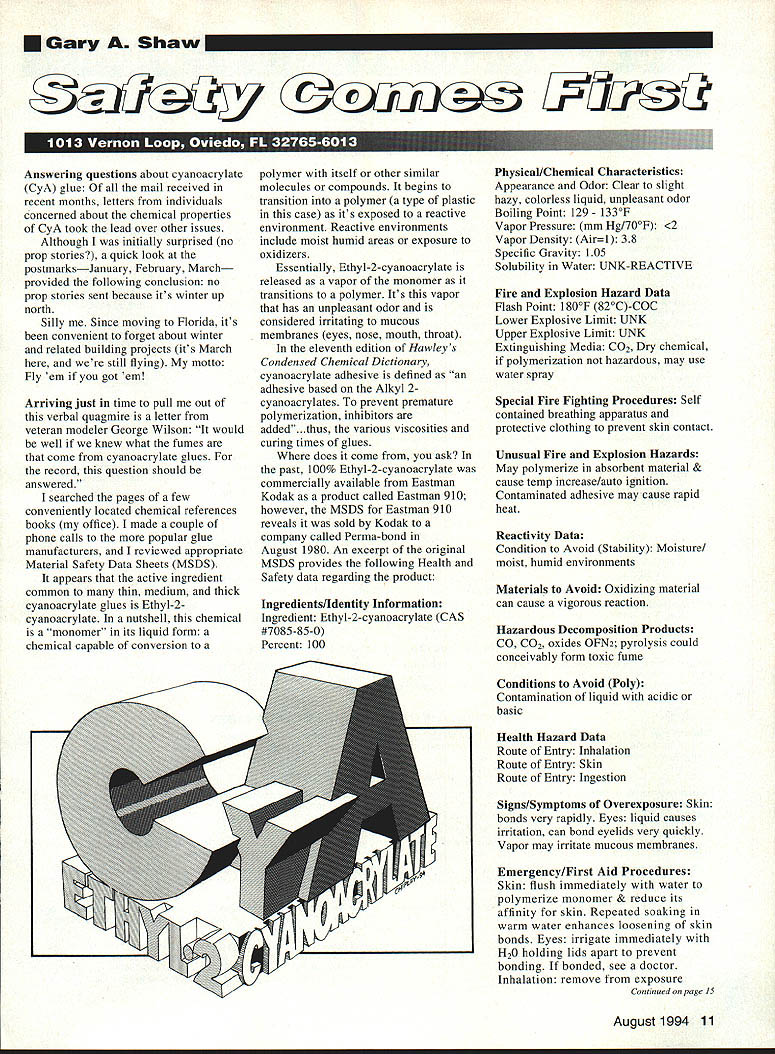
It appears that the active ingredient common to many thin, medium, and thick cyanoacrylate glues is ethyl-2-cyanoacrylate. In a nutshell, this chemical is a "monomer" in its liquid form: a chemical capable of conversion to a polymer with itself or other similar molecules or compounds. It begins to transition into a polymer (a type of plastic in this case) as it's exposed to a reactive environment. Reactive environments include moist, humid areas or exposure to oxidizers.
Essentially, ethyl-2-cyanoacrylate is released as a vapor of the monomer as it transitions to a polymer. It's this vapor that has an unpleasant odor and is considered irritating to mucous membranes (eyes, nose, mouth, throat).
In the eleventh edition of Hawley's Condensed Chemical Dictionary, cyanoacrylate adhesive is defined as "an adhesive based on the alkyl 2-cyanoacrylates. To prevent premature polymerization, inhibitors are added"—thus, the various viscosities and curing times of glues.
Where does it come from, you ask? In the past, 100% ethyl-2-cyanoacrylate was commercially available from Eastman Kodak as a product called Eastman 910; however, the MSDS for Eastman 910 reveals it was sold by Kodak to a company called Perma-Bond in August 1980. An excerpt of the original MSDS provides the following health and safety data regarding the product:
Ingredients/Identity Information
- Ingredient: Ethyl-2-cyanoacrylate (CAS #7085-85-0)
- Percent: 100
Physical/Chemical Characteristics
- Appearance and Odor: Clear to slightly hazy, colorless liquid; unpleasant odor
- Boiling Point: 129–133°F
- Vapor Pressure (mm Hg/70°F): <2
- Vapor Density (Air = 1): 3.8
- Specific Gravity: 1.05
- Solubility in Water: Unknown — reactive
Fire and Explosion Hazard Data
- Flash Point: 180°F (82°C) - COC
- Lower Explosive Limit: Unknown
- Upper Explosive Limit: Unknown
- Extinguishing Media: CO2, dry chemical; if polymerization is not hazardous, may use water spray
- Special Fire Fighting Procedures: Self-contained breathing apparatus and protective clothing to prevent skin contact
- Unusual Fire and Explosion Hazards: May polymerize in absorbent material and cause a temperature increase/autoignition. Contaminated adhesive may cause rapid heat.
Reactivity Data
- Conditions to Avoid (Stability): Moisture; moist, humid environments
- Materials to Avoid: Oxidizing materials can cause a vigorous reaction
- Hazardous Decomposition Products: CO, CO2, oxides of nitrogen; pyrolysis could conceivably form toxic fumes
- Conditions to Avoid (Polymerization): Contamination of liquid with acidic or basic materials
Health Hazard Data
- Route of Entry: Inhalation
- Route of Entry: Skin
- Route of Entry: Ingestion
Signs/Symptoms of Overexposure
- Skin: bonds very rapidly
- Eyes: liquid causes irritation, can bond eyelids very quickly
- Vapor: may irritate mucous membranes
Emergency/First Aid Procedures
- Skin: Flush immediately with water to polymerize monomer and reduce its affinity for skin. Repeated soaking in warm water enhances loosening of skin bonds.
- Eyes: Irrigate immediately with water, holding lids apart to prevent bonding. If bonded, see a doctor.
- Inhalation: Remove from exposure.
Precautions for Safe Handling and Use
- Steps If Material Released/Spill: Eliminate ignition sources; use cloths to absorb adhesive. Incinerate immediately or store in a closed metal container; clothes containing adhesive may undergo autoignition. Protect eyes, skin, and clothing from contact with adhesive.
- Waste Disposal Method: Incineration or landfill. Observe all federal, state, and local laws concerning health and pollution.
- Precautions — Handling/Storing: Avoid eye, skin, and clothing contact. Avoid breathing vapor. Use with ventilation. Keep container tightly closed. Avoid moisture contact and physical damage to containers.
- Other Precautions: If skin bonding occurs, soaking of bond area may hasten loosening of the bond. Keep away from heat and open flame; contamination of adhesive with polymerization catalyst could cause rapid heat/rupture of container.
- Control Measures — Respiratory Protection: A NIOSH-approved respirator for organic vapor may be worn if needed.
- Ventilation: Manufacturer recommends local exhaust and mechanical general ventilation.
- Protective Gloves: Polyethylene
- Eye Protection: Safety glasses/goggles
- Other Protective Equipment: Eye-bath equipment should be available in work areas.
- Supplemental Safety & Health Data: Per manufacturer (Perma-Bond, 1/18/84), no multiple hazards exist. Storage with other combustibles is sufficient. Product sold to Perma-Bond by Kodak, August 1980.
To sum up the MSDS, this particular glue reacts quickly when in contact with moisture or chemical accelerants, and is known to generate heat while polymerizing.
If used in large quantities, heat generated during polymerization may cause autoignition of combustible material with which it's in contact (we're talking lots of CyA, folks).
Additionally, since it bonds extremely quickly, you should keep it off what you don't want glued. Eyes, skin, nasal passages, and mouth come quickly to mind.
The vapor generated when the glue transitions to a polymer is not known to be hazardous at this time. Since body chemistries react differently to things in the environment, a good rule to follow is: if it irritates your senses, you're not using enough ventilation.
Compare the vapor to that of onions being sliced. If you avoid the teary eyes that come from peeling them, practice the same procedure when using cyanoacrylates.
If you have medical conditions (allergies) that prevent you from being exposed to CyA liquid or vapor, then these glues may not be for you. If irritation from the vapor is the only issue, try one of the odorless varieties before considering alternatives. OK, next question — what's in odorless CyA? You'll have to wait for next month's column!
Bitten by the Bug
In my June '94 column, I provided a few simple tips on how to avoid becoming the next victim of vector-borne disease (disease transmitted by insects) when visiting the field. Of particular concern to modelers in recent years is a tick-borne organism that causes Lyme disease when transmitted to humans.
"No little bug can hurt me," you say! Avoid free-flighter Bob Hotscheck of Brooklyn Skyscrapers may disagree. Bob provides the following confession:
"I've been chasing free-flights for more than half a century—across all kinds of terrain, rural and urban, all over the USA and Canada, and on two other continents as well. I've flushed pheasants and rabbits and deer and kangaroos. I've been lured by 'broken winged' quail and harried by red-winged blackbirds. I've detoured around watchdogs, skunks, and rattlesnakes; I've calmed cattle and armed farmers with shotguns. I lather myself with sunblock. I wear long pants and tuck them into my boots or socks or canvas leggings. At night I check my body for parasites. In all that time, I've never caught anything worse than poison ivy.
"Until last year—when I was diagnosed with Lyme disease. I had many exposures, but no ticks I could remember. I never developed the classic bull's-eye rash. I didn't feel particularly ill—just a bit more tired than usual, and a little achier in some of my joints. But I figured the fatigue was my age catching up to me, and the sore knees and elbows were a touch of gout (which I knew I had).
"Early in the flying season I went for my semiannual physical (my doctor checks regularly on my hypertension, gout, asthma, diverticulosis, and other old men's infirmities not related to model aviation), and I mentioned the fatigue and stiffness. Because he knows I chase model airplanes and because the soreness was in several different joints (not concentrated in one like gout), the doctor sent a sample of my blood for a Lyme test, and it came back positive. He prescribed a regimen of oral antibiotics, and lo: the symptoms disappeared."
Bob's message is simple: one can never go wrong by getting an annual physical. You never know what you may have stumbled into while chasing those planes. Periodic medical checkups are always advised. Of course, doctors can't treat what you can't prevent; an ounce of prevention is worth a pound of cure. Try an ounce of insect repellent at your field next time; it's cheaper than a visit to the doctor.
Incidentally, Bob revealed he's the editor of a popular free-flight quarterly journal called Flyoff. The publication is packed full of information and is available c/o Robert L. Hartschen, 316 Grosvenor Street, Douglaston, NY 11363 for a nominal fee.
Enjoy the summer!
Transcribed from original scans by AI. Minor OCR errors may remain.

