
Gary A. Shaw 1013 Vernon Loop, Oviedo, FL 32765-6013
Safety Comes First
PET-Powered Retracts
If you're like most modelers, you're always on the lookout for new ways to solve little issues or irritants that arise when building or flying aircraft. One innovative — but dangerous — idea is using Polyethylene Terephthalate (PET) soda pop bottles to power air retract systems.
What are PET containers? They are the common 16-ounce, 20-ounce, one- and two-liter soda bottles found in stores. Many modelers favor large PET containers to power large retract systems (Pattern, quarter-Scale, Giant Scale, Madera racers, etc.). The danger is the violent failure that occurs when a PET container is overpressurized: a loud explosion and deadly shrapnel.
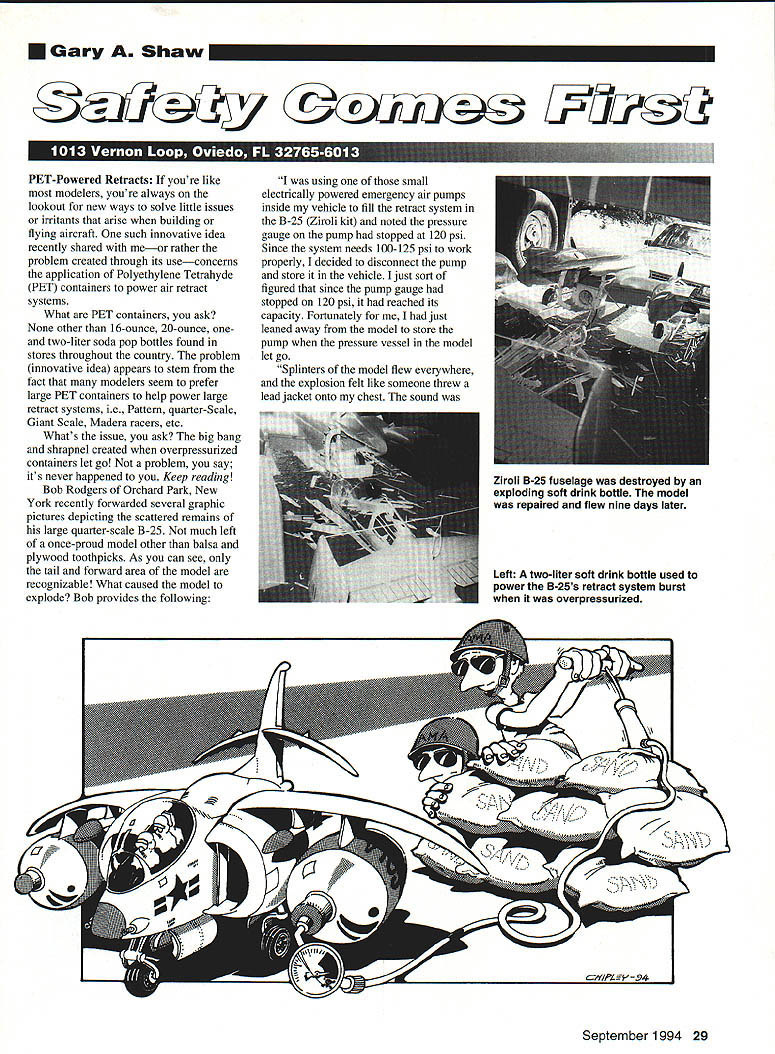
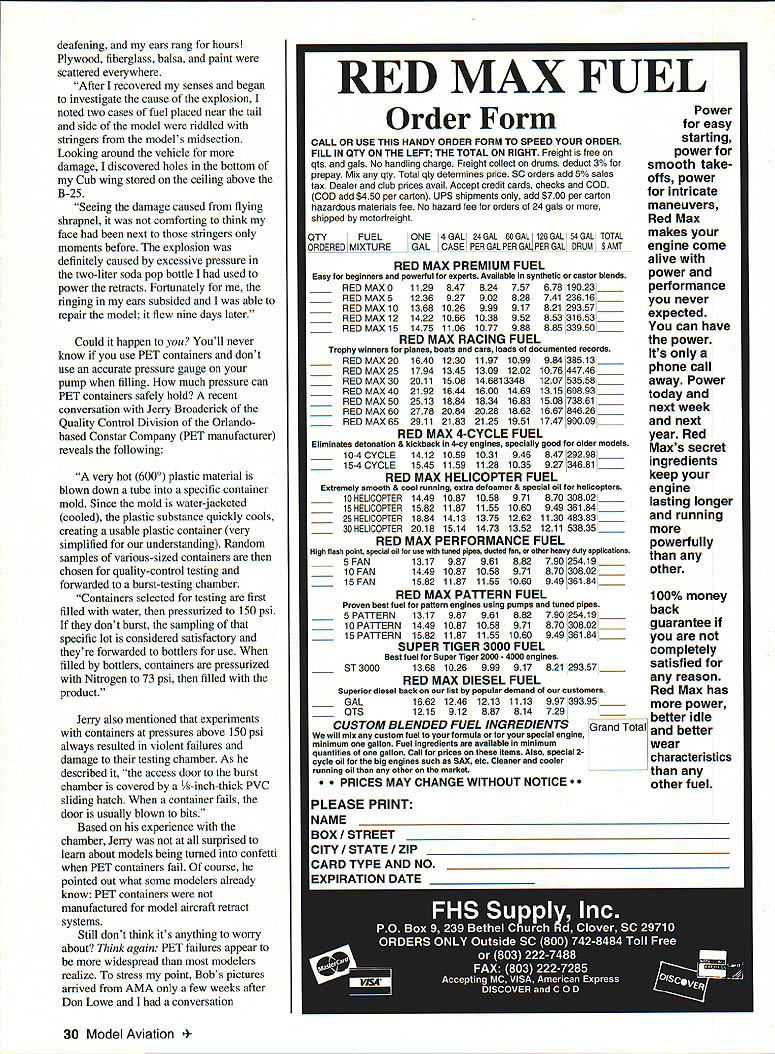
Bob Rodgers of Orchard Park, New York, sent graphic pictures of his large quarter-scale B-25 after such a failure. Only the tail and forward area were recognizable — the rest was reduced to splinters. Bob describes the incident:
"I was using a small electrically powered emergency air pump inside my vehicle to fill the retract system in the B-25 (Ziroli kit) and noted the pressure gauge on the pump had stopped at 120 psi. Since the system needs 100–125 psi to work properly, I decided to disconnect the pump and store it in the vehicle. I just sort of figured that since the pump gauge had stopped on 120 psi, it had reached its capacity. Fortunately, I had just leaned away from the model to stow the pump when the pressure vessel in the model let go.
"Splinters of the model flew everywhere, and the explosion felt like someone threw a lead jacket onto my chest. The sound was deafening — my ears rang for hours. Plywood, fiberglass, balsa, paint — scattered everywhere. After I recovered my senses and began to investigate the cause of the explosion, I noted two cases of fuel placed near the tail. Looking around the vehicle for damage, I discovered holes in the bottom of my Cub wing stored on the ceiling above the B-25. Seeing the damage caused by flying shrapnel is a comforting thought; I think my face was next to the stringers moments before the explosion. It definitely caused excessive pressure in the two-liter soda pop bottle used to power the retracts. Fortunately, the model was repaired and flew nine days later."
Could it happen to you? Possibly — especially if you rely on an inaccurate pressure gauge or pump when filling PET containers.
I spoke with Jerry Broderick, Quality Control Division, Constar Company (a PET manufacturer in Orlando). He explained how PET bottles are made (hot plastic blown into a water-cooled mold) and how quality control works: random samples are burst-tested. For testing, containers are filled with water and pressurized to 150 psi; if they don't burst, the lot is considered satisfactory. Filled bottles are pressurized with nitrogen to about 73 psi when filled with product. Broderick noted that experiments above 150 psi always resulted in violent failures and damage to the burst chamber — the access door (covered with a 1/8-inch-thick PVC sliding hatch) is routinely blown to bits when a container fails.
Based on that experience, Broderick was not surprised to learn of models being turned into confetti when PET containers fail. He emphasized what many modelers may not realize: PET containers are not manufactured for model aircraft retract systems and are not designed to safely handle pressures above approximately 73–75 psi.
This problem appears more widespread than commonly assumed. Shortly after receiving Bob's photos, I learned of other incidents. Don Lowe witnessed a model next to him explode at a trade show; the cause was an overpressurized PET container with some CO2 added. Don described the explosion as deafening and was amazed no one nearby was injured. Bob knew of at least two more recent losses — one at Madera air races when a PET container let go in the pits, and another in Canada that ended as a giant fireball while flying.
Roger Kemph of Ontario was flying a Byron P-51 converted to glow when a battery shorted on board. The short melted into the fuel tank, ignited the methanol, the burning fuel melted through the smoke tank and ignited kerosene, which then melted the PET retract container — ka-boom. After the resulting three-acre fire was extinguished, only a smoking four-bladed prop remained. Firefighters did not find the incident amusing.
These occurrences reinforce the manufacturer guidance: pop bottles are not intended for model retract systems and should not be used for anything requiring pressures above the levels they were designed for.
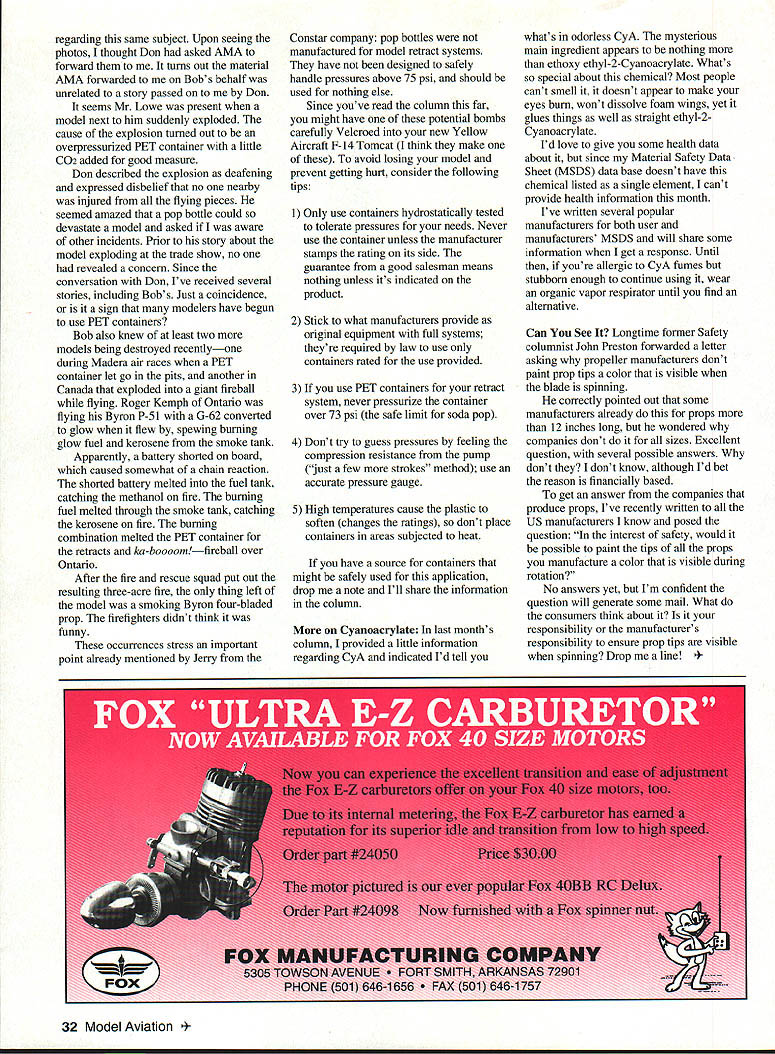
To avoid losing your model or getting hurt, consider the following tips:
- Only use containers hydrostatically tested to tolerate the pressures you need. Never use a container unless the manufacturer stamps the rating on its side. A salesperson's guarantee is no substitute for a rated product.
- Use original equipment provided by manufacturers for complete systems; certified systems are required to use containers rated for their intended use.
- If you use PET containers for your retract system, never pressurize the container over 73 psi (the safe limit for soda pop bottles).
- Don't guess pressures by feel ("just a few more strokes"); use an accurate pressure gauge.
- High temperatures soften plastic and change ratings, so don't place containers in areas subjected to heat.
If you have a reliable source for containers suitable for this application, drop me a note and I'll share the information in a future column.
More on Cyanoacrylate
In last month's column I mentioned cyanoacrylate (CyA) and promised more on odorless CyA. The primary ingredient appears to be ethyl-2-cyanoacrylate. What's notable about this chemical is that many people can't smell it; it doesn't seem to irritate the eyes or dissolve foam wings, yet it bonds as effectively as straight ethyl-2-cyanoacrylate.
I currently don't have detailed health data: my MSDS database does not list this specific formulation as a single chemical. I have written to several manufacturers requesting both user and manufacturer MSDSs and will share any information I receive. In the meantime, if you are allergic to CyA fumes but continue to use it, wear an organic vapor respirator until you find an alternative.
Can You See It?
Longtime former Safety columnist John Preston forwarded a letter asking why propeller manufacturers don't paint prop tips a color visible when the blade is spinning. Some manufacturers do this for props longer than 12 inches, but the question is why not for all sizes. The likely reason is financial, but it's worth asking the companies directly.
I've written to U.S. prop manufacturers asking: "In the interest of safety, would it be possible to paint the tips of all the props you manufacture a color that is visible during rotation?" I haven't received answers yet, but I expect responses. What do consumers think? Is it the manufacturer's responsibility or the retailer's to ensure prop tips are visible when spinning? Drop me a line.
Transcribed from original scans by AI. Minor OCR errors may remain.

