
Gary A. Shaw 1013 Vernon Loop, Oviedo, FL 32765-6013
Safety Comes First
Introduction
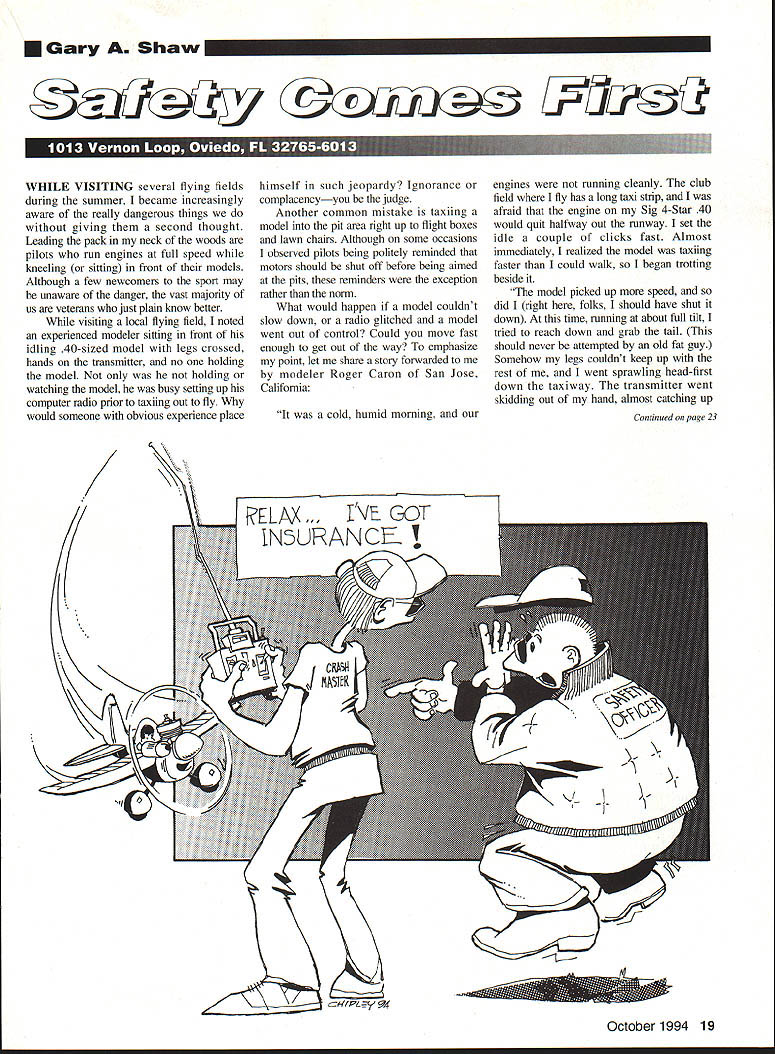
While visiting several flying fields during the summer, I became increasingly aware of the really dangerous things we do without giving them a second thought. Leading the pack in my neck of the woods are pilots who run engines full speed while kneeling (or sitting) in front of their models. Although a few newcomers to the sport may be unaware of the danger, the vast majority of us are veterans who just plain know better.
Common Dangerous Practices
- Running engines at full speed while kneeling or sitting directly in front of models.
- Taxiing models into the pit area with motors running, up to flight boxes and lawn chairs.
- Low-altitude, high-speed passes close to pilots, spectators, or the pit area.
While visiting a local flying field, I noted an experienced modeler sitting in front of his idling .40-size model with legs crossed, hands on the transmitter, and no one holding the model. Not only was he not holding or watching the model, he was busy setting up his computer radio prior to taxiing out to fly. Why would someone with obvious experience place himself in such jeopardy? Ignorance or complacency—you be the judge.
Taxiing a model into the pit area right up to flight boxes and lawn chairs is another common mistake. Although on some occasions I have observed pilots being politely reminded that motors should be shut off before being carried into the pits, these reminders were the exception rather than the norm. What would happen if a model couldn't slow down, or a radio glitched and a model went out of control? Could you move fast enough out of the way?
Roger Caron: A Taxiing Story
To emphasize the point, here is a story forwarded to me by modeler Roger Caron of San Jose, California:
"It was a cold, humid morning, and our engines were not running cleanly. The club field where I fly has a long taxi strip, and I was afraid that the engine on my Sig 4-Star .40 would quit halfway out on the runway, so I set the idle a couple clicks fast. Almost immediately, I realized the model was taxiing faster than I could walk, so I began trotting beside it.
"The model picked up more speed, and so did I (right here, folks, I should have shut it down). At this time, running at about full tilt, I tried to reach down and grab the tail. (This should never be attempted by an old fat guy.) Somehow my legs couldn't keep up with the rest of me, and I went sprawling head-first down the taxiway. The transmitter went skidding out of my hand, almost catching up.
"The model instantly went full throttle. The 4-Star made some kind of ground loop and headed straight back towards me. I threw my arms over my head, shut my eyes and went screaming. A couple feet away it went directly towards the pits. The next thing I remember is seeing a bunch of flying buddies scattering in every direction. Some old guys can really move fast. The 4-Star's right wing struck a steel post used to support the wind sock. The model went roaring around and around like a pinwheel. Hands and knees crawling, I finally shut the transmitter off. Everyone was falling down, crying with uncontrollable laughter. Final outcome: minor damage to the model; no physical injury to me. I was ultimately awarded the club's coveted Dumb Thumb trophy. The message, of course? Never try to keep up with a model taxiing faster than you can walk—unless you're ready to provide entertainment for the day."
Need for Speed: Low-Altitude, High-Speed Passes
The third and final observation for the summer goes to those pilots who seem to have the "need for speed." Ah yes—the low-altitude, high-speed pass—no lack of mail forwarded to me regarding this subject. Editor Leroy Cordes of the Chicagoland Radio Control Modelers, Incorporated provides the following story:
"A week or so ago, I watched a good flier make numerous low-altitude, high-speed passes where he would dive the model toward himself and at the last minute turn and fly it east along the edge of the asphalt about 15 feet out.
After he had settled his gear and was relaxing, I suggested that his low-speed passes (which I acknowledged were fun) would be a little bit safer if done a little farther out. I was amazed at his response: 'I usually fly when there is nobody else around, and I have insurance in case anything happens.' I was so dumbfounded by his answer that I didn't think to ask if his young daughter standing alongside him had insurance also. What goes through people's minds?"
Which Way Did It Go
A year or so ago, I did a short piece about a relative of mine who almost had a flyaway (keeps going without responding to controls) because he forgot to extend his transmitter antenna prior to taking off.
While doing a downwind pass over the field, he suddenly realized the model was locked into straight flight and headed toward the wild blue yonder. Although he eventually figured out why the model wasn't responding and managed to get it back, it's a lesson learned the hard way and one he won't soon forget. He was lucky to get it back.
Charles Castaing: Don't Take Your Eyes Off the Model
Similarities in another story were provided by longtime modeler Charles Castaing of New Iberia, Louisiana, from which another moral might be learned:
"This really happened to a friend of mine in another club in this state. He was flying his RC model plane and following all the rules—he had the proper frequency pin, etc. One of the other fliers walked up to him and asked some questions regarding which frequency he was using, and a lively discussion ensued.
"After turning to face his questioner and continuing the conversation for quite some time, he finally realized he was still flying his model...or thought he was. By this time, the aircraft was nowhere in sight. He had made a critical error in taking his eyes off the model.
"The large search party that was formed was lucky enough to find the model, which sustained only minimal damage. The moral of this story is quite clear: Don't take your eyes off the model while flying!"
"On the Runway!"
Hopefully all of you use the words "on the runway" or "coming out" each time you access the runway to pick up a model or taxi out to start a flight. Many times I've seen models collide on the ground simply because pilots failed to tell each other what they were doing or didn't pay attention to what was going on around them. Thirteen-year-old Damien Augustin of Valley Stream, New York lends credibility to my statement:
"I am a 13-year-old boy who is writing to you about a very serious topic that concerns many airfields across the United States. In the summer of 1992, I had a close encounter with a P-51D Mustang. I was flying my Flightstar 40 when it was time to land. Since I was a beginner, a more experienced pilot landed the model for me. Then it happened...my close encounter!
"I called out, 'On the runway,' and walked out to retrieve my model. I was on the south side of the runway walking downwind when a P-51D Gold Edition taxied onto the runway. The aircraft throttled forward and acquired sufficient airspeed to take off.
"The huge model became airborne, gained about 10 feet of altitude, and rolled 90° left. The blood-thirsty aircraft was on a direct intercept course for a petrified me! I used every evasive maneuver known to man; however the speed of the model and its close proximity provided very little time. I turned to my auxiliary plan and made a flat-out run in the opposite direction of the oncoming aircraft. Thanks to my quick reaction and my mighty speed, I was able to sprint out of harm's way. I request that you publish my story in order to warn others of this potential threat."
Thanks for the letter, Damien. It's enlightening to receive mail from safety-conscious modelers, and it's even better when provided by our youth. How many more of you have safety stories to share? I'm looking forward to receiving more.
Until next month: Keep the wings level and the batteries charged.
Transcribed from original scans by AI. Minor OCR errors may remain.

