
Gary A. Shaw
Safety Comes First
AUTOPILOT ARRIVES! I indicated in my April and July 1994 columns that I had been introduced to a gentleman from Israel who represents a company involved in developing electronics for radio-controlled drones. I had observed a demonstration flight of an RC model with an autopilot installed.
After watching the test aircraft fully recover from numerous violent spins, rolls, dives, stalls, and bad landings through hands-off use of the on-board autopilot, I began to visualize scenarios for which this revolutionary new safety tool might lend a helping hand:
- Student pilots—those who have yet to master basic flight.
- Giant Scale pilots—could save their investments and avoid injuring people on the ground due to loss of control or signal.
- Racing models—could fly more consistently around a course and eliminate personal injury due to control or signal loss.
- The physically impaired—could be assisted with control responses.
How can a small piece of electronic wizardry be so useful in all these applications and many more? Simple; it works!
I had watched the flight demonstration months ago, and after receiving a unit I didn't waste any time putting it through some of my scenarios. I installed it in a Great Planes Big Stick 60, equipped with PCM 1024 and an O.S. 91 four-stroke. Weighing about six ounces and being just a little longer than a cigarette pack, the unit fit easily between the servos and rear tank area.
Electronic installation was a snap. I used five Futaba J connectors labeled:
- Elevator in (plugs into the elevator receiver channel)
- Elevator out (plugs to the elevator servo lead)
- Aileron in (plugs into the aileron receiver channel)
- Aileron out (plugs to the aileron servo(s) via Y-harness/short extension)
- Mode (plugs into an unused channel or the retract channel)
Looking at the autopilot on the model, you can see conveniently located normal/reverse switches for control surfaces and separate gain controls for aileron and elevator to set sensitivity. The autopilot is switched to assist mode via the gear switch. An extra switch will work through the PCM fail-safe; the fail-safe is programmed to turn the gear switch signal to a preset position if signal is lost.
Separate zeroing pots are initially used to match trimmed surface control positions to the receiver/transmitter—simply flip the gear switch back and forth while turning a pot until the autopilot trim and model trim cancel each other out and control surfaces no longer move when the retract switch is flipped back and forth.
After spending no more than 10 minutes installing the autopilot (a simple breeze), I loaded up the gear, headed to the field, and spent the rest of the afternoon putting the unit through its paces.
What a slick piece of gear! Don't let me sound like a salesman—it's because I'm impressed. Armed with stick position charts, snaps, spins, lomcevaks, etc., it did everything I could throw at it. The autopilot essentially is a system that functions by controlling both pitch and roll (elevator and aileron), activated through the gear switch.
A few examples:
Turn the unit on through the gear switch and the autopilot assists flying by dampening elevator and aileron control. Whatever you set the sensitivity to—lots of surface movement or very little—the choice is yours. In flying-assist mode, put the model into a snap, let go of the sticks, and the model quickly returns to straight, level flight, maintaining attitude no matter what the previous attitude. Inverted? No problem—let go of the sticks and the unit rolls the model right-side-up and continues flying level.
Cut the power to idle and the model assumes a perfect, wings-level descent, letting the aircraft stall. Bank the model hard over with full power (don't apply elevator) and it completes a perfect turn without losing altitude. Let go of the aileron control and the model rolls level. Line up on the runway and cut power to idle or experience a dead stick—regardless of wind or turbulence, the model stays level and glides down to a perfect landing; only adjustments for wind drift are needed.
To test the fail-safe feature I set fail-safe stick positions to 20% left aileron, 25% elevator, 30% power and set the retract switch. During straight, level flight at about 150 feet I turned the transmitter off. The model instantly reduced power, entered a shallow left bank and slowly circled the field. Power was adequate to maintain altitude and the autopilot flew the model. I sat back on the grass and watched the model fly itself for the next ten minutes. Turning the transmitter back on, the model returned to straight flight and functioned perfectly.
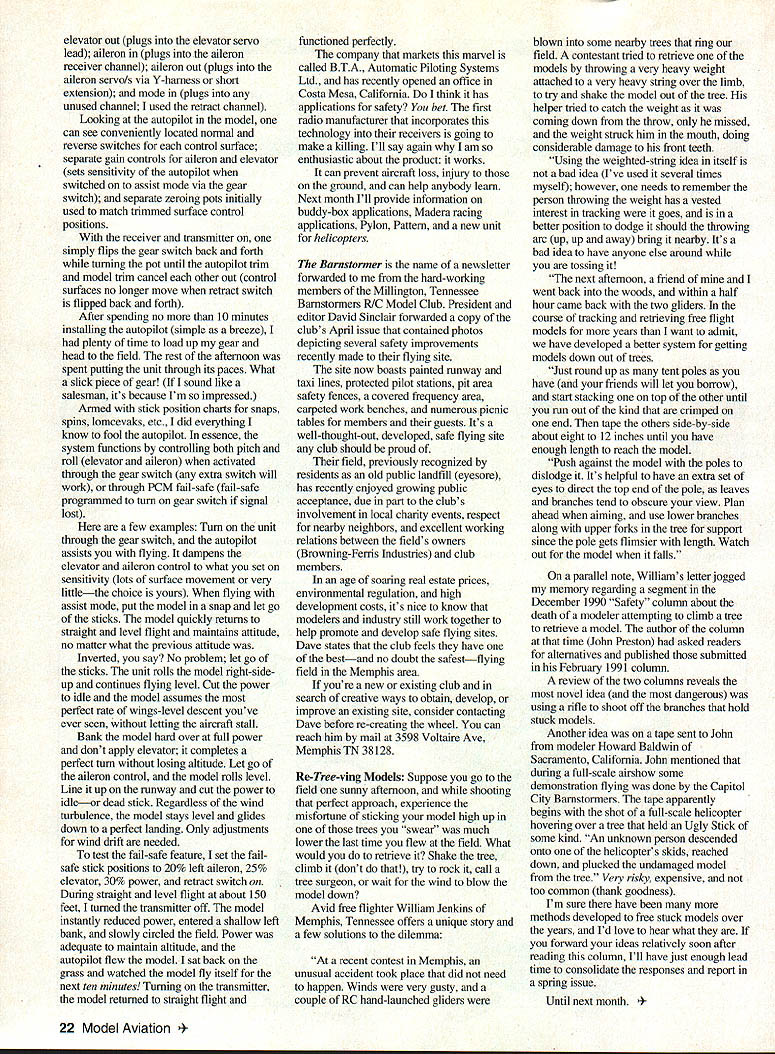
The company that markets this marvel is called BTA Automatic Piloting Systems Ltd. It has recently opened an office in Costa Mesa, California and I think has applications... for safety? You bet. The first radio manufacturer that incorporates this technology into their receivers is going to make a killing. I'll say again why I am so enthusiastic about the product: it works.
It can prevent aircraft loss, injury to those on the ground, and can help anybody learn. Next month I'll provide information on buddy-box applications, Madras racing applications, Pylon, Pattern, and a new unit for helicopters.
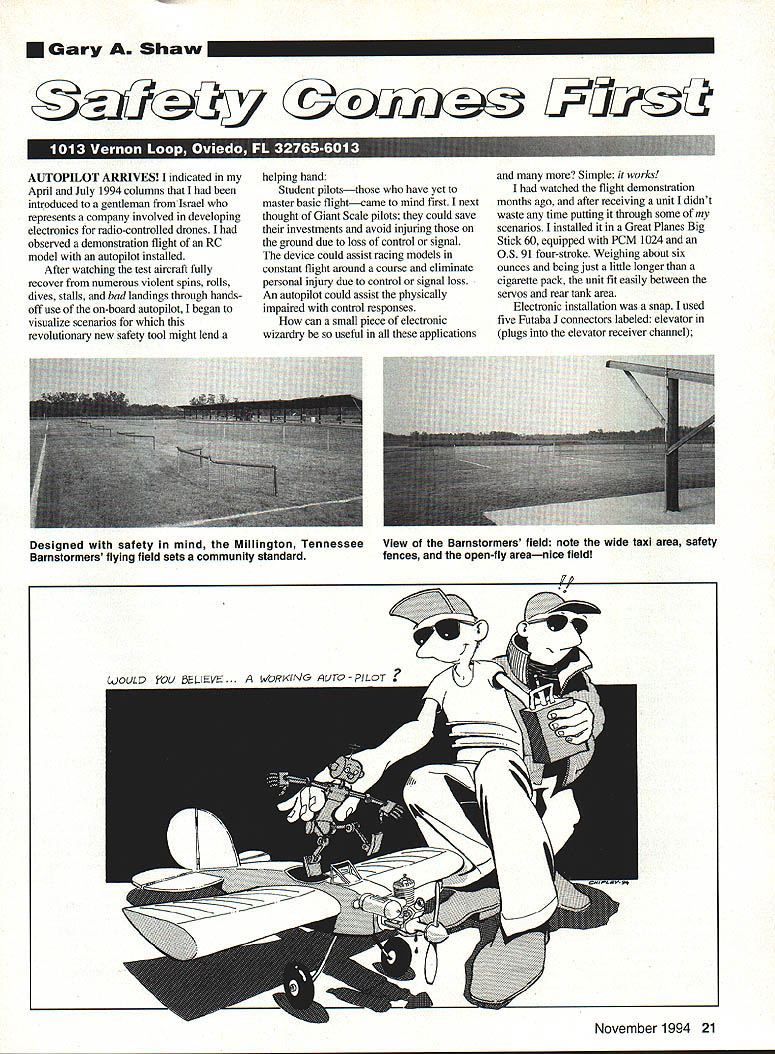
The Barnstormer is the name of a newsletter forwarded to me from the hard-working members of the Millington, Tennessee Barnstormers R/C Model Club. President and editor David Sinclair forwarded a copy of the club's April issue that contained photos depicting important safety improvements recently made to their flying site.
The site now boasts painted runway and taxi lines, protected pit stations, pit area safety fences, a covered frequency area, carpeted work benches, and numerous picnic tables for members and their guests. It's a well-thought-out, developed, safe flying site any club should be proud of.
Their field, previously recognized by residents as an old public landfill (an eyesore), has recently enjoyed growing public acceptance, due in part to the club's involvement in local charity events, respect for nearby neighbors, and excellent working relations between the field's owners (Browning-Ferris Industries) and club members.
In an age of soaring real estate prices, environmental regulation, and high development costs, it's nice to know that modelers and industry still work together to help promote and develop safe flying sites. Dave states that the club feels they have one of the best—and no doubt the safest—flying fields in the Memphis area.
If you're a new or existing club and in search of creative ways to obtain, develop, or improve an existing site, consider contacting Dave before re-creating the wheel. You can reach him by mail at:
3598 Voltaire Ave. Memphis, TN 38128
Re-Tree-ving Models
Suppose you go to the field one sunny afternoon, and while shooting that perfect approach, experience the misfortune of sticking your model high up in one of those trees you "swear" was much lower the last time you flew at the field. What would you do to retrieve it? Shake the tree, climb it (I don't do that!), try to rock it, call a tree surgeon, or wait for the wind to blow the model down?
Avid free flighter William Jenkins of Memphis, Tennessee offers a unique story and a few solutions to the dilemma:
"At a recent contest in Memphis, an unusual accident took place that did not need to happen. Winds were very gusty, and a couple of RC hand-launched gliders were blown into some nearby trees that ring our field. A contestant tried to retrieve one of the models by throwing a very heavy weight attached to a very heavy string over the limb, to try and shake the model out of the tree. His helper tried to catch the weight as it was coming down from the throw, only to miss, and the weight struck him in the mouth, doing considerable damage to his front teeth. Using the weighted-string idea in itself is not a bad idea (I've used it several times myself); however, one needs to remember the person throwing the weight has a vested interest in tracking where it goes, and is in a better position to dodge it should the throwing arc (up and away) bring it nearby. It's a better idea to have anyone else around while you are tossing it."
"The next afternoon, a friend of mine and I went back into the woods, and within a half hour came back with the two gliders. In the course of tracking and retrieving free-flight models for more years than I want to admit, we have developed a better system for getting models down out of trees.
"Just round up as many ten poles as you have (and your friends will let you borrow), and start stacking one on top of the other until you run out of the kind that are crimped on one end. Then tape the others side-by-side about eight to 12 inches until you have enough length to reach the model.
"Push against the model with the poles to dislodge it. It's helpful to have an extra set of poles to direct the top end of the pole, as leaves and branches tend to obscure your view. Plan ahead when aiming, and use lower branches along with upper forks in the tree for support since the pole gets flimsy with length. Watch out for the model when it falls."
On a parallel note, William's letter jogged my memory regarding a segment in the December 1990 "Safety" column about the death of a modeler attempting to climb a tree to retrieve a model. The author of the column at that time (John Preston) had asked readers for alternatives and published those submitted in his February 1991 column.
A review of the two columns reveals the most novel idea (and the most dangerous) was using a rifle to shoot off the branches that hold stuck models.
Another idea was on a tape sent to John from modeler Howard Baldwin of Sacramento, California. John mentioned that during a full-scale airshow some spectators were filming a demonstration that was done by a full-scale helicopter that hovered over a tree that held an Ugly Stick of some kind. An unknown person descended onto one of the helicopter's skids, reached up, and plucked the undamaged model from the tree. Very risky, expensive, and not to be recommended.
I'm sure there have been many more methods developed to free stuck models over the years, and I'd love to hear what they are. If you forward your ideas relatively soon after reading this column, I'll have just enough lead time to consolidate the responses and report in a spring issue.
Until next month.
Transcribed from original scans by AI. Minor OCR errors may remain.

