
Safety Comes First
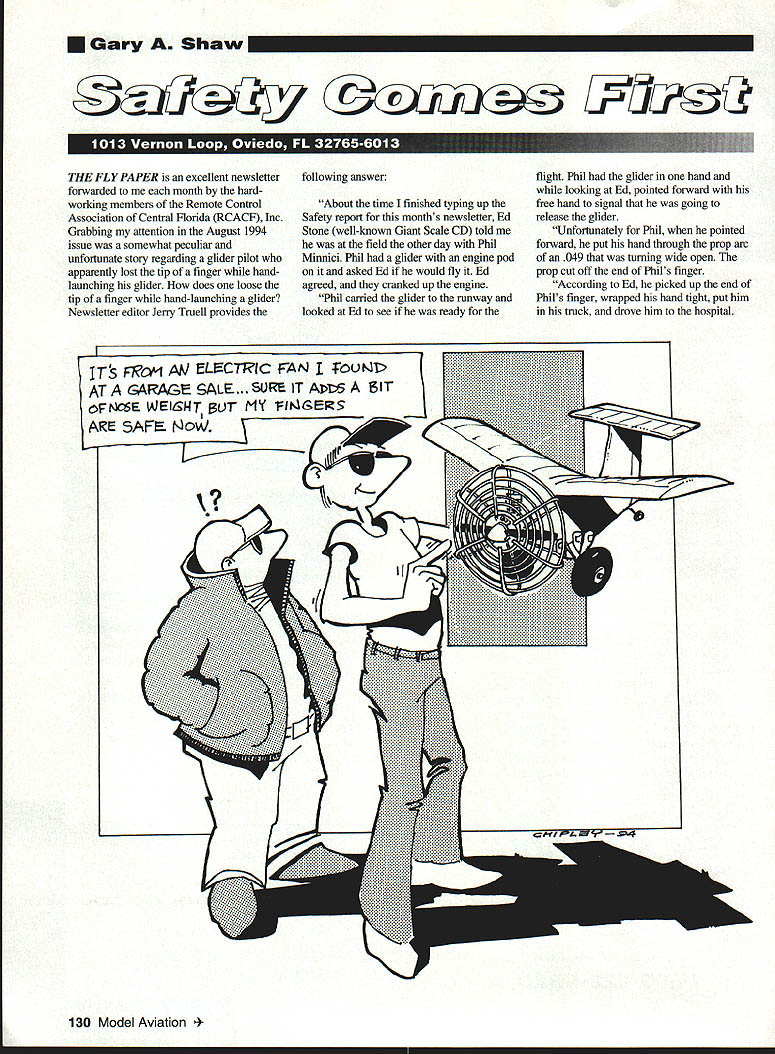
THE FLY PAPER is an excellent newsletter forwarded to me each month by the hard-working members of the Remote Control Association of Central Florida (RCACF), Inc. Grabbing my attention in the August 1994 issue was a somewhat peculiar and unfortunate story regarding a glider pilot who apparently lost the tip of a finger while hand-launching his glider. How does one lose the tip of a finger while hand-launching a glider? Newsletter editor Jerry Truell provides the following answer:
"About the time I finished typing up the Safety report for this month's newsletter, Ed Stone (well-known Giant Scale CD) told me he was at the field the other day with Phil Minnici. Phil had a glider with an engine pod on it and asked Ed if he would fly it. Ed agreed, and they cranked up the engine.
Phil carried the glider to the runway and looked at Ed to see if he was ready for the flight. Phil had the glider in one hand and, while looking at Ed, pointed forward with his free hand to signal that he was going to release the glider.
Unfortunately for Phil, when he pointed forward, he put his hand through the prop arc of an .049 that was turning wide open. The prop cut off the end of Phil's finger.
According to Ed, he picked up the end of Phil's finger, wrapped his hand tight, put him in his truck, and drove him to the hospital."
It is remarkable the surgeons were able to sew the end of the finger back on with only a little loss of bone. Ouch. Jerry went on to say Phil recovered nicely and has been seen recently flying at the field. It would have been a much different outcome had Phil elected to fly solo. Once again, thanks to the efforts of his quick-thinking friend, the loss of a highly desirable body part was avoided. The message is simple: don't take your eyes off whirling blades. Never fly alone.
"Oh, fudge"
Ah yes — sun warms the back, you watch your prized possession climb with authority into the vastness of another bright blue afternoon sky. Must be Florida; there isn't the slightest breeze or a cloud in the sky — does life get better? Wait — something doesn't feel right.
The controls feel a little mushy. Naw, it's just imagination. It's probably just nerves after realizing how much the new marvel cost. Suddenly the craft yaws left, then rolls right; you quickly stabilize it. Maximum rudder and aileron bring it under control. A glance around quickly looking for similar frequency flags; adrenaline starts pumping.
What's going on? Are you getting radio hits? Did you use wing bolts? Your mind scrambles for answers as you try to limp the craft back to earth. God, the plane cost a lot. Hold steady; bring it around slowly... good, good. Line up — you're almost — What's that? Someone walking the runway. Clear runway! Get out of the way!
Concentration gone, the model rolls a little left, heads for the pits. There's no time; act — do something fast! You're aware of people scrambling to get out of the way; lawn chairs tip over as people dive for cover; someone's baby starts crying. Things seem to happen in slow motion as you suddenly realize all eyes at the field are watching you.
Sound familiar? Trust me, if you've been flying R/C a long time, sooner or later this will happen. What would you do? If you haven't thought of an answer, maybe you should read about an example set recently during the Farragut Flyers' 1994 Scalemasters Regional competition held in Post Falls, Idaho.
Claude Tanner — example of extraordinary airmanship
Contest Director Matt Jacobson wrote to tell about an individual I consider a local hero — Claude Tanner.
Claude was flying a Thunderbolt through gusty winds and a bit of rain, the kind of weather that requires extra concentration to get an aircraft up through its routine and back down. Contest Director Matt Jacobson sensed trouble as well: the aircraft was already headed for the pit area immediately in front of the spectators. Mrs. Irwin (Claude's caller for the flight) already knew this to be fact.
Claude, anticipating the action, looked over his shoulder and, using what little control remained, pulled up the gear, put the nose down, and decided to sacrifice the aircraft — deliberately crashing a very expensive, albeit sick, airplane safely off the end of the runway. There's no doubt his action prevented what could have been a very disastrous event. Claude's only comment? "O fudge."
What the people running the contest saw was an act of extraordinary airmanship and self-sacrifice on the part of Mr. Claude Tanner. We feel this should not go unacknowledged, and we offer our thanks. Simply stated, Claude's action exemplifies what true sportsmanship is all about. My hat's off to you, Claude! If anyone has an extra kit that Claude could build over the winter to help him get back in the contest cycle, drop me a note and I'll arrange to get it to the right spot.
'Tis the Season to be Shopping
As I write this, it's early August in Florida and the first of many cold fronts appears to be nearing local citrus groves. (Oh goody — the temperature might drop from 95° to 93°.) Although I can't imagine what the weather will be like in your neck of the woods when this issue arrives in late October, I'll bet it's safe to say Santa's already received your Christmas list.
No doubt many items near the top of your list have much to do with safety. Do I hear laughter in the distance? Those having the last laugh during the coming winter months will be the ones who find R/C simulator software under the tree, accompanied by an R/C trainer joystick interface from Computer Designs in Helena, Montana.
What does simulator software and an R/C interface have to do with safety? Wake up — we're in the computer age, and simulators let us practice all we want without risking equipment. Take a tip from commercial pilots who fly thousands of hours in simulators when they're not flying the real thing. Couple a scale cockpit to a computer, and voilà — sharp flying skills.
The advantage of buying simulator software and the R/C trainer joystick interface is that it's the only combination on the market that allows you to connect your original transmitter to the computer via your buddy-box socket. Why is that important? In the past, companies marketing simulator packages included their own version of a transmitter that connected to the computer. This transmitter was smaller, bulkier, and the sticks didn't have the same feel as what we use out in the field. Although effective for simulator use, they lacked the sophistication and feel many of us have come to appreciate — so Computer Designs from Helena, Montana sprang up.
Through cooperation with simulator companies, software packages are now available separately and work perfectly via the interface. Since the cost of the software and the R/C interface is essentially the same as the old software-and-odd-box combination, you'd be much wiser to get the setup that allows the use of your particular transmitter.
- The R/C trainer can be obtained from Computer Designs, 8530 N. Montana Ave., Helena, MT 59601; Tel.: (406) 458-9416. Be sure to specify what brand of radio you use.
BTA Enterprises' R/C autopilot is next on the list of things to get if you're just learning to fly (or just want to avoid crashing a valuable model due to radio failure). As mentioned in the last column, the autopilots work great and offer new horizons to R/C users. Since they assist with pitch and roll (elevator and aileron), they're ideal for flight trainers and Giant Scale applications, helping the pilot during flight, approach, or signal loss. Regardless of model type, it's almost impossible to make a bad approach and landing with one of these units installed.
Coming soon from BTA is another autopilot that offers altitude memory capability. The extra function plugs into any extra radio channel and, with the switch turned on, memorizes barometric pressure. From that point on (or until the autopilot is cycled off), when the altitude switch is on the aircraft returns to the memorized barometric pressure.
For those who race or fly pattern, this feature should be invaluable in preventing a crash (the model goes back to preset altitude during signal loss or if turned on) or keeping distances level when transitioning a course.
Just a few thoughts to whet your whistle for the holidays. I wish you all new props and chicken sticks for Christmas. Fly safely.
Transcribed from original scans by AI. Minor OCR errors may remain.

