
Safety Comes First
Gary A. Shaw
Preflight Checklists
- Before Starting Engine — Control Surfaces: Move in the correct direction. Throw set to proper amount. Deflection set for takeoff. No play in hinges; firmly attached.
- Throttle Linkage: Moves in the correct direction and through the full range.
- Fasteners: All accessible screws, bolts, rubber bands, wheel collars, and clevises secure and tight.
- Radio: Transmitter switches set. Receiver and battery stowed and secured. Battery charged. Range check OK. Transmitter antenna fully extended. Receiver antenna stretched out straight.
- Engine: Secure. Prop and spinner safe to use.
- General: Check alignment of wings, tail, landing gear, and engine. Everything firmly attached.
- After Starting Engine — Control Surfaces: No fluttering. Move in the correct direction. Flaps, spoilers, etc., properly set.
- Engine: No bubbles in fuel line. Mixture correct. Reliable idle and return to high throttle. At full throttle, engine runs properly with nose pointed up or down.
- Before Releasing: Check controls and throttle again. Look over the entire aircraft for obvious problems.
Notes on First Flight / Overhaul / Repair Checklist
- Before Starting Engine — Control Surfaces: No binding of linkages between servos and control surfaces/throttle. Move in the correct direction. Throw set to proper amount. Centered with trim in center. No play. Firmly attached. Flaps, spoilers, etc., operate correctly.
- Throttle Linkage: Moves in the correct direction. Closes enough to shut the engine. Opens to full throttle. Does not stall the servo.
- Fasteners: Correctly installed. Wing bolts, rubber bands, wheel collars, safety devices locked with fuel tubing, engine bolts, landing gear screws in place.
- Radio: Receiver battery properly protected and secured. Dual rates, trims, etc., properly set. Batteries charged. Range check OK. Receiver antenna stretched out straight. Transmitter antenna fully extended.
- Balance: CG in the proper location. Balances on the roll axis as well.
- Engine / Fuel: Tank height correct. Fuel lines not kinked. Prop balanced.
- Flying Surfaces: Incidence, washout, and warps checked with an incidence meter.
- Landing Gear: Wings level with aircraft on the ground. Nose wheel and aircraft sit at the proper angle of attack.
- After Engine Start — Engine: Fuel tank full. Reliable idle and return to high throttle. Can be shut off with the transmitter. Mixture correct. No air bubbles in the fuel line. Full throttle runs correctly with nose pointed up or down.
- Control Surfaces: No fluttering at any throttle setting. Check again that they move in the correct direction, not just that they move.
- Taxi: Airplane tracks straight. Steering not too sensitive.
- General: Covering and paint applied correctly. Cowlings, wheel pants, and other accessories properly attached.
Watch the Prop Line
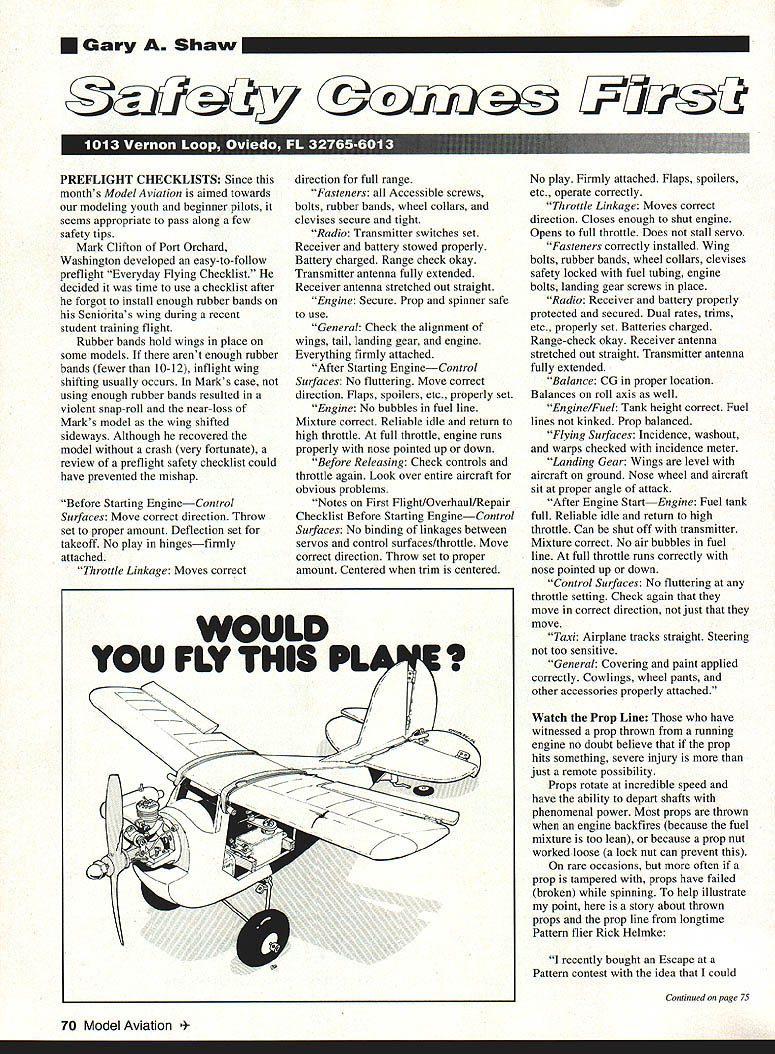
Those who have witnessed a prop thrown from a running engine know that if the prop hits something, severe injury is a real possibility. Props rotate at incredible speed and can depart shafts with phenomenal force. Most props are thrown when an engine backfires (often because the fuel mixture is too lean) or because a prop nut worked loose (a lock nut can help prevent this). On rare occasions, and more often if a prop has been tampered with, props have failed (broken) while spinning.
Longtime Pattern flier Rick Helmke shared this account to illustrate the danger:
"I recently bought an Escape at a Pattern contest with the idea that I could run some of my old two-stroke engines that had been taking up space in boxes the last couple of years. I finally decided to install a Webra Racing .61 rear-exhaust, complete with pipe (and not to worry about how much noise the thing made, since noise isn't a problem at my home field).
"I had to dig around to find the right-sized prop, glow plug, and so on, but I finally put the thing together and was ready to test-run. I took it out into my backyard, fueled it, and it started up quickly. I remembered enough to get the pipe length close, and the engine came right on pipe. It really came on. I had forgotten how fast those short-strokes turn.
"I was preparing to tach it about two or three minutes into the run when—at full throttle—the prop snapped a blade. I was so surprised that it took me a couple of seconds to shut the thing down.
"Fortunately, no one was injured and nothing was damaged, but it took me a few minutes to regain my composure.
"Shedding a prop blade any time is cause for concern, but at high speeds and using high-performance equipment, the results could have been much worse. I spent some time thinking about this, and several things occurred to me:
"First, this was an old prop (at least two years old). I didn't see any damage initially, but when I looked again at what was left, I saw a scrub mark on the back of the remaining blade. I don't know if it was there before I ran the engine or not. Also, the prop shaft hole had been enlarged from the original size.
"The second thing that occurred to me was that when I ran this engine on a competition aircraft, I was using 10% Cool Power. When I fueled it yesterday—without giving it a second thought—I filled it with 25% pattern blend fuel from the same company. I think maybe this was why I was so surprised at the rpm and power the engine was developing.
"The point of all of this is to remind everyone to never let a spectator stand in the prop arc of a running engine—particularly a high-powered engine. Modelers should know better, but others probably don't. I have a big backyard and still haven't found all of the missing blade. The only thing I'm sure of is that it's not sticking in somebody.
"Remember: when you change from one type of setup to another, you might forget some of what you used to know. I've been flying a four-stroke for a while now, and it's clear to me that I didn't put enough thought into what I was doing.
"Finally, I want to say this is absolutely not an indictment of the prop or its maker; I've used and will continue to use their products. I will, however, find out what one needs to do to store used props and what rpm limitation might apply."
This was a first for me, and I don't need a second. Rick's advice is right on the mark and should be heeded whenever you notice someone standing in the arc of a revolving prop. Longtime readers may remember a story in this column about a thrown prop that found its way into a modeler's chest. Yes—sticking out of the chest like a dagger. Not something any of us wish to repeat, and definitely preventable. How do you prevent a similar accident? Tell those around you to stand clear of the prop arc while you start or run the engine.
Battery and Flight-Pack Lesson
It's early September as I write this, and I'm on vacation in Montana enjoying the cool, crisp mountain air—a welcome reprieve from central Florida's summer heat and humidity, and the perfect time to practice a little Pattern before attending the annual Billings Flying Mustangs State Championship Pattern meet.
A local friend from Helena allowed me to share and compete with his model while on vacation. The afternoon weather was outstanding, and we took turns flying the craft for seven or eight rounds. We were having a blast and time was flying by.
While refueling the model for another round, I suggested we give the flight pack a fast charge. "No need," my friend said, "my 500 mA flight pack gets at least 15 to 20 rounds up there with no problem."
"You aren't serious," I replied. "I have a 1200 mA pack in my model and I get worried after six flights!"
We had a short discussion about battery maintenance and charging, and I was somewhat satisfied he knew his batteries better than I did. My accomplice took to the air and performed knife-edge after knife-edge with ease.
Upon landing and refueling, I again suggested we check the battery status and recharge if necessary. We didn't have a voltmeter aboard, and my partner took note of elapsed flying time on the transmitter and said we were still okay. Up into the sky I went.
As fuel got short, I decided to land and activated the retract switch. Activating the retracts took the last bit of juice from the battery; the nose of the plane pitched down into a single, smooth flutter to the ground. It took less than a minute (it seemed like forever) for the model to auger into the gravel at the end of the runway. I almost got it back.
Fudge. Boy, did I feel terrible. Both of us walked over to the wreckage, and I made a conscious effort to stay an arm's length away from my stunned friend. What a sport. Although he hated being proven wrong through the crash, he focused on the bright side and talked about what was learned.
What did I learn?
- Never rely on elapsed battery time to judge the condition of a battery.
- Always bring a voltmeter to the field.
- Always use a voltmeter with a built-in load to estimate remaining battery power.
- Never fly someone else's model when your gut tells you the batteries are almost dead. Check the voltage, recharge if necessary, or call it a day.
- Install a pack with more capacity than you normally use whenever heavy use of a model is expected.
Until next month, put the meter on it!
Transcribed from original scans by AI. Minor OCR errors may remain.

