
Safety Comes First
Gary A. Shaw
5063 Benton Boulevard, Pace, FL 32571
More About Retrieving Models
Several informative letters arrived in response to a segment in my November column titled "Re-Tree-ving Models." These letters contained additional ways to solve this annoying dilemma.
Clyde Wealand, Akron, Pennsylvania
A few years ago, a young flier about 16 years old was flying a sailplane with a small engine. He flew it into a tree at about the 30-foot level. The tree was also covered with poison ivy.
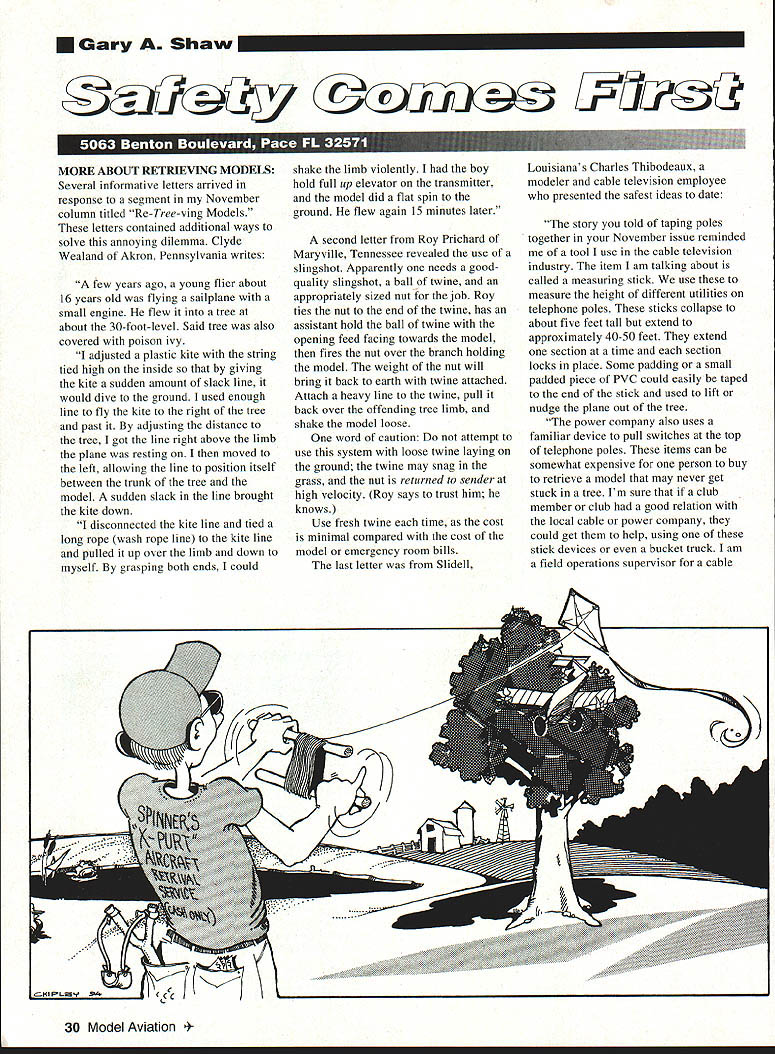
Clyde used a plastic kite with the string tied high on the inside so that, by giving the kite a sudden amount of slack line, it would dive to the ground. He used enough line to fly the kite to the right of the tree and past it. By adjusting the distance to the tree, he got the line right above the limb the plane was resting on. He then moved to the left, allowing the line to position itself between the trunk of the tree and the model. A sudden slack in the line brought the kite down.
He disconnected the kite line and tied a long rope (wash-rope line) to the kite line and pulled it up over the limb and down to himself. By grasping both ends, he could shake the limb violently. He had the boy hold full up elevator on the transmitter, and the model did a flat spin to the ground. The boy flew again 15 minutes later.
Roy Prichard, Maryville, Tennessee
Roy recommends using a good-quality slingshot, a ball of twine, and an appropriately sized nut.
- Tie the nut to the end of the twine.
- Have an assistant hold the ball of twine with the opening feed facing toward the model.
- Fire the nut over the branch holding the model. The weight of the nut will bring it back to earth with twine attached.
- Attach a heavy line to the twine, pull it back over the offending tree limb, and shake the model loose.
Caution:
- Do not attempt this with loose twine laying on the ground; the twine may snag in the grass and the nut could be returned at high velocity.
- Use fresh twine each time; the cost is minimal compared with the cost of the model or emergency room bills.
Charles Thibodeaux, Slidell, Louisiana
Charles, a modeler and cable television employee, offered a very safe approach using tools from the cable industry.
- A measuring stick used for telephone poles collapses to about five feet and can extend to approximately 40–50 feet, one section at a time, with each section locking in place. Some padding or a small padded piece of PVC could be taped to the end of the stick and used to lift or nudge the plane out of the tree.
- Power companies also use insulated pole devices to pull switches at the top of poles. These items can be somewhat expensive for an individual to buy, but a club with a good relation with the local cable or power company might get assistance or use a bucket truck.
Charles is a field operations supervisor for a cable company and volunteered to help.
There you have it: several more ideas to contemplate as you continue building projects or cleaning your flight box during the winter.
Respirator Safety
Bob De Mattei asked that anyone contemplating using a respirator receive an appropriate medical exam from a physician familiar with respirator use, and be properly fitted. Respirators from different manufacturers fit differently and come in different sizes.
His letter contains information regarding respirator protection factors (PF) and threshold limit values that may limit specific types of respirator use. I will cover that subject in a future column.
Modeler Receives Mild Beating
An interesting letter arrived from Gerald Ewell of Manchester, Tennessee regarding an "up close and personal" encounter with a thrown spinner.
Although most of us understand the dangers of standing in the arc of a spinning prop (it could hit you if it comes off the shaft), rarely do we consider what might happen if a spinner, backplate, nut, or screw suddenly departs the shaft and heads our way. The whole shootin' match—spinner, nut, screw, backplate, spacer, etc.—normally comes off when the prop gets tossed, and all of it can scatter with the power of high-speed shrapnel.
Gerald provided a firsthand account to help others avoid a similar mishap:
Upon returning from Zimmerman's Giant Scale fly-in in Walter Hill, Tennessee, Gerald was test-running his O.S. long-stroke in the Sukhoi model he had recently finished. He was using a 14 x 6 Master airscrew prop and a spinner furnished with the kit.
After two or three hard starts with the electric starter and one or two starts with a chicken stick, he noticed the compression position of the prop had changed from about 2:30 to 12 o'clock. He ignored this symptom, which he now realizes was a big mistake.
After starting the engine and running it at low-to-medium speed, everything suddenly came apart. The spinner came off and hit him below the right eye, broke his safety sunglasses, tore off both earpieces, twisted his regular glasses, bruised the bridge of his nose where his glasses fit, left a knot on his right cheek just below the eye, and generally shocked him. He found no bleeding but inspected himself in his truck mirror and was relieved there was no further apparent injury.
Lessons learned:
- Pay attention to changes in engine performance that may indicate loosened spinner nuts, thrown props, or broken engine mounts.
- Check and tighten nuts and bolts routinely.
- Replace cracked or broken parts with new ones.
- Always check thrown parts for damage and replace if necessary. When in doubt, discard bent spinners or chipped props.
- Wear safety glasses when working around engines and other eye-hazardous equipment.
The Fly Paper
As noted in my December 1994 column, I used a story provided by the Remote Control Association of Central Florida about a central Florida modeler who apparently lost the tip of his finger while hand-launching a glider.
After reading the column, the injured individual called to clarify the story. No body parts were lost; however, several stitches were necessary due to an encounter with a running .049. As mentioned previously: don't take your eyes off spinning blades, and never fly alone.
That's it for this month. Keep your eyes to the sky, and your wings level.
Transcribed from original scans by AI. Minor OCR errors may remain.

