
SAFETY COMES FIRST!
Propellers, flying-field safety practices, TV interference, mufflers, two-part curable polyurethane paints — we review some of the key safety items from 1980.
John Preston
When we wrote this column at the end of December, 1980 was about over. No doubt many readers received modeling supplies and Christmas presents that will be put to good use during 1981. We would like to think none of these new items will be involved in any injury-producing accidents. However, no matter how careful we are — both in the shop and out at the flying field — some of us will, no doubt, be involved in an accident. Hopefully, not a serious one.
Rather than tackle a new topic this month, we thought a review of some of the subjects we've covered during 1980 might be appropriate to refresh memories on what can happen to the unwary. Let's start with the ever-present threat to powered-plane modelers: the propeller.
Propellers
We know of several modelers who ended 1980 with less than a full set of fingers. We also know many more who had a finger or hand temporarily out of action for several weeks due to contact with a prop. Since we all now use a glove, chicken stick (smart stick), or electric starter when coaxing our motors to life, and we never reach over the prop to adjust the needle valve, we feel sure that in 1981 your chance of being bitten by that rotating meat cutter will be minimal. Right? Wrong! As long as props turn, fingers will get caught.
As we have stated in a previous column, beware of the black, glass-filled variety; their invisibility when running, coupled with their high strength, appears to make them especially hazardous.
The following is a quote from a letter from William Wilbur, president of the New England Sport Scale Association, and illustrates how one far-sighted club has attempted to minimize injuries from black props:
"Several of our club members have tried these props and find them to be quite good in all but the visibility standpoint. They seem to be balanced very well and take a lot of abuse before they need replacing. I have been required to practice my first aid on two club members who managed to forget that the prop was there. One member required five stitches to close the resulting wound (stitching done at hospital). Needless to say, we now require that any person using one of these props at our field have the tips painted. If the person has not painted the tips, we have a can of day‑glow orange paint in the club field box which takes care of the problem."
We wonder why the manufacturers of these props don't paint the tips. Perhaps this question should be addressed in a letter to the manufacturer. We will let you know what response we get.
Flying-field conduct and safety officers
In a previous column we discussed conduct at the flying field and listed 43 different items we had extracted from the safety rules of various clubs across the nation. Subsequent to the publication of that column (May 1980 issue), we noted in more than one club's newsletter some derogatory statements inferring we were suggesting all of these rules should be adopted. That's not what we had in mind, so we apologize if that's the way it came out. The column also suggested large clubs might consider establishing a safety committee to draft and enforce safety rules.
We recently have noticed references to a Club Safety Officer in several clubs' newsletters. No matter the size of the club, this sounds like a worthwhile position for one of the club's officers to fulfill. If any of our readers already hold this title, we would welcome a letter telling about duties, experiences, etc. It is possible the (hopefully) about-to-be-formed AMA Safety Committee may suggest that all AMA‑chartered clubs should have a club safety officer. More on this in the future.
Radio interference and TV transmissions
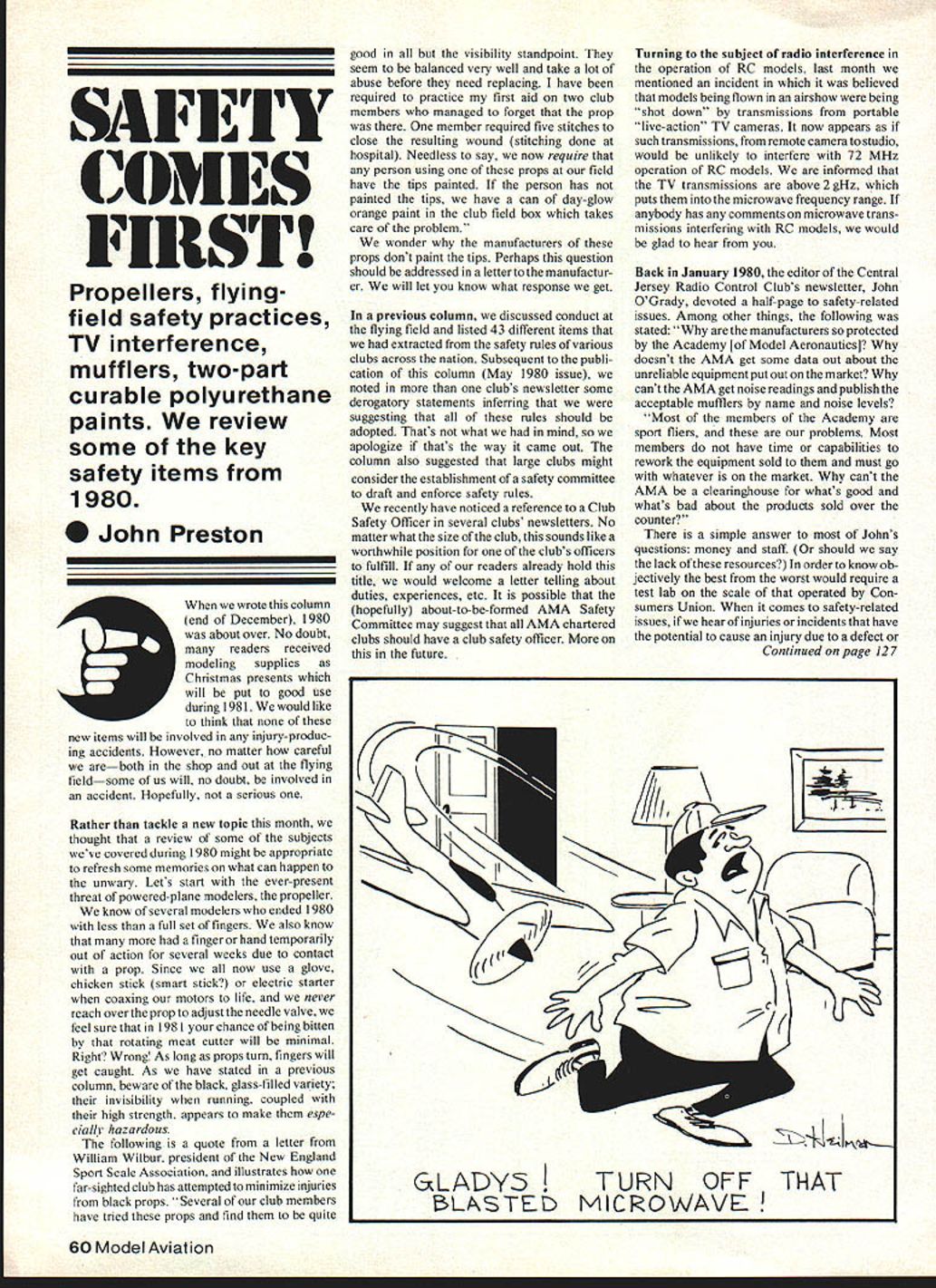
Turning to the subject of radio interference in the operation of RC models, last month we mentioned an incident believed to involve models being flown in an airshow being "shot down" by transmissions from portable "live-action" TV cameras. It now appears such transmissions, from remote camera to studio, would be unlikely to interfere with 72 MHz operation of RC models. We are informed the TV transmissions are above 2 GHz, which puts them into the microwave frequency range. If anybody has comments on microwave transmissions interfering with RC models, we would be glad to hear from you.
Manufacturers, the AMA, and product testing
Back in January 1980, the editor of the Central Jersey Radio Control Club's newsletter, John O'Grady, devoted a half‑page to safety-related issues. Among other things, the following was stated:
"Why are the manufacturers so protected by the Academy (of Model Aeronautics)? Why doesn't the AMA get some data out about the unreliable equipment put out on the market? Why can't the AMA get noise readings and publish the acceptable mufflers by name and noise levels?"
Most of the members of the Academy are sport fliers, and these are our problems. Most members do not have the time or capabilities to rework the equipment sold to them and must go with whatever is on the market. Why can't the AMA be a clearinghouse for what's good and what's bad about the products sold over the counter?
There is a simple answer to most of John's questions: money and staff (or, more accurately, the lack of these resources). To know objectively the best from the worst would require a test lab on the scale of that operated by Consumers Union. When it comes to safety-related issues, if we hear of injuries or incidents that have the potential to cause injury due to a defect or a less-than-desirable feature of a product, we feel obligated to inform you through this column. However, we have no wish to be sued by a manufacturer, so we have to be fairly sure of our facts. This isn't always an easy chore. Some products may be perfectly safe in the hands of one modeler, but have the potential to be lethal in the hands of a "klutz." One reason we suggested to the AMA Executive Council that there should be an AMA Safety Committee was to establish a panel of "experts" to evaluate products or practices that may lead to bodily injury.
Noise levels and mufflers
On the subject of noise levels and acceptable mufflers, this is an area that is dear to many modelers' hearts. However, there appears to be a significant number of modelers who would like to do away with mufflers entirely. A Scale Rules Change Proposal, SC‑82‑10, sought to eliminate the muffler requirement from CL Scale events. (Editor's note: This rule proposal failed to pass the Scale Contest Board and is "dead" for this cycle of rules revisions. RBMcM.) A recent opinion poll of the members of the National Association of Scale Aeromodelers (NASA) showed they were split exactly 50/50 on this proposal. We hope the Scale Board members see fit to retain the requirement.
We firmly believe mufflers should stay, and we would go one step further and say that there should be an upper limit established for engine noise levels. However, as we stated in a previous column, this would be very hard to justify if hearing loss is the issue. Again, if anybody wants to get on his soapbox on the subject of noise levels and muffler effectiveness, we'd be glad to hear from you.
Reader letter — two-part polyurethane paints
Our final topic this month concerns a letter from a reader, Bob Barbara from Miami, Fla. After reading Bob's letter, perhaps you will agree this safety column is a worthwhile feature of the magazine.
"Dear Mr. Preston,
"I must inform you how a possible tragedy was averted by your 'Safety Comes First' column in Model Aviation.
"Recently, a friend asked me to paint a model for him. Since I needed a few extra bucks for the holidays, I accepted the job. My friend conveniently gave me some super paint that a paint distributor had given him. I never saw this type or brand of paint before. My friend assured me that this paint was great stuff, worth $50 a gallon. The name of this paint is Bostic Aliphatic Isocyanate Bonding Coat (better known as a two‑part polyurethane). Usually, I take the time to read the directions on the can on how to use the paint. In this particular instance, there were so many instructions that I only glanced at the first few. There was no big glaring warning on the can itself as to the hazards of this paint.
"So much for directions, on with the painting. I looked around for my spray mask but couldn't find it. My wife is always reminding me to wear it. Needless to say, I decided to paint without it. I proceeded to mix up the paint and load up my spray gun. I usually spray my planes right in front of my garage to pick up the natural ventilation, but today it was rather chilly, and I decided to paint inside the garage with the door halfway shut. Just about to start spraying, I saw the mailman pull up for his Saturday delivery. Having spotted the Model Aviation magazine in his hand, I walked out of the garage to pick it up. As I was browsing through it, I turned to the 'Safety Comes First' column. I couldn't believe what I had just read. I was about to drop the cyanide pellet into the acid!"
"I learned a lesson today on reading directions. This was a shocking experience for me. I consider myself a very cautious person with regards to safety, but as I have demonstrated, it takes only one slip‑up.
"At this time all I can say is, Thank you, Mr. Preston, Thank you, Model Aviation, Thank you, Mr. Mailman, For possibly saving my life.
Sincerely, Bob Barbara"
To the list of thanks you must add the name of Bob Hoeckele. It was Bob's editorial in the January 1981 column in Modeler magazine that had the paragraph reprinted on this page. In case you haven't read the original article on the hazards of breathing the vapors of two‑part curable polyurethanes: if you haven't read the article, you won't use them.
Contact
By the time this magazine reaches you, there is a possibility my address may have changed. Until further notice, any correspondence should be addressed as follows:
John Preston c/o Model Aviation 815 15th St., N.W. Washington, DC 20005
Transcribed from original scans by AI. Minor OCR errors may remain.

