

Gary A. Shaw
5063 Benton Boulevard, Pace FL 32561
Safety Comes First
SHOT DOWN OVER THE WEST COAST: As mentioned in my June 1994 column, I was surprised to hear an Associated Press news story about an individual in France who was so frustrated with an RC model club near his home that he allegedly took matters into his own hands.
The individual allegedly had made it known to the club that passes of radio-controlled aircraft over his property would no longer be tolerated. Since the problem continued to go on for some time and negotiations to solve the issue were unsuccessful, the landowner went to court and obtained an order to make the flyovers stop.
Evidently the order had little effect, as the landowner's airspace continued to be violated—that is, until airplanes mysteriously began falling from the sky. Eventually the landowner was arrested and charged with using radio gear that allegedly caused the demise of nearly 100 aircraft. At last report, both sides were awaiting a court date to explain their positions.
On a note a little closer to home comes a story from the West Coast regarding alleged RC frequency jamming during a popular Giant Scale air race. After reading the police report, one could conclude that the modeling community may no longer be immune from such actions in this country. One would have to wonder if we ever have been.
As I write this column it's early January 1995 and the West Coast case has yet to see its day in court. So I don't report anything inaccurately, you'll have to wait for the details until the case is published as public record. In the meantime, there are some specific things you can do to prevent intentional or unintentional RC frequency conflicts at your field:
- Use a frequency board whenever possible. Don't assume you have a clear frequency until the pin for your channel is obtained or you know for certain no one else has your channel in use (for those flying at fields without frequency boards).
- Buy or periodically lease a frequency scanner for use at your field, and use it often. Never allow yourself to think radio interference can't happen where you fly.
- Learn to recognize interference patterns in your area so that routine interference or a devious foe can be discovered.
- Trace interference to its source, if possible; identify and correct potential problems. Enlist the help of the FCC whenever possible.
- Watch for events that seem out of place, i.e., people arrive but don't get out of cars, cars noted to be parking on side roads near flying sites, etc.
- Suspect all things when trying to figure out why mysterious radio interference problems plague your area, and alert club officials to any activity deemed suspicious or inappropriate. Don't be naive—in this day and age anything is possible.
- Consider using an autopilot. If aircraft at the event in question had been so equipped, the risk of loss from the alleged radio interference would have been greatly reduced, if not eliminated. If you're unfamiliar with the application of autopilots to RC aircraft, consider reviewing my August 1994 column for more information, or simply drop me an SASE.
Spring "tick'le"
Of all the toys I've accumulated during the past few years, I'd have to say my computer has finally worked its way into the top-ten category of favorite things to use. After recently installing multimedia hardware/software, I suddenly found myself overwhelmed by the many new sights and sounds a modern PC can produce. Video cards, voice/fax modems, radio cards, CD applications, etc., are just a few of the wonders modelers can explore during the cold winter months.
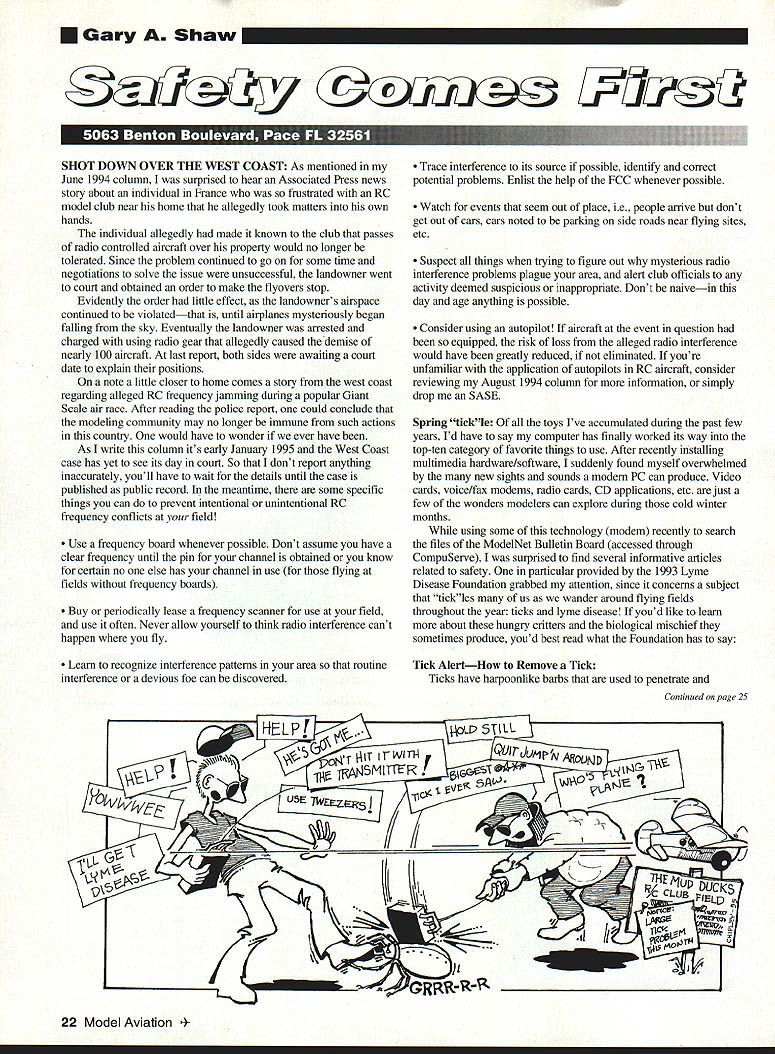
While using some of this technology (modem) recently to search the files of the ModelNet Bulletin Board (accessed through CompuServe), I was surprised to find several informative articles related to safety. One in particular provided by the 1993 Lyme Disease Foundation grabbed my attention, since it concerns a subject that "ticks" like many of us as we wander around flying fields throughout the year: ticks and Lyme disease. If you'd like to learn more about these hungry critters and the biological mischief they sometimes produce, you'd best read what the Foundation has to say:
Tick Alert—How to Remove a Tick
Ticks have harpoon-like barbs that are used to penetrate and maintain attachment to the skin. Ticks secrete a cement-like substance that helps adhere them to humans and animals.
- Using fine-point tweezers, grasp the tick's mouthparts (place of attachment) as close to the skin as possible.
- Gently pull the tick straight out with steady pressure. Do not twist or jerk the tick.
- Place the tick in a small vial with a blade of grass and label with the date and your name and address, and keep for tick identification.
- Wash your hands. Disinfect the tweezers and the bite site.
- Contact your doctor. The Lyme Disease Foundation Medical Advisory Committee recommends treatment on the bite of ticks capable of transmitting Lyme disease.
Cautions:
- Check pets carefully, especially around the eyes and ears.
- Children should be told to seek adult help for proper tick removal.
- Adults should have someone else remove attached ticks.
- It is better to wait for tweezer removal than to pull the tick off with your fingers.
- If you must remove the tick with your fingers, use a tissue or leaf to avoid contact with potentially infectious tick fluids.
- Do not prick or burn the tick, as it may cause the release of infectious tick secretions.
- Do not try to smother the tick, as it has enough oxygen to last through the entire feeding.
Ixodes ticks primarily transmit disease. Tick names include:
- Black-legged tick (Ixodes scapularis)
- Western black-legged tick (Ixodes pacificus)
Tick size ranges from larva (rarely infected) to nymphs to adult to engorged adult (maximum size).
Lyme Disease Symptoms
- Early infection: Flu-like symptoms — headache, fever, muscle or joint pain, unusual tiredness, loss of appetite, or swollen glands.
- Skin: Single rash at the bite site. About 50% of infected people do not get a rash. This rash occurs in many shapes and colors. It appears as red or purplish on light skin and as a bruise on dark skin. Discoloration at the bite site within hours of tick removal may be skin irritation and not disease.
- Eye: Conjunctivitis.
- Disseminated Infection — General: Fatigue, loss of appetite, vomiting.
- Disseminated Infection — Brain: Severe headaches, cranial nerve paralysis (e.g., facial droop), photosensitivity, loss of reflexes, radicular pain, sensory problems, stroke (rare), inflammation of the spinal cord, brain, or nerves.
- Disseminated Infection — Eye: Inflammation of various parts or optic nerve, retinal detachments, double vision.
- Chronic Infection — General: Chronic fatigue.
- Chronic Infection — Brain: Cognitive or behavioral changes, disorders of the peripheral nerves, severe headaches, inflammation of the brain.
- Chronic Infection — Eyes: Loss of vision.
- Chronic Infection — Skin: Degeneration of the skin on the hands or feet, recurring rashes.
- Chronic Infection — Joints: Disabling pain, intermittent or chronic.
- Pregnancy: The Lyme bacterium can cross the placenta and infect the unborn. Reported potential complications include miscarriage, stillbirth, and death after birth.
For more information on Lyme disease or other tick-borne diseases, send a SASE business-sized envelope to Lyme Disease Foundation, 1 Financial Plaza, Hartford, CT 06103 or call the Lyme Disease National Hotline: (800) 886-LYME.
Splitting fuel jugs
Joe Wagner of New Wilmington, Pennsylvania recently wrote to alert me to a problem he’s encountered regarding plastic fuel jugs spontaneously splitting open while in storage.
Apparently Joe has had three containers split open in the last few years, resulting in some severe fuel spills in his workshop and the trunk of his Oldsmobile. The splits varied in length from 1/2 inch to almost two inches, which resulted in slow trickles, rather than a gush.
Joe thinks the jug failures may be caused by a manufacturing defect rather than high or low temperatures, since the failures occurred in cool weather. He didn’t specify the brand of fuel, since apparently all three occurrences were from separate manufacturers (probably a generic, low-cost, blown-plastic product used by numerous companies).
To combat this problem, Joe routinely transfers all of his glow fuel into heavy-duty UL-approved containers before transporting them in his car. He feels that additional trouble and expense is necessary if he’s to avoid more spills in his workshop or car.
Since Joe’s letter was the first I’ve received in regard to fuel-jug integrity, I’m left wondering if others have had occurrences of the same type. I’d appreciate a postcard from those of you who have had similar occurrences.
You may have noticed a change of address at the top of the page. The family and I have moved for the second time in a year (what fun). Hopefully the gods will let us stay for a while and the family’s roots will get a chance to grow!
That’s all for this month! Drive carefully on your way to the field!
Transcribed from original scans by AI. Minor OCR errors may remain.

