
Safety Comes First
5063 Benton Boulevard, Pace, FL 32561
Note: We recently learned that Gary Shaw has been deployed to Croatia for a six-month tour. Shaw, an officer in the U.S. Navy, has been assigned to be the health officer to the United Nations headquarters in Croatia. He is responsible for health issues in three countries for 33 battalions of UN forces. I'm sure all of you will join the MA staff in wishing Gary a safe and speedy return!
Rob Kurek Publications Manager
Audio-Visual Indicator
I'm sure that those of you who enjoy flying electric-powered models took note of my March 1995 column, which pointed out one of their greatest advantages: "they start with the push of a button!" I'm also sure it came as no surprise when I mentioned one of their greatest disadvantages: "they start with the push of a button!" Still confused? I'll try to clear it up one more time.
Push the button — the model is "armed" for flight. Push the button again — the model is no longer "armed" for flight. Simple enough, right? Well, not quite.
As told by veteran silent flier Dick Miller of Wernersville, PA, unless you have the appropriate transmitter in your hands and/or know the appropriate on/off switch positions of every airplane around you, it's nearly impossible to tell if a buddy's model is "armed" for flight. As a result, if someone leaves a model turned on while in the pits, the next person lucky enough to use the same frequency will suddenly find themselves controlling two aircraft.
Having experienced this type of excitement on several occasions, Dick felt it necessary to research a few electronic solutions; he passed along two in the form of easy-to-read schematics.
The first schematic described a simple and inexpensive fail-safe motor-control latching circuit which can be constructed from parts readily available at Radio Shack. Although not well tested, Dick indicated that the latching circuit operates when a transmitter is turned on followed by the receiver. Pushing a fail-safe button then activates a relay which connects power to the motor control. The relay stays energized as long as the transmitter is on, and its engagement apparently does not interfere with control operations. As described by Dick, if a receiver is inadvertently left on and the transmitter is turned off, loss of the signal will cause the relay to drop out—effectively electrically disengaging the motor.
Another possible solution was a schematic of an audio-visual indicator (this one works great) which uses a combination LED/Piezo element to blink and beep when the aircraft receiver is turned on (or left on). The unit utilizes three inexpensive components, readily available from Radio Shack. Coming in at less than six dollars complete, the device offers cost-effective performance that's simply hard to beat.
Although it was originally designed by Dick for use in electric models, one could just as well use the LED/Piezo device in "wet"-powered models (it simply plugs into any unused receiver channel).
Since first appearing in the March issue, no less than 30 letters have arrived with requests for copies of Dick's schematics. A recent letter from Dick revealed yet another electronic device which promises to put his original ideas in the file cabinet:
"I am now a columnist for Flying Models magazine, writing specifically about small electric FFs and R/Cs. In the course of pursuing various electronic gadgets, one of my contacts set me onto the Cricket, a device that has been on the market for some four years. This unit does everything I had wanted. The designer, Richard Adams, had previously only sold his Cricket at shows, but after some appropriate haranguing, thought it might now be appropriate to sell it mail-order. The unit weighs 11 g and will:"
- Check R/C system range on the ground
- Check binding; servos causing excessive receiver current drain
- Indicate someone's frequency
- Aid in locating a downed aircraft
- Indicate receiver voltage low
- Signal you've forgotten to turn the receiver off
- Indicate when the system is discharging batteries
The unit works with the power plant you've got—wet or dry. The Cricket sells for $24.95 without a universal servo connector, $29.95 with one. Add $2.50 for S&H. Write Adams Enterprises, 43 Sagebrush Lane, Erlanger, KY 41018, or phone (606) 331-1771 for more info. Had this been available earlier, it would have saved us both a great deal of time, money, and effort.
For those of you who might still like to build one of the units described above, schematics can be obtained by sending an SASE to Dick Miller, 193 Huntzinger Rd., Wernersville, PA 19565.
Invisible Props
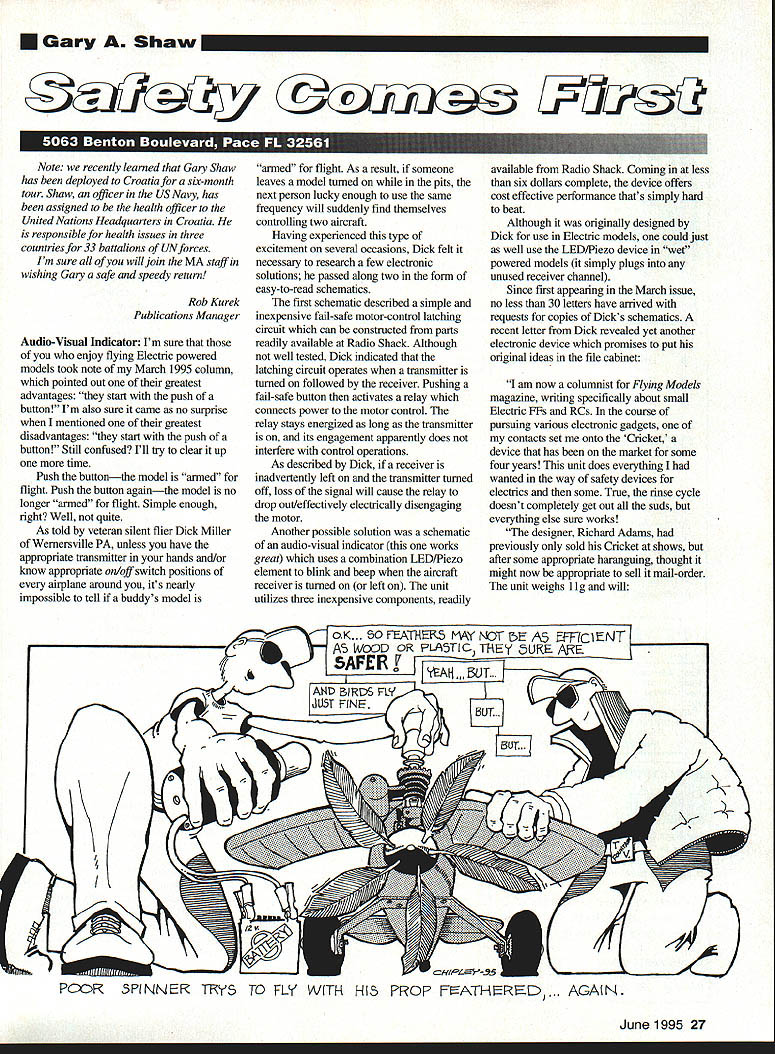
By the time you read this column the flying season should be well underway throughout much of the country, and many winter building projects will be headed for the field. Before you get too far out of the workshop doors, look down at that model—new or old—and visually check the prop to ensure that you painted the tips!
Why, you ask? What else will allow you to see the arc of the prop as it whizzes through the air, only inches (or less) from your precious knuckles? It's surprising how many people overlook this one most important safety requirement before starting the engine.
Although letters received from modelers who have injured themselves are valuable educational tools for many of us to learn from (some love the pictures), wouldn't it be better if no one had to endure pain and suffering for our benefit?
In my September 1994 column I asked modelers to write regarding who they thought should be responsible for ensuring prop tips are painted—the modeler or manufacturer. Oddly enough, I only received three responses.
One modeler indicated that if the manufacturers were to paint the tips, lawsuits could be built on grounds that manufacturers were painting tips because they knew a product hazard existed. The second possessed a similar tone to the one above, in that it was expressed modelers should be concerned enough to ensure tip painting and manufacturers should provide how-to instructions and/or written warnings.
The response that I feel possessed the most credibility was from an acknowledged beginner. "Folks, these are the ones who need to be made aware." Roy Lawson of Carrollton, Texas writes:
"I read your column concerning the painting of propeller tips, and cannot agree more! I am just a beginner in the hobby, in fact, I haven't even soloed, and it is pretty obvious to me that the tips ought to be painted so that you can see them. I bought a package of props for use on my Telemaster 40 and after balancing them, immediately painted the tips white. You know, that white circle caused by the spinning propeller makes it look nice.
"Gary, I started out building a quarter-scale Stearman using Jack Strickland's plans and got the opportunity to fly one of his Stearmans. I haven't finished my Stearman yet and am seriously considering not ever flying it. Why? It just scares the hell out of me when I stand behind that big Stearman and consider what could happen if that airplane decided to come apart when the engine is being run up at full rpm. I mean, it really requires a lot of effort to hold that plane back when doing a run-up on the engine.
"Just last week a friend of mine got his finger into a propeller on a .120 four-stroke. This accident had nothing to do with painting the tips of the propeller, but was rather caused by the strap on his radio accidentally pushing the throttle stick fully forward, causing the airplane to lunge toward him. The prop got his finger as he tried to grab the airplane. The engine didn't miss a lick.
"I just got out of the large-scale model railroad hobby because of the weight of the locomotives, 500 to 2000 pounds, running at 100-150 pounds per square inch steam pressure. Flat cars and box cars weighed in the range of 100 to 150 pounds each. I have never seen one of these locomotives blow up, and I hope I never will. I wanted to get into a hobby where the equipment wasn't so heavy and would be a lot safer. From what I've seen so far, there appears to be a lot of danger in this hobby as well. Unlike a spinning prop, at least I knew where my train was, either on the track or on the ground."
For those of you who think too much attention is paid to injuries received from props, I suggest you do the minimum for your own safety by deciding to fly again at the field. Check to see if your field has posted emergency plans which can assist those helping you with your injury if needed. It should contain no less than which fire department, rescue squad, and/or emergency room serves your area and how to access them. Understand that not all emergency rooms are created equal. Know in advance exactly where the help you need might be obtained. My hope is that after reading all this you'll realize a paint can and some masking tape applied to a prop is a much cheaper alternative than trauma-center expenses.
Keep your eyes to the sky and the wheels on the bottom!
Transcribed from original scans by AI. Minor OCR errors may remain.

