


Gary A. Shaw 5063 Benton Boulevard, Pace, FL 32561
Safety Comes First
While flying with a local model club a few weeks ago, I was once again made aware of the dangerous things that some of us do without much of a second thought.
Leading the pack that day was a pilot who started his airplane, laid his transmitter down, walked over to his vehicle to grab a pack of smokes, and walked back. No big deal, right? Well, it should be noted that during his short walk the model was left unattended, running, sitting on smooth asphalt, and facing the pits. While the pilot was walking back, a stiff breeze pushed the model and it began to move across the pavement toward him.
When the model reached its pilot, he casually reached down and turned it around. He let the model taxi back past the transmitter before he picked up the controls and proceeded to fly. Now tell me if I missed something here! An uncontrolled model rolling toward the pits? Even newcomers to the hobby should recognize the danger of an unattended, running (and moving) model at a flying field.
Oddly enough, several other modelers were standing near the model as it slowly crept along but did nothing to stop it. Although it was obvious that the pilot was either unaware of the danger this represented or just didn't care, there's no excuse for the lack of action by the others that were present. What I saw was indifference or "attitude" toward the problem. This makes you feel as though this sort of thing happens frequently—otherwise someone would have grabbed the model and cautioned the owner.
Remember: practicing good safety takes an application of common sense, teamwork, and good judgment—as a club, a group, or simply as a few guys hanging at the field. Normally this means helping another—even if the help is nothing more than a few words of caution.
Is it unpopular to say something to someone? You bet. Does it normally fix the problem? You bet! Question: what kind of damage can a rotating prop do to the human body? Need I provide pictures? Use your imagination!
On a similar note, the event I mentioned above got me thinking about another incident I witnessed last year while attending a popular fun-fly at a different club.
On that occasion I noted a more-experienced modeler sitting in front of his idling .40-size airplane with his legs crossed. His hands were on the transmitter, and no one was holding the airplane. He was busy setting up his computer radio prior to taxiing out to fly.
Why do people place themselves in such jeopardy? In both cases it was ignorance, complacency, the "I dunno" syndrome, or just plain stupidity. You be the judge.
A Near-Miss from a Fuel Can Explosion
Last month's column included a story about a modeler who escaped serious injury when a fuel can he was carrying exploded. The explosion occurred when a departing flier decided to carry a chair in one hand and his battery box and fuel can in the other.
Seconds after he picked up his gear the exposed battery terminals shorted against the can, causing the explosion. Fortunately, the top of the can separated on the side away from the victim, directing the blast away from his hand, arm and body. The can fell to the ground, tipped over, and ignited the grass. The grass fire was easily extinguished, and the flier was very fortunate to have avoided being seriously burned.
"Not so fortunate" could be the theme of a story sent to me recently by modeler Frank Purpura of the Thorn Creek R/C Club in Chicago, Illinois. This story also involved an exploding fuel can—it's funny how stories like these seem to arrive in pairs. To provide the highlights, Frank writes the following:
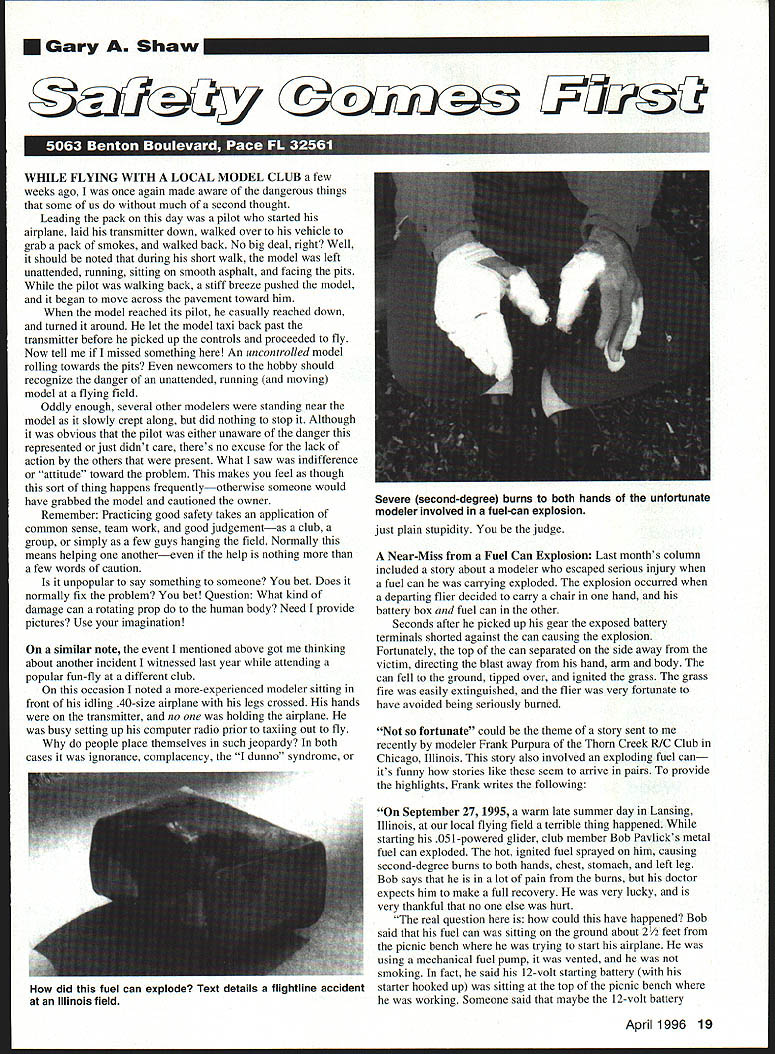
"On September 27, 1995, a warm late-summer day in Lansing, Illinois, at our local flying field a terrible thing happened. While starting his .051-powered glider, club member Bob Pavlick's metal fuel can exploded. The hot, ignited fuel sprayed on him, causing second-degree burns to both hands, chest, stomach, and left leg. Bob says he is in a lot of pain from the burns, but his doctor expects him to make a full recovery. He was very lucky, and is very thankful that no one else was hurt.
"'The real question here is: how could this have happened?' Bob said that his fuel can was sitting on the ground about 2½ feet from the picnic bench where he was trying to start his airplane. He was using a mechanical fuel pump, it was vented, and he was not smoking. In fact, he said his 12-volt starting battery (with his starter hooked up) was sitting at the top of the picnic bench where he was working. Someone said that maybe the 12-volt battery shorted out, causing a fire and explosion. I don't know if that is what happened; there were no eyewitnesses. Everyone at the field that day was doing their own thing, and didn't know anything was wrong until hearing the explosion and Bob's cries for help.
"I didn't get there until after the accident happened, and I don't think I will ever know the actual cause of the accident. If anyone who reads this story has any possible explanations, we would like to hear from you. Please write to Frank Purpura, president of Thorn Creek R/C, 10930 Mackinaw Ave., Chicago, IL 60617."
Frank provided photos that show the severity of the explosion and Bob's injuries. As you can see, the can split open like a ripe banana, and the injuries to Bob's hands look very painful.
There are a few things we can review to help prevent injuries like this in the future:
- 12-volt starting battery: Does it have any loose or frayed wires? Does the positive terminal have an insulator over it? Are your battery and fuel can at opposite ends of the box? A small spark near the fuel can can cause a rather unpleasant explosion.
- Starter: Are the alligator clips (or banana plugs) securely attached? Do they spark when you use the starter? If so, consider cleaning the connections or replacing the plugs.
- Electric fuel pump: Does it have good connections? Does it leak? If so, repair or replace it. Remember, fuel leaks and sparks can start a fire.
- Power panel: Check all electrical connections. Make sure they're clean and secure. Some panels use a dropping resistor for the 1.5-volt glow-plug voltage; this resistor gets very hot and needs ventilation. Is yours getting enough air? (Columnist's note: if the electrical connections on the back of your power panel were not sealed by the manufacturer, use a hot-glue gun to seal them.) Coat all bare wires and terminals. All it takes is a touch from a wrench on the back of an exposed panel to spark a fire or explosion.
- Glow-plug battery leads: Are the connections at both ends good and tight? If you use alligator clips, make one wire shorter than the other so that the clips can't touch. On a head-lock-type connector, use the plastic cap provided by the manufacturer when it's not in use so that nothing can short it out.
- Fuel can: Does it seal properly? If it's plastic, is the jug still sealed? If not, replace it—seams sometimes leak as containers age, and internal pressure pushes them apart. Is the can rusted? If so, replace it to avoid fuel contamination and/or leaks.
- Ni-Cd starter: Is it stored in your flight box? If so, does it have a protective cap to prevent shorting with other objects?
Remember: given the right conditions, fuel vapor can travel several feet from its source and ignite if it comes in contact with a spark.
Last year a young man told me of an accident which occurred as he played with matches in the garage. Apparently his flight box was a few feet away when it suddenly exploded. Like Bob, he was showered with the ignited fuel but was not seriously injured. In this case the clear fuel vapor leaked from his flight box, traveled across the room, and ignited as the tossed matches were lit.
Be careful with fuel. Store it where it cannot be exposed to sources of ignition. Keep it away from pilot lights, hot starters, batteries, and lighted sockets. Keep the bottle from rolling around inside your car's trunk.
When you think about the upcoming flying season, try to keep your focus on one thing: make the fuel explode inside your model's engine! Until next month, keep the glue off the table and the wheels on the bottom!
Transcribed from original scans by AI. Minor OCR errors may remain.

