
Safety Comes First
5063 Benton Boulevard, Pace FL 32561
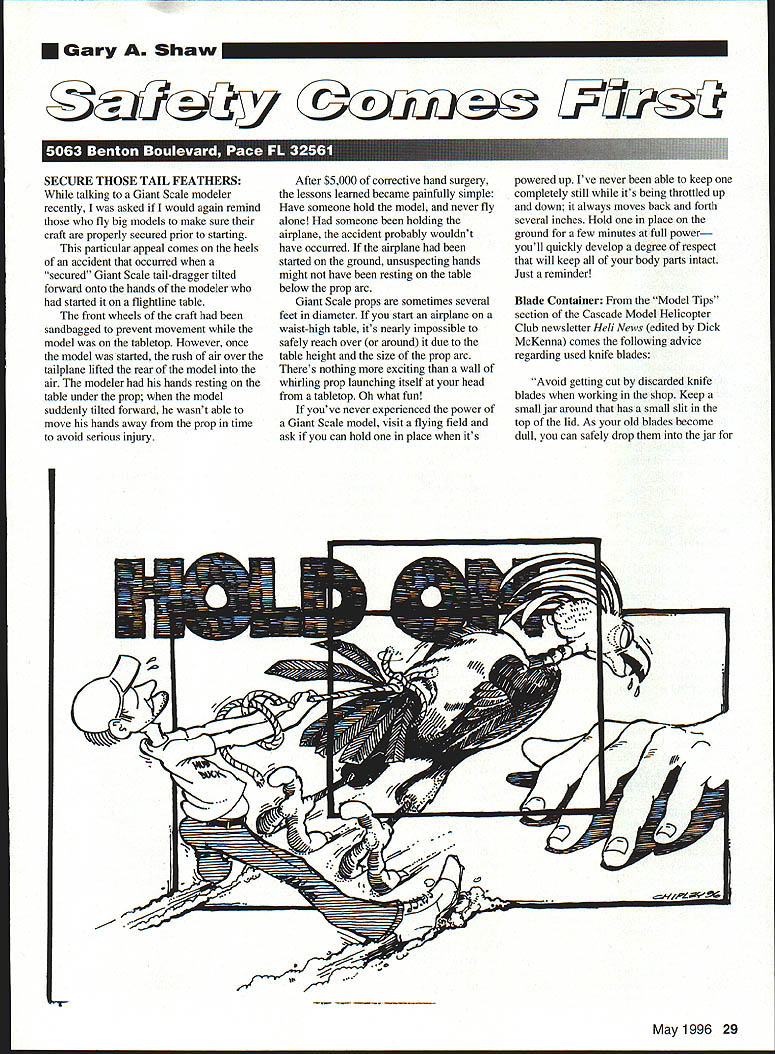
Secure Those Tail Feathers
While talking to a Giant Scale modeler recently, I was asked to again remind those who fly big models to make sure their craft are properly secured prior to starting.
This appeal follows an accident in which a "secured" Giant Scale tail-dragger tilted forward onto the hands of the modeler who had started it on a flightline table. The front wheels had been sandbagged to prevent movement while the model was on the tabletop. However, once the model was started, the rush of air over the tailplane lifted the rear of the model. The modeler had his hands resting on the table under the prop; when the model suddenly tilted forward, he wasn't able to move his hands away from the prop in time to avoid serious injury.
After $5,000 of corrective hand surgery, the lessons learned were painfully simple: have someone hold the model, and never fly alone. Had someone been holding the airplane, the accident probably wouldn't have occurred. If the airplane had been started on the ground, unsuspecting hands might not have been resting on the table below the prop arc.
Giant Scale props are sometimes several feet in diameter. If you start an airplane on a waist-high table, it's nearly impossible to safely reach over (or around) it because of the table height and the size of the prop arc. There's nothing more frightening than a wall of whirling prop launching itself at your head from a tabletop.
If you've never experienced the power of a Giant Scale model, visit a flying field and ask if you can hold one in place when it's powered up. I have never been able to keep one completely still while it's being throttled up and down; it always moves back and forth several inches. Hold one in place on the ground for a few minutes at full power — you'll quickly develop a respect that will keep your body parts intact. Just a reminder!
Blade Container
From the "Model Tips" section of the Cascade Model Helicopter Club newsletter Heli News (edited by Dick McKenna) comes this advice regarding used knife blades:
- Avoid getting cut by discarded knife blades when working in the shop. Keep a small jar with a small slit in the top of the lid. As your old blades become dull, safely drop them into the jar for disposal.
Safety Paints and Solvents
During the past few years I've spent considerable time researching and writing about using paints, glues and solvents safely in the workshop. A Paint Safety article in the March 1995 issue of the Belleville RC Flyers newsletter Transmitter (edited by Darwin L. Evelsizer), titled "Safety Information Regarding Paints" by David Dale, Houston, Texas, contains useful reminders for anyone getting ready to paint a project. Review the following and you may reorder your priorities.
- Two-part and catalyzed paints can seriously harm the lungs, coating alveoli and causing suffocation. Epoxies can cause systemic sensitization that results in allergic reactions affecting skin or the respiratory system. This applies to epoxies, glues and paints.
- Zinc chromate (one-part primer) is a proven carcinogen according to its label; the solvent toluol is also hazardous. Epoxy-chromate primers combine the hazards of zinc chromate and epoxies. Dust created when sanding these primers can cause sore throat, headache, flu-like symptoms and body pain.
- Catalyzed acrylic enamels (for example, DuPont Centari) have both solvent hazards and catalyzing hazards. Centari may be used with catalyzing gloss hardener and is very fuel-resistant. Imron and other polyurethanes (polyisocyanate compounds) can be extremely hazardous — they may cause severe allergic reactions and can be life-threatening if they coat the lungs.
- Lacquers and dopes are generally less hazardous than the above, but inhalation of concentrated dope vapors can cause brain hemorrhage and kidney damage.
- Most thinners and cleaning solvents will pass through the skin and collect in the liver and kidneys. Acetone occurs in the body naturally and is not terribly dangerous in small amounts, but it soaks through the skin and can carry other chemicals into the bloodstream. Use a good waterless hand cleaner instead of thinner to clean hands.
- Epoxy glues can be removed with methanol or rubbing alcohol; hand cleaner won't remove them. Methanol is considered safer than acetone for this purpose. Lacquer thinner and dope thinner often contain MEK, which targets the liver and is a known carcinogen.
- Vinyl or latex examination gloves, available inexpensively through medical-supply stores, will protect your hands from most of these hazards.
- The only acceptable respirators are those rated for volatile organic compounds (VOCs). Cheaper respirators do not provide adequate protection even if you cannot smell the vapors. Continue covering exposed skin as well. The best protection is to avoid contact to begin with.
Most of this information comes from product labels, a physician familiar with these products, and first-hand experience. Handle these products with care.
Wing Away: An account of an RC model accident
"The 69-year-old pilot had been flying since 1953. There was no log record of his time. He had not flown or been flight-checked for 15 years. His AMA license was current. The aircraft was a Hobbistar 60, a high-wing monoplane of all-wood construction with tricycle gear. It was powered by a new Fox .74 engine (the aircraft manufacturer's recommended power is .60). The wing was removable for transport and had considerable dihedral.
"This was the second flight for the aircraft. During the first flight the engine stopped shortly after takeoff. A successful straight-ahead dead-stick landing was made without damage. On a Saturday in July at the Lakeland Club aircraft field, the pilot mounted the wing on the fuselage with four bands on each side and no cross bands (the bands were four years or more old). The manual states five bands each side and at least two cross bands; the bands should be new. The aircraft check was completed, the tank was filled, and the engine was started. The takeoff roll was normal. When the airplane was airborne, it began to roll. The wing folded; the airplane crashed. The pilot was fatally injured. The fuselage was crushed and the engine was substantially damaged, requiring repairs equal to one-half of its new cost."
The lessons learned:
- Follow the aircraft manual advice.
- Don't overpower your aircraft.
- Don't use full power or full control movement on initial flights.
- Take it easy if you haven't flown for many years.
Author's additions:
- Don't use old rubber bands; discard what remains in the field box each season and replace with new.
- Get checked out with an instructor if you haven't flown for some time; be an honest judge of your abilities.
- Break in a new engine by running a few tanks of fuel before putting it on an airplane—make necessary adjustments, check all bolts and screws, then bolt it in place.
Make It Visible
Tips from Robert Sudduth of the Texarkana RC Flying Club to help increase aircraft visibility. When choosing colors for a new model this spring, consider the following:
- Avoid single-color aircraft, particularly solid silver or solid dark colors.
- Beginners are advised to color the bottoms of wings a dark color and the tops a light color.
- Orientation recognition can be enhanced by placing large dark circles under the wings and a starburst pattern of straight lines on the top.
- Any series of adjacent colors intended to facilitate orientation should be gray-scale opposites — not color opposites.
- Don't rely on intricate patterns; they tend to blend together and form an edgeless fuzz at about 100 feet away.
- A bright red or orange leading edge on the wing and horizontal stabilizer will help you keep your wings level during landings.
- Color lines parallel to and above the fuselage trim stripe provide a good angular reference on the glide path prior to the final turn.
- For better loops, make the wingtips and horizontal stabilizer red or orange, and the fuselage background a very light color (white or yellow). This helps you tell if the wings are flat.
- Try different color schemes and patterns on small balsa gliders to see how well you can see them in the air.
Hope you have a great spring and a wonderful flying season! Keep an eye out for ticks!
Transcribed from original scans by AI. Minor OCR errors may remain.

