
Safety Comes First
5063 Benton Boulevard, Pace FL 32561
It's a Challenge
As winter weather finally gives way to warm spring days and favorable flying conditions become more and more common, it really becomes a challenge for me to sit at the computer and work on a column when I know all the folks are whooping it up at the flying field just a few miles away!
Today is one of the few days I'll have off over the next few weeks, and here I sit staring at my computer monitor instead of watching my airplane jump into some picture-perfect morning air. It's funny that I seem to find myself in such a predicament, although I know I only have myself to blame for having waited until the last moment to sit down and write my column.
While reading USA Today during one of my many connections to Europe, I read an article about the problems the new Denver airport seems to be going through. What relation does this have to safety, you ask? Well, none — although I did find it a little amusing that the phone company apparently published the number of a local model airfield in the phone book as the number of the new Denver airport. See what having a good flying field can do for a club? Gets you all the attention you ever wanted, and maybe some federal matching funds to boot!
I just hope that blast from the jumbo jets doesn't get in the way of a great day of flying, and that the modelers can finally solve the baggage-handling problems. I wonder how the air traffic control is working out?
Preflight Your Airplane
Yes, it's spring, and the skies are calling as you speed home from the office, intent on taking advantage of the last few minutes of sunshine at the flying field.
You arrive home and quickly grab the airplane, fast charger, flight box, and radio, while you explain to your wife how you need to get to the field. You kiss the kids, load up the gear, and head for the field as the family stands in the doorway shaking their heads. As you drive down the street you wonder if you've left anything behind, then dismiss the thought as you round the first corner.
Sound familiar? What do we usually say when we return home and our wives see us unloading the remains of our pride and joy? "It was Murphy, dear, and don't worry, I can use all the parts in the next one!"
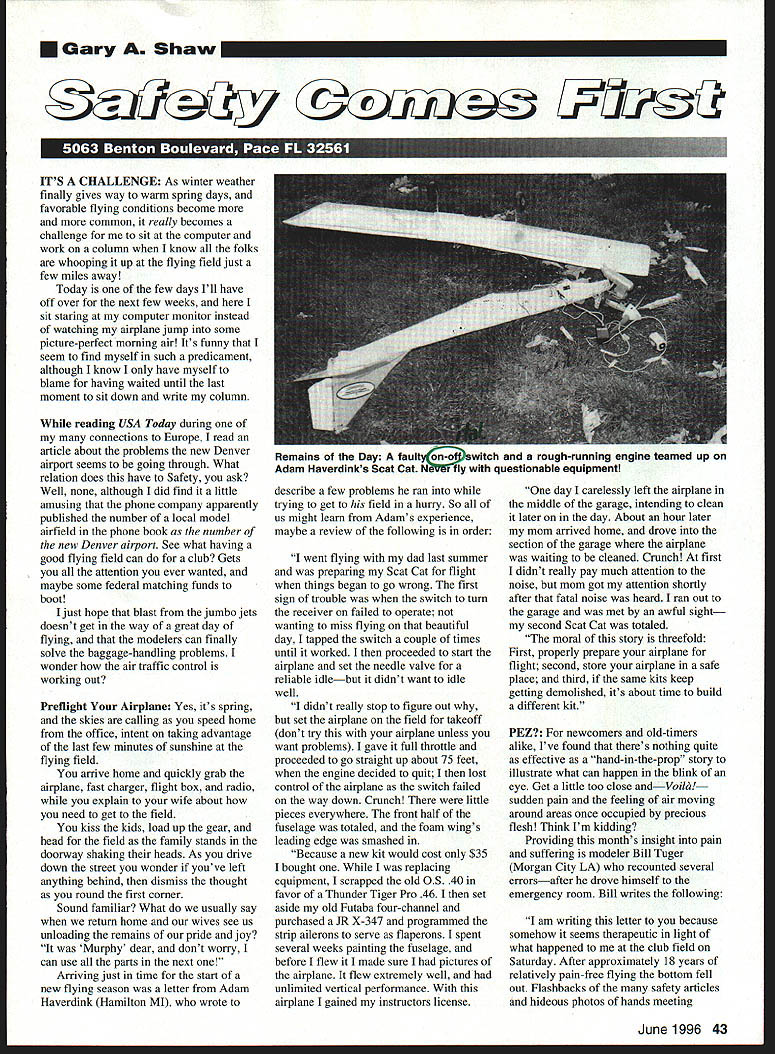
Arriving just in time for the start of a new flying season was a letter from Adam Haverdink (Hamilton, MI), who wrote to describe a few problems he ran into while trying to get to his field in a hurry. So all of us might learn from Adam's experience; maybe a review of the following is in order:
"I went flying with my dad last summer and was preparing my Scat Cat for flight when things began to go wrong. The first sign of trouble was when the switch on the receiver failed to operate; not wanting to miss flying on that beautiful day, I tapped the switch a couple of times until it worked. I then proceeded to start the airplane and set the needle valve for a reliable idle — but it didn't want to idle well.
"I didn't really stop to figure out why, but set the airplane on the field for takeoff (don't try this with your airplane unless you want problems). I gave it full throttle and proceeded to go straight up about 75 feet, when the engine decided to quit; I then lost control of the airplane as the switch failed on the way down. Crunch! There were little pieces everywhere. The front half of the fuselage was totaled, and the foam wing's leading edge was smashed in.
"Because a new kit would cost only $35 I bought one. While I was replacing equipment, I scrapped the old O.S. .40 in favor of a Thunder Tiger Pro .46. I then set aside my old Futaba four-channel and purchased a JR X-347 and programmed the strip ailerons to serve as flaperons. I spent several weeks painting the fuselage, and before I flew it I made sure I had pictures of the airplane. It flew extremely well, and had unlimited vertical performance. With this airplane I gained my instructor's license.
"One day I carelessly left the airplane in the middle of the garage, intending to clean it later in the day. About an hour later my mom arrived home and drove into the section of the garage where the airplane was waiting to be cleaned. Crunch! At first I didn't really pay much attention to the noise, but mom got my attention shortly after that fatal noise was heard. I ran out to the garage and was met by an awful sight — the second Scat Cat was totaled.
"The moral of this story is threefold:
- Properly prepare your airplane for flight.
- Store your airplane in a safe place.
- If the same kits keep getting demolished, it's about time to build a different kit."
PEZ?
For newcomers and old-timers alike, I've found that there's nothing quite as effective as a "hand-in-the-prop" story to illustrate what can happen in the blink of an eye. Get a little too close and — voila! — sudden pain and the feeling of air moving around once occupied by precious flesh. Think I'm kidding?
Providing this month's insight into pain and suffering is modeler Bill Tuger (Morgan City, LA), who recounted several errors — after he drove himself to the emergency room. Bill writes the following:
"I am writing this letter to you because somehow it seems therapeutic in light of what happened to me at the club field on Saturday. After approximately 18 years of relatively pain-free flying the bottom fell out. Flashbacks of the many safety articles and hideous photos of hands meeting rotating propellers were repeated in my mind's eye as I sat in the emergency ward of our local hospital.
"I reminded myself that I had never really taken safety procedures lightly, and yet in an instant of time I had to deal with two severe cuts to my left hand. However, looking back at yesterday's incident, it is evident that I must at least reconsider my procedures, which should help to eliminate a repeat of this physical and mental anguish.
"I could not resist a mostly perfect South Louisiana autumn day. This feeling was shared by other club members who would be meeting me at the club field. Arriving first, I quickly assembled my five-year-old 'pride and joy' P-51 Mustang. Eager to start my engine and make carburetor adjustments (so that engine performance would match a perfect flying day), I quickly got the Mustang airborne. As was the case from my last flying session, my .40-sized engine had good top end, but would die on final approach while idling.
"On the third such adjustment in the pits, my starting procedure got sloppy. Instead of putting the transmitter in the box's designed holder, I simply leaned it against the box. Taking my glow battery and electric starter, the engine came to life effortlessly, idling low and smooth.
"Returning the battery and starter to the box, the transmitter fell over on its face, advancing the left stick to full throttle. The engine quickly obliged. My reaction was instantaneous, though in vain, as the screaming engine sliced through my left hand. Seeing portions of both blades departing from the aircraft I knew I was hospital bound.
"I'm still amazed at the patterns of the cuts and the severity of this 'blink-of-an-eye' accident. The left index finger is cut straight down the middle of the nail, clear through, approximately 1 1/2 inches down to the second joint. The shape is similar to a serpent's tongue. My left thumb is sliced at 90° to the other finger, across the thumbnail, penetrating down to (and through) the tip of the bone. The action of the severed tip resembled a PEZ candy dispenser."
The procedural mistakes leading up to Saturday's mishap should be obvious to all, not the least of which is proper stowing of a transmitter during startup. Also beneficial would have been one of the commercially available restraining devices which only release the aircraft when you're ready.
Everything was complicated by the fact that at the time my adrenaline was at its highest, and I was alone at the field with a ten-mile drive ahead of me to treat my unusable left hand.
While the doctor says the jury is still out on the future of these two fingers, my concern is for all of the other model enthusiasts whose procedures simulate the ones that led to my injury.
As I now prop my hand above my head to reduce the terrible throbbing, I look back with crystal-clear hindsight and urge all modelers to reflect on past safety articles and the suggestions therein. With the possibility of pain and hospital bills in everyone's future, an ounce of prevention has greatly gone up in value.
Let's eliminate the cost of treating model-related injuries this year by following Bill's advice. Pay attention to what you are doing, and how you are doing it! Don't let yourself get hurt by being, as Bill described it, "sloppy."
Until next month, happy flying and keep the wheels on the bottom!
P.S. Send mail! It's been a long winter and I could use some input!
Transcribed from original scans by AI. Minor OCR errors may remain.

