
SAFETY COMES FIRST!
Safety in the CL circle; warnings on storing diesel fuel; thoughts on pull-testing untypical CL models.
John Preston
Safety in the CL circle
Back in the October 1980 issue of Model Aviation we discussed safety in the CL circle. In that column we published a letter from Larry Miles of Mission, KS suggesting we publish some basic do's and don'ts regarding CL flying. Although originally intended for CL fliers, many of Larry's tips apply equally to FF and RC engine-powered models. Below are 18 safety tips compiled from Larry and other contributors.
18 Safety Tips
- On single‑wheel models make sure the outboard wing tip is pointed groundward for takeoff to give maximum control‑line clearance. For ground launches, launchers should visually check the control lines before release—lines can catch in cracks on concrete and are even more easily snagged on grass.
- Make sure spectators are clear of prop wash. Dirt, dust, and small gravel can be blown into people's eyes.
- Always disconnect the glow‑plug battery when giving the engine an exhaust‑port prime. Wipe up any spilled fuel immediately. Failure to remove the battery invites an accidental start and possible fire.
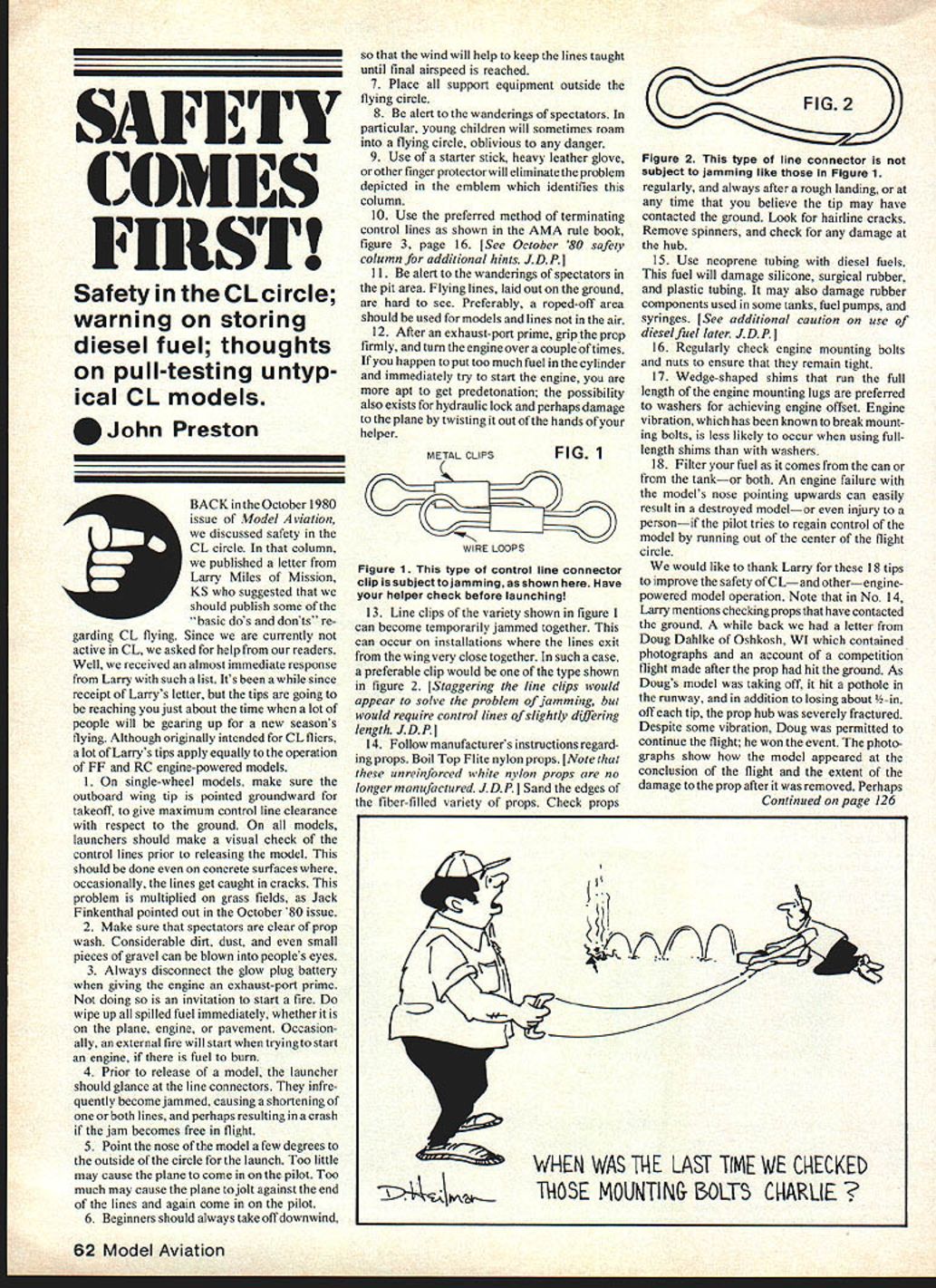
- Before release, the launcher should glance at the line connectors. They can infrequently jam, shortening one or both lines and possibly causing a crash if the jam frees in flight.
- Point the nose of the model a few degrees to the outside of the circle for launch. Too little may send the plane toward the pilot; too much may make it jolt at the end of the lines and again come in on the pilot.
- Beginners should take off downwind so the wind helps keep the lines taut until final airspeed is reached.
- Place all support equipment outside the flying circle.
- Be alert to wandering spectators, especially young children who may roam into the flying circle oblivious to danger.
- Use a starter stick, heavy leather glove, or other finger protector to avoid injury when starting engines by hand.
- Use the preferred method of terminating control lines as shown in the AMA rule book (see figure referenced in the rule book).
- Be alert to wandering spectators in the pit area. Flying lines laid out on the ground are hard to see; preferably use a roped‑off area for models and lines not in the air.
- After an exhaust‑port prime, grip the prop firmly and turn the engine over a couple of times. If the cylinder is over‑primed, immediate starting can cause pre‑detonation or hydraulic lock and may damage the model or twist it out of the hands of your helper.
- Line clips can become temporarily jammed together, especially where the lines exit the wing very close together. Use staggered clips or a clip type that minimizes jamming.
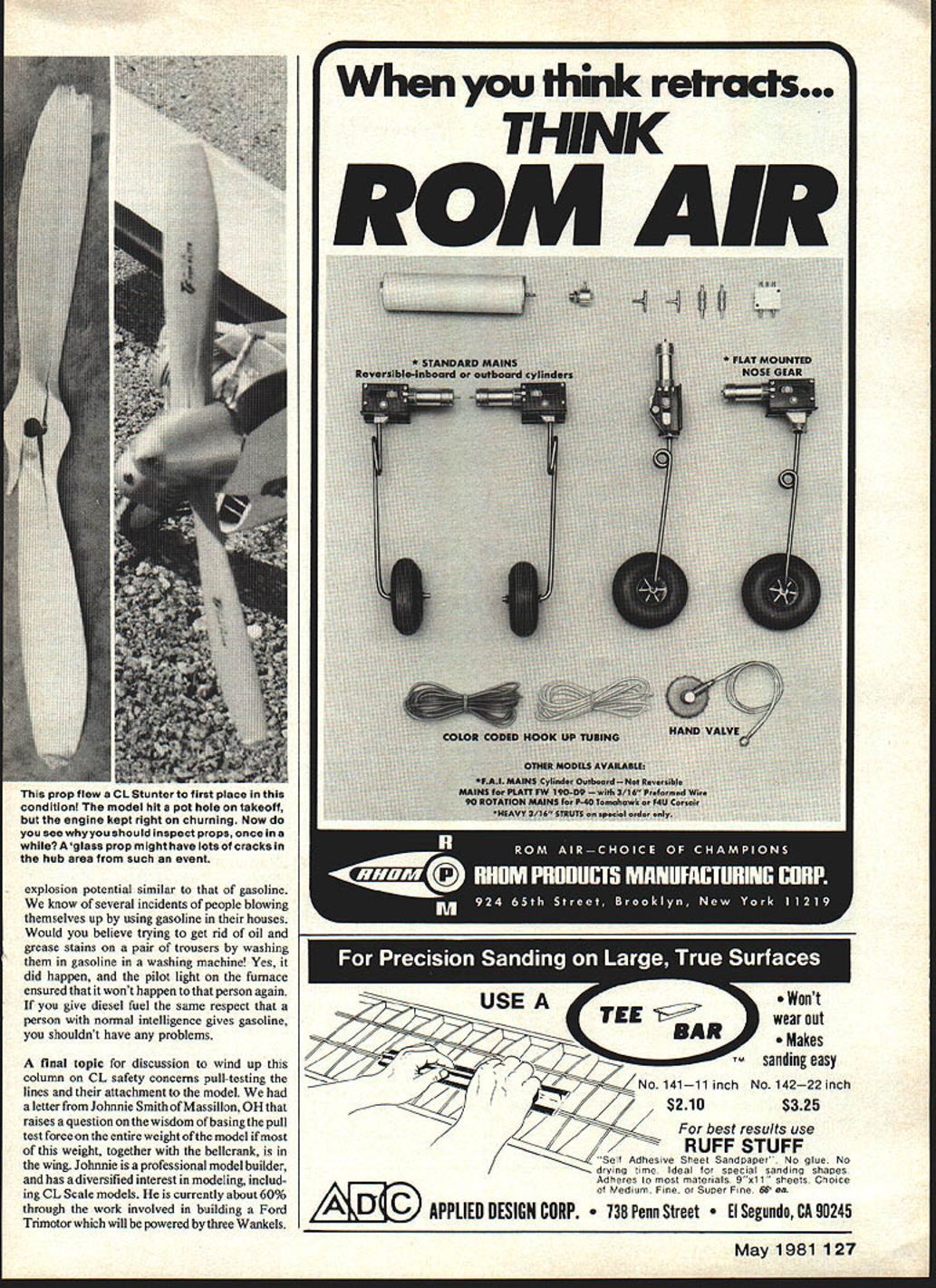
- Follow manufacturers' instructions regarding props. Sand the edges of fiber‑filled props. Check props regularly and always after a rough landing or any suspected tip contact with the ground. Look for hairline cracks, and remove spinners to inspect the hub.
- Use neoprene tubing with diesel fuels. Diesel will damage silicone, surgical rubber, and some plastics and may affect rubber components in tanks, fuel pumps, and syringes.
- Regularly check engine‑mounting bolts and nuts to ensure they remain tight.
- Wedge‑shaped shims that run the full length of the engine‑mounting lugs are preferred over washers for achieving engine offset. Full‑length shims reduce vibration and the risk of broken mounting bolts.
- Filter fuel as it comes from the can or before it reaches the tank. An engine failure with the model's nose pointing upward can result in a destroyed model or injury if the pilot runs out of the center of the flight circle trying to regain control.
Prop damage anecdote and throttle control question
We thank Larry for these tips. A letter from Doug Dahlke of Oshkosh, WI described a competition flight in which a prop that had hit a pothole lost about 1/4 inch from each tip and had a severely fractured hub. Despite vibration, Doug continued and won the event; the photographs showed extreme hub damage. It would have been prudent to terminate the flight immediately after ground contact, but that raises a practical question: can you safely terminate a CL stunter flight immediately if the model lacks throttle control?
Diesel fuel—storage and handling warnings
On the subject of diesel fuel explosion potential: never store diesel fuel in the refrigerator, and we do not recommend storing it anywhere inside the house. Diesel blends containing ether have an extremely low flash point; their vapors are heavier than air and can collect near the floor. In the presence of a spark or flame from household appliances, a dangerous situation could result.
To reduce hazard when using diesels:
- Start engines outdoors whenever possible.
- If you must start indoors, ensure adequate ventilation—open doors or windows and use a fan to remove fumes.
- Use neoprene tubing and inspect rubber components for compatibility.
Starting flooded engines and pull‑starting hazards
Pull‑starting an engine that is full of fuel can cause the prop to kick back violently when the engine fires. If you suspect a heavy prime:
- Protect finger and wrist with suitable guards.
- Do not attempt to clear a flooded engine by spinning it rapidly.
- Instead, open the muffler or remove the glow‑plug battery and allow the engine to clear before restarting.
Spectator control
Accidents often involve observers. Control the flying site and keep observers at a safe distance. A rope line or barrier is a good idea.
Pull‑testing Scale and multi‑engine models
Johnnie Smith of Massillon, OH raised a question about the wisdom of basing the pull‑test force on the entire weight of a model when much of that weight (and the bellcrank) is in the wing. Smith, a professional model builder working on a Ford Trimotor powered by three Wankels, points out that the wing‑engine combination may be 60–70% of total weight while the fuselage is 30–40%. Even though only part of the flight G‑load may be in the wing‑fuselage joint, the pull‑test is determined by the entire weight, so the fuselage attachment must be built to withstand the total pull. This can present design and construction challenges for scale modelers.
I have some thoughts on this subject but, not being an active CL flier, will leave the discussion open to readers. Any CL scale enthusiasts care to comment on realistic pull‑testing procedures for a Ford Trimotor or similar multi‑engine CL models?
Closing
Until next month, think safety, and don't wash your pants in gasoline!
John Preston c/o Model Aviation 815 Fifteenth St., N.W. Washington, DC 20005
SAFE FLYING IS NO ACCIDENT
Transcribed from original scans by AI. Minor OCR errors may remain.

