

Safety Comes First
Happy Fourth of July! As you read this column the long summer days, warm temperatures, and gentle breezes will have returned to most of the country, and many of us will have already visited the flying field a dozen times or so to shake the bugs out of the new creations we built last winter. I hope all is going well with your new craft and/or the old standby, and that the maintenance you did over the winter is paying off.
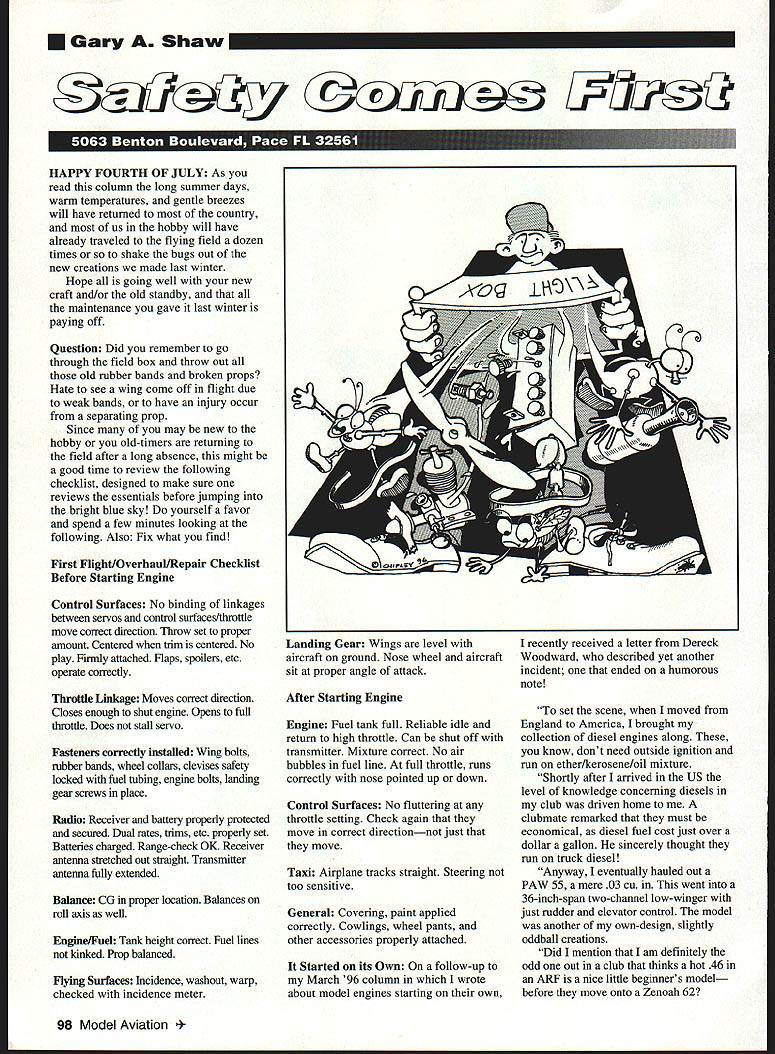
Question: Did you remember to go through the field box and throw out all those old rubber bands and broken props? I hate to see a wing come off in flight due to weak bands, or to have an injury occur from a separating prop.
Since many of you may be new to the hobby, or you old-timers are returning to the field after a long absence, this is a good time to review the following checklist designed to make sure you cover the essentials before jumping into the bright blue sky. Do yourself a favor and spend a few minutes looking over this — and fix what you find!
First Flight / Overhaul / Repair Checklist — Before Starting Engine
- Control Surfaces: No binding of linkages between servos and control surfaces. Throttle moves in the correct direction. Throws set to the proper amount. Surfaces centered when trim is centered. No play; firmly attached. Flaps, spoilers, etc., operate correctly.
- Throttle Linkage: Moves in the correct direction. Closes enough to shut the engine. Opens to full throttle. Does not stall the servo.
- Fasteners: Wing bolts, rubber bands, wheel collars, clevises safety-locked with fuel tubing, engine bolts, and landing gear screws in place.
- Radio: Receiver and battery properly protected and secured. Dual rates, trims, etc., properly set. Batteries charged. Range-check OK. Receiver antenna stretched out straight. Transmitter antenna fully extended.
- Balance: CG in the proper location. Balances on the roll axis as well.
- Engine / Fuel: Tank height correct. Fuel lines not kinked. Prop balanced.
- Flying Surfaces: Incidence, washout, and warp checked with an incidence meter.
After Starting Engine
- Engine: Fuel tank full. Reliable idle and return to high throttle. Can be shut off with the transmitter. Mixture correct. No air bubbles in the fuel line. At full throttle, runs correctly with nose pointed up or down.
- Control Surfaces: No fluttering at any throttle setting. Verify they move in the correct direction — not just that they move.
- Taxi: Airplane tracks straight. Steering not too sensitive.
- General: Covering and paint applied correctly. Cowlings, wheel pants, and other accessories properly attached.
It Started on Its Own
Following up on a March column about model engines starting on their own, I received a letter from Derek Woodward describing another incident that ended humorously but illustrates a real danger.
Derek moved from England to the U.S. and brought his collection of diesel engines. Diesels don’t need outside ignition and run on an ether/kerosene/oil mixture. Soon after arriving, a clubmate remarked that they must be economical because diesel fuel cost just over a dollar a gallon — thinking diesels ran on truck diesel.
Derek eventually mounted a PAW .055 (about .03 cu. in.) in a 36-inch-span, two-channel low-winger (rudder and elevator only), one of his oddball designs. The crowd was amazed that a model weighing under a pound flew so well. He parked it on the bench and wandered off.
A few minutes later he heard the unmistakable purring of his little engine. He turned to find a clubmate — an experienced flier of big, hot ships — holding the model with the engine running. The man had idly flipped the six-inch prop and it lit up on him. Fortunately, he had hold of it; most grown men can tolerate the pull of a six-inch prop at 12,000 rpm without being pulled over. There must have been a little fuel left after the previous flight’s deadstick. Diesels are fuel-thrifty and the engine ran happily for about a minute while everyone laughed.
The point: besides that messing with props is dangerous in any circumstance, stay off props on those “funny” engines that have T-bars where glow plugs should be. Modern diesels can start easily without appearing to have any fuel in the tank — fuel left in the head and crankcase can run a diesel long enough to get the prop up to speed. There’s plenty of chance for fingers or other body parts to get chewed up before it runs out.
Paint Those Tips
Before you get too far out of the workshop doors, look down at the model — new or old — and visually check the prop to ensure you painted the tips. Why? Painted tips make it possible to see the arc of the prop as it whizzes through the air only inches (or less) from your knuckles.
A letter from Roy Lawson highlights this:
"Concerning the painting of propeller tips, I am just a beginner in the hobby and it is pretty obvious to me that the tips ought to be painted so that you can see them. I bought a package of props for use on my Telemaster 40 and after balancing them, immediately painted the tips white. That white circle caused by the spinning propeller makes it look nice too!"
I also received a note from a builder of a quarter-scale Stearman who said he’s considering never flying it because it scares him to stand behind that big airplane during a run-up. He recalled a friend who got the fingertip into a prop on a .120 four-stroke. That accident wasn’t due to unpainted tips but was caused when the strap on his radio accidentally pushed the throttle stick fully forward, lurching the airplane toward him. The prop caught his finger as he tried to grab the airplane; the engine didn’t miss a lick.
Author's note: Once painted, check the prop again for balance to ensure smooth operation.
Emergency Preparedness
If you think too much attention is paid to injuries from props, do this for yourself before you fly again at the field: check to see if your field has a posted emergency plan that can assist people who get injured. If none exists, the club should at minimum list the name and phone number of the local fire department, rescue squad, and/or emergency room that serves your area, and how to access these services.
Understand that not all emergency rooms treat major trauma cases. Know exactly where the help you might need can be obtained.
My hope is that after reading all this you'll realize that a paint can and some masking tape applied to a prop is a much cheaper alternative than trauma-center expenses. Use your head and keep your hands — paint those tips!
Transcribed from original scans by AI. Minor OCR errors may remain.

