
Safety Comes First
Gary A. Shaw
I guess I might be a little off base (OK; some claim more than a little), but I would bet most of you feel there's no better way to spend an afternoon than flying a good-running airplane in nice weather, among the company of good friends.
Having said that, I guess it's safe to say that I just returned from the field with an airplane that didn't work (the engine gremlins). The weather got bad (the weather gremlins), and no modelers I knew showed up. I bet I know what you're thinking—no, I didn't fly alone, and yes, I do have friends to fly with, at least every once in a while!
Getting to the field and finding that things won't work the way they're supposed to seems to be the story of my life these days. In fact, thanks to the failure of a fuel pump on this outing (just an educated guess), a long-awaited flight with my LA-2 Pattern airplane will have to wait until next weekend—again! Jeepers, I thought the silicone used in fuel pumps these days was supposed to last for more than 10 years—not to mention those 20-year batteries that only seem to last for two or three. I'll have to dig out my warranty books to see who I should give this stuff back to—just kidding!
It certainly does seem easier to blame my equipment problems on something other than the real cause—my lack of use and/or maintenance. Maybe next time I should follow my own advice and preflight the airplane before driving to the field! Even better, I could fly the stuff at the field more frequently to keep it in top-notch shape—I'll have to mention that to my wife!
The Hunter
As darkness crept over the flying field, a lone pilot lifted his .60-size craft off the ground to catch one more flight in the cool evening air. Up went the model, climbing quickly into the distance until all that could be seen was a moving silhouette. This took all of about 15 seconds in the available light; I guess maybe my fortyish eyes aren't what they used to be, because once the model became airborne I could barely see it.
I thought that the pilot was having a hard time seeing the model as well, because as soon as he got it off the ground he banked it hard left into a tight circle and brought it back around onto the runway. However, no sooner had the airplane touched down than the engine roared to life and off it went again!
I was amazed; this lad's eyes must have been good, because I could barely see the model. Another tight left circle was again followed by a landing—this time a little closer to the pits. Another takeoff followed by another landing—real close to the pits. The model did one more circuit and made a "final landing" behind the pilot in the pits.
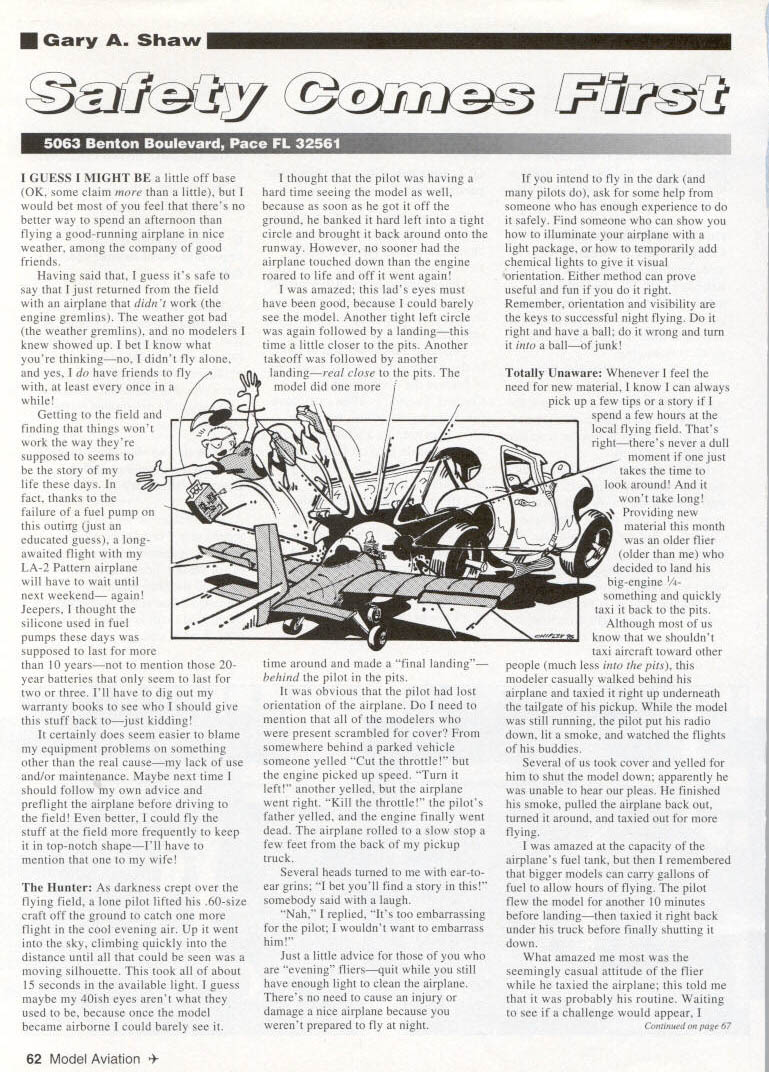
It was obvious that the pilot had lost orientation of the airplane. Do I need to mention that all of the modelers who were present scrambled for cover? From somewhere behind a parked vehicle someone yelled, "Cut the throttle!" but the engine picked up speed. "Turn it left!" another yelled, but the airplane went right. "Kill the throttle!" the pilot's father yelled, and the engine finally went dead. The airplane rolled to a slow stop a few feet from the back of my pickup truck.
Several heads turned to me with ear-to-ear grins. "I bet you'll find a story in this!" somebody said with a laugh.
"Nah," I replied, "it's too embarrassing for the pilot; I wouldn't want to embarrass him!"
Just a little advice for those of you who are evening fliers—quit while you still have enough light to clean the airplane. There's no need to cause an injury or damage a nice airplane because you weren't prepared to fly at night.
If you intend to fly in the dark (and many pilots do), ask for some help from someone who has enough experience to do it safely. Find someone who can show you how to illuminate your airplane with a light package, or how to temporarily add chemical lights to give it visual orientation. Either method can prove useful and fun. Remember, orientation and visibility are the keys to successful night flying. Do it right and have a ball; do it wrong and turn it into a ball—of junk!
Totally Unaware
Whenever I feel the need for new material, I know I can always pick up a few tips or a story if I spend a few hours at the local flying field. That's right—there's never a dull moment if one just takes the time to look around!
Providing new material this month was an older flier (older than me) who decided to land his big-engine model and quickly taxi it back to the pits. Although most of us know that we shouldn't taxi aircraft toward other people, much less into the pits, this modeler casually walked behind his airplane and taxied it right up underneath the tailgate of his pickup while the model was still running. The pilot put his radio down, lit a smoke, and watched the flights. Several of us took cover and yelled for him to shut the model down; apparently he was unable to hear our pleas. He finished his smoke, pulled the airplane back out, turned it around, and taxied out for more flying.
I was amazed at the capacity of the airplane's fuel tank, but then I remembered that bigger models can carry gallons of fuel to allow hours of flying. The pilot flew the model for another 10 minutes before landing—then taxied it right back under his truck before finally shutting it down.
What amazed me most was the seemingly casual attitude of the flier while he taxied the airplane; this told me that it was probably his routine. Waiting to see if a challenge would appear, I stayed put inside my vehicle a few minutes to see if anyone would provide a kind word. Nothing happened—nothing other than the club's safety officer walking over to compliment the pilot on a clean flight and landing. No mention of taxiing into the pits!
Am I missing something here? None of those who scrambled for cover approached the individual to explain the error. Acting as the "bad guy," I walked over and explained the dangers to the seemingly unaware modeler. To my surprise, I believe the modeler was unaware of the danger. In fact, he seemed sincerely thankful that someone had pointed it out. A long conversation about modeling ensued, and I found that I had made a really nice friend! Now I have someone else to fly with when I go to the field. After talking for a while I was invited to fly his machine, and I suddenly found myself refueling the model and getting it ready for another flight—this time, without taxiing under the truck!
I was glad I took the time to meet this person, and I was even happier that he took the light criticism so well. It just goes to show you that it pays to lend a hand to someone who needs it.
Maybe the next time you're at the field and see someone in need you could provide a little help; most modelers seem to appreciate some help while at the field. There are many different skill levels out there, so finding someone who can benefit from your knowledge should be an easy task. If we all dropped our defenses and pitched in to help each other at the field a little more, I dare say our injuries would go down, and our satisfaction with the hobby would go up.
Until next month, keep 'em flying!
Transcribed from original scans by AI. Minor OCR errors may remain.

