
Gary A. Shaw
Safety Comes First
As told to me by longtime modeler and friend Charles Castaing of New Iberia, Louisiana: "Safety should be very high on our list of priorities and should be kept in mind at all times. It seems that most accidents occur when we don't concentrate and/or allow ourselves to be distracted from the task at hand." How true that statement is, especially in our hobby!
Anytime you engage in a hobby that is as dynamic as ours, the opportunity for error and injury goes up. Given all the safety information that is available, one would think that the common modeler would be more immune to error — but we all know that isn't the case. If we were able to measure our risk level the same way companies measure their employees' occupational risk, I believe we would find that modelers would need to possess a certain level of knowledge to safely accomplish the job at hand, and to understand the dangers involved when engaged in complex tasks. The common modeler, like the common employee, needs training to be able to work effectively and safely.
Unfortunately for us, unless organized clubs or those individuals choose to take active training roles, many of us will continue to learn through "trial and error" — costly to individuals and our organizations.
So what's my point? Let's go back to what Charles said at the beginning of this column: "It seems that most accidents occur when we don't concentrate and/or allow ourselves to be distracted from the task at hand." In a nutshell, pay attention to detail and take the time to learn all of the steps necessary to accomplish what you're trying to do. Once you understand all the facets of the project, keep things simple, and do one thing at a time. If you don't understand something, try to get some help. Don't rush that painting job, talk on the telephone while using the table saw, or try to start that 1/4-scale model without helping pay attention to what you're doing! The same goes for flying it, driving it, or floating it once it's completed. Learn what's needed to complete each step of the process before attempting it, then enjoy what the hobby should be all about — having fun!
Oops, Wrong Model!
On the note of having fun, Charles also provided the following story, which describes what can happen to even the most experienced flier when the skies get crowded:
"A new RC flier was flying his model when the engine quit and he called for help. There were five models flying at the time. One of the club's appointed flight instructors ran over for the rescue. He was an experienced and competent flier and had been a flight instructor for several years. He took the transmitter from the panic-stricken beginner and proceeded to land the airplane. He remarked to the beginner, 'How's this for a smooth landing?' as he proudly watched the model make a perfect landing. To which the beginner said, 'That's not my airplane!'
"Because there were many models in the air at one time, the instructor focused on the wrong model (a look-alike). The errant model was subsequently located after a search and suffered only moderate damage. Needless to say, the ego of the flight instructor was much more severely damaged."
The moral of the story: stay on the ground until the sky is sufficiently clear of hazards (i.e., "models"). Being able to distinguish your model from others is necessary, unless you have very deep pockets! When you're taking over for someone in an emergency, be sure to move the sticks around a bit to ensure that you're flying the right airplane. This helps determine that you have positive control.
We often fly with a model rather than flying the model to a desired point in the sky. If you don't feel comfortable "commanding" the model, take a back seat to being an instructor until you've mastered flying. Take a tip from Charles: concentrate on what you're doing, and then concentrate some more!
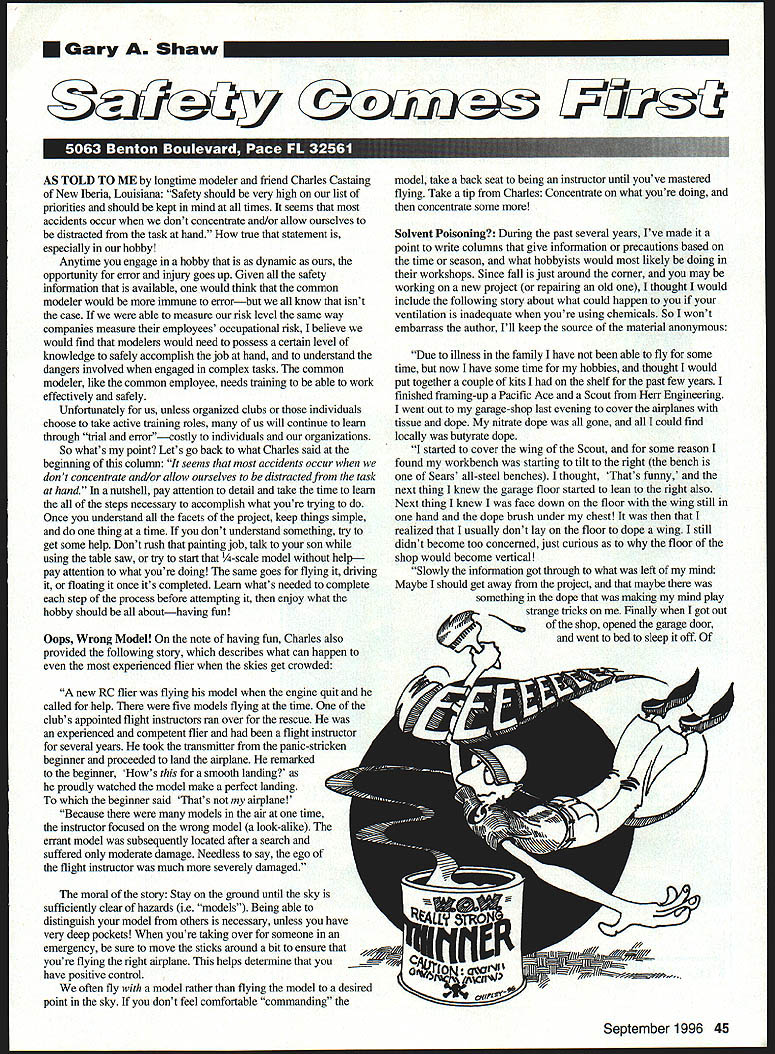
Solvent Poisoning?
During the past several years, I've made it a point to write columns that give information or precautions based on the time or season, and what hobbyists would most likely be doing in their workshops. Since fall is just around the corner, and you may be working on a new project (or repairing an old one), I thought I would include the following story about what could happen to you if your ventilation is inadequate when you're using chemicals. So I won't embarrass the author, I'll keep the source of the material anonymous:
"Due to illness in the family I have not been able to fly for some time, but now I have some time for my hobbies, and thought I would put together a couple of kits I had on the shelf for the past few years. I finished framing-up a Pacific Ace and a Scout from Herr Engineering. I went out to my garage-shop last evening to cover the airplanes with tissue and dope. My nitrate dope was gone and all I could find locally was butyrate dope. I started to cover the wing of the Scout, and for some reason I found my workbench starting to tilt to the right (the bench is one of Sears' all-steel benches). I thought, 'That's funny,' and the next thing I knew the garage floor started to lean to the right also. Next thing I knew I was face down on the floor with the wing still in one hand and the dope brush under my chest! It was then that I realized that I usually don't lay on the floor to do a wing. I still didn't become too concerned, just curious as to why the floor of the shop would become vertical!
"Slowly the information got through to what was left of my mind: maybe I should get away from the project, and that maybe there was something in the dope that was making my mind play strange tricks on me. Finally when I got out of the shop, opened the garage door, and went to bed I slept it off."
Of course, the next day when I saw the wing with all the wrinkles, bags, and crushed ribs, I knew I was the victim of solvent poisoning.
"I know better than to fool with solvents in an enclosed area, since I supervised several laboratories during my working career. Also, I've used solvents and resins for my other hobby: building full-sized boats. I've always used gloves, barrier creams, dust masks, etc., and worked either outside or had the garage door open and a big fan going. I figured a couple of little airplanes didn't need all these precautions; besides, it's hard to handle the tissue with the fans going.
"Since I'm now living alone, it gave me quite a fright. When my mind cleared up I could visualize everybody wondering whatever became of me—until my body was found clutching a half-doped wing. Although our projects are rather small in size, the dangers include more than spinning props and runaway Giant Scale planes. Even a 30-inch wing for a rubber-band job can jump up and bite you unless you think and are aware of what you are doing."
Kill-Switch Setups
With the advent of computer radios, it has become very popular and very easy to assign functions to switches with the touch of a menu button. With such electronic capabilities built into radios nowadays, it's easy to assign the rudder function to the retract switch, or the elevator to the throttle stick, or the ailerons to the throttle knob, etc. The possibilities are limited only by your imagination.
Although this capability is desirable for setting up and flying today's bigger and more complex aircraft (which have many functions), at least one simple rule regarding how to assign kill-switch functions ought to be considered. Having learned his lesson on this subject firsthand, I thought I'd provide a tip from Wayne Madsen of Woodland Hills, Utah:
"It was a beautiful day and things were going great. Then the muffler on my 1/4-scale fell off as I was preparing to land. A couple of fly-bys showed everything else seemed to be in order except that at idle, now much faster, the airplane was trying to fly too fast to land comfortably on our runway. So I decided to kill the engine and glide it in the next time around. Good plan — it worked nicely.
"The airplane was lined up about three feet above the runway's centerline when I reached up to activate the kill switch. That's when my airplane hit the runway at a rather sharp angle (crashed). Why did this happen? It happened because the trainer lever got in the way! I hit the trainer lever instead of the kill switch! Should fast approaches occur in the future, everything will go as planned (I think). How can I plan on landing safely? Simply because I will kill the engine by pushing the switch lever away rather than pulling it toward me."
Sounds like good advice to me! If anyone else has suggestions regarding safety and switch setups, I'd appreciate some mail on the subject. Until next month, have a good time flying—but do it with care!
Transcribed from original scans by AI. Minor OCR errors may remain.

