
Safety Comes First
By Gary A. Shaw
Address
5063 Benton Boulevard, Pace FL 32561
Hurricane season and safety
As I write this column it's early July and the first storm of the hurricane season is churning its way through the Caribbean on what appears to be a direct course for the United States. Jumping out of the gate this year is Bertha, whose 90-mph winds and rain (the Weather Channel says so) are currently ravaging the U.S. Virgin Islands and Puerto Rico.
Having experienced several direct hits from hurricanes in recent years, it's safe to say that those who live in coastal states are following this particular storm's direction with interest. I know I am!
Are you wondering just where the storms will go? Rest assured that no matter where they go, those affected can always count on two things: wind and rain. Since I've encountered several of these drenchers first-hand in recent years, I believe I can say with authority that no other event in the world has the potential to rain out a flying day like a hurricane! (Okay, for the sake of argument, I'd say a typhoon probably qualifies as a hurricane's only adversary.) Any meteorologists out there who can tell me I'm all wet?
So what does a hurricane have to do with model safety, you ask? For starters, I'd say you're slightly touched if you'd like to fly in storms. Refer to Benjamin Franklin if you need your memory jogged!
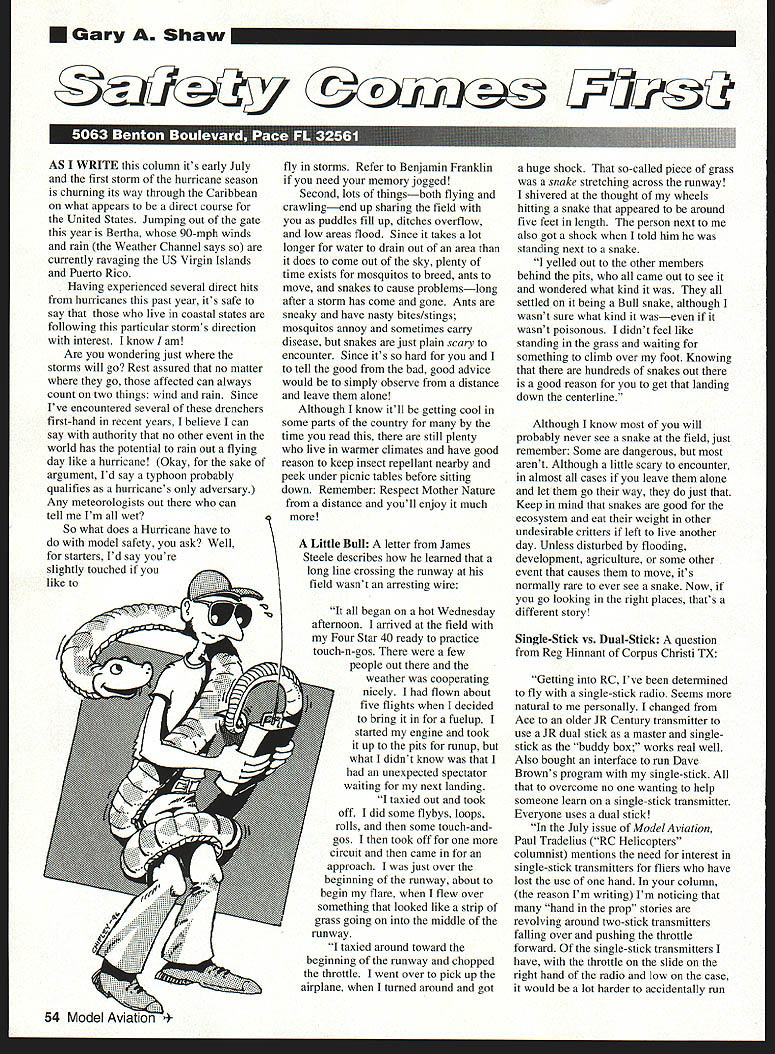
Second, lots of things—both flying and crawling—end up sharing the field with you as puddles fill up, ditches overflow and low areas flood. Since it takes a lot longer for water to drain out of an area than it does to come out of the sky, plenty of time exists for mosquitoes to breed, ants to move, and snakes to cause problems—long after a storm has come and gone. Ants are sneaky and have nasty bites/stings; mosquitoes annoy and sometimes carry disease; snakes are just plain scary to encounter. Since it's so hard for you and me to tell the good from the bad, good advice would be to simply observe from a distance and leave them alone!
Although I know it'll be getting cool in some parts of the country for many by the time you read this, plenty of folks live in warmer climates and have good reason to keep insect repellent nearby and peek under picnic tables before sitting down. Remember: respect Mother Nature from a distance and you'll enjoy it much more.
Wildlife at the field — a cautionary tale ("A Little Bull")
A letter from James Steele describes how he learned that a long line crossing the runway at his field wasn't an arresting wire:
"It all began on a hot Wednesday afternoon. I arrived at the field with my Four Star 40 ready to practice touch-and-gos. There were a few people out there and the weather was cooperating nicely. I had flown about five flights when I decided to bring it in for a fuel-up. I started my engine and took it up to the pits for run-up, but what I didn't know was that I had an unexpected spectator waiting for my next landing.
"I taxied out and took off. I did some flybys, loops, rolls, and then some touch-and-gos. I then took off for one more circuit and then came in for an approach. I was just over the beginning of the runway, about to begin my flare, when I flew over something that looked like a strip of grass going on into the middle of the runway.
"I taxied around toward the beginning of the runway and chopped the throttle. I went over to pick up the airplane, when I turned around and got a huge shock. That so-called piece of grass was a snake stretching across the runway!" He shivered at the thought of his wheels hitting a snake that appeared to be around five feet in length. The person next to him also got a shock when he told him he was standing next to a snake.
"I yelled out to the other members behind the pits, who all came out to see it and wondered what kind it was. They all settled on it being a bull snake, although I wasn't sure what kind it was—even if it wasn't poisonous. I didn't feel like standing in the grass and waiting for something to climb over my foot. Knowing that there are hundreds of snakes out there is a good reason for you to get that landing down the centerline."
Although most of you will probably never see a snake at the field, remember: some are dangerous, but most aren't. In almost all cases, if you leave them alone they will move away. Snakes are good for the ecosystem and eat their weight in other undesirable critters if left to live another day. Unless disturbed by flooding, development, agriculture, or some other event that causes them to move, it's normally rare to ever see a snake. Now, if you go looking in the right places, that's a different story!
Single-stick vs. dual-stick transmitters
A question from Reg Hinnant of Corpus Christi, TX:
"Getting into RC, I've been determined to fly with a single-stick radio. Seems more natural to me personally. I changed from Ace to an older JR Century transmitter to use a JR dual stick as a master and single-stick as the 'buddy box'; works real well. Also bought an interface to run Dave Brown's program with my single-stick. All that to overcome no one wanting to help someone learn on a single-stick transmitter. Everyone uses a dual stick!
"In the July issue of Model Aviation, Paul Tradelius ('RC Helicopters' columnist) mentions the need for interest in single-stick transmitters for fliers who have lost the use of one hand. In your column (the reason I'm writing) I'm noticing that many 'hand in the prop' stories are revolving around two-stick transmitters falling over and pushing the throttle forward. Of the single-stick transmitters I have, with the throttle on the slide on the right hand of the radio and low on the case, it would be a lot harder to accidentally run the throttle up. I know this suggestion won't convert any dual-stickers, but it's a design layout I feel is a lot safer."
Reg is right when he says the majority of us primarily use dual-stick transmitters, although past conversations with Tony Stillman at Radio South in Pensacola, Florida revealed that a few more are converting for one reason or another. Although I've never used a single-stick myself, I'd have to agree that if a single-stick transmitter had been used by modelers injured when their "duals" tipped over (prop went to full speed), I probably wouldn't have received any writing material. (Don't worry, I have plenty left to write about without the use of "hand in the prop" stories.)
Regarding someone who's set up to do some training with a single-stick, it sounds like Reg is ready to become the club expert. I hope he lets me know if it catches on in his area; I would agree that the use of singles would eliminate the throttle hazard.
In the past I've received mail with recommendations to attach a rubber band to the throttle stick so it will "spring" back to off and prevent an injury.
One problem with this method is that the band would have to be strong enough to overcome the transmitter falling on its face and advancing the throttle. I'm sure the stick could be rigged to retract itself, but it would most likely be restrictive or difficult to use while flying.
For now, the easy things to do are:
- Put the radio in the impound area when not in use.
- Lay the radio down flat while starting or running the engine in the pits.
In the meantime, I'm anxious to hear from some of you who use single-stick transmitters and the reasons why you do. Are there any advantages you can point out to those of us less experienced?
Closing
Well, that's it for this month. Wishing you happy and safe flying. P.S.: Keep an eye out for critters!
Transcribed from original scans by AI. Minor OCR errors may remain.

