
Gary A. Shaw
Box 33094, Pensacola FL 32508-3094
Safety Comes First
ARFs — Blessings or Burdens?
With summer days behind us and winter months lurking just around the corner, it's the time of year when many of us decide to return to old projects, pick out something new, or begin construction on the dream machine that's been hiding in the closet for the past few seasons. Whether it's a jet, a helicopter, a quarter-scale model, or a glider, the choices have become so varied that even making up your mind can be difficult.
If you're like me and enjoy flipping through model magazines to pass the time, you'll no doubt have noticed the trend toward advertising ARF (Almost Ready to Fly) or RTF (Ready to Fly) aircraft. They're attractive aircraft that seem to fit the bill for many modelers, for a number of reasons — they're easy to build, especially if you have a lack of building knowledge, space, time, or tools. As for my project this winter, I fall into the limited-building-time category, which had me seriously considering an ARF — until I read a letter from veteran flier Art Grabow of Everett, Washington:
"The current trend in our hobby is shifting more and more toward prebuilt airplanes, commonly known as 'ARFs.' I have no problem with this. As a matter of fact, I have even recommended a few to new people coming into the sport. The reason I have done this is because very little time is spent putting them together. Nothing will discourage somebody quicker than spending a lot of time building, and then seeing their creation 're-kit' itself."
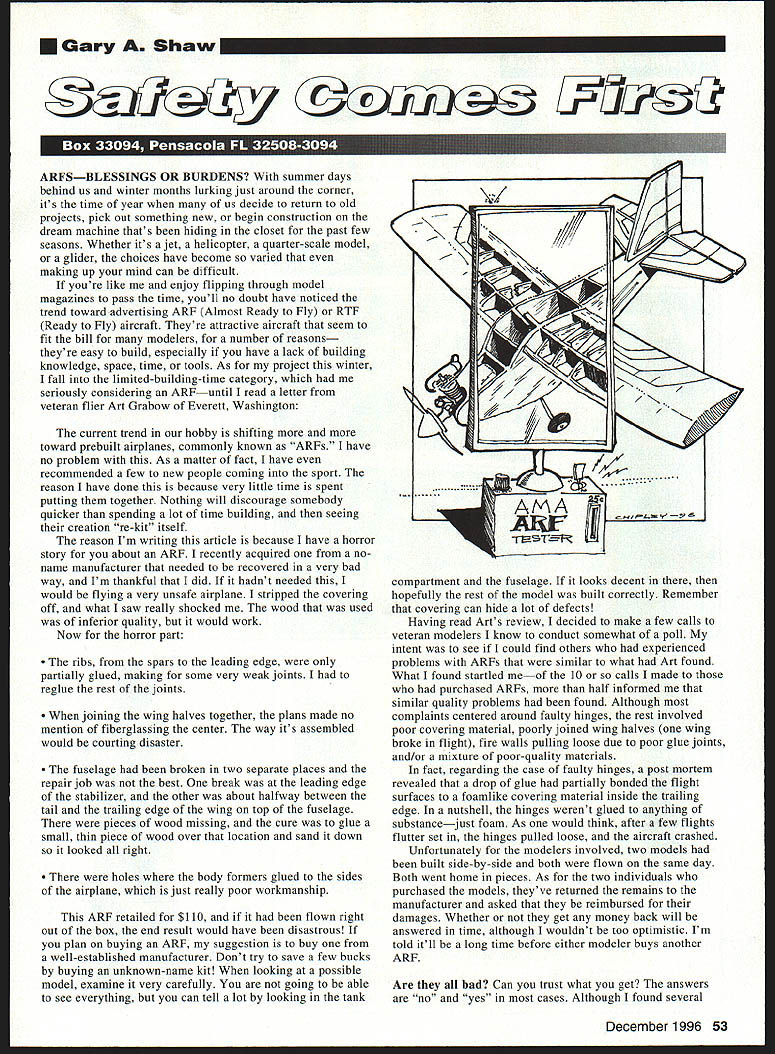
The reason I'm writing this article is because I have a horror story for you about an ARF. I recently acquired one from a no-name manufacturer that needed to be recovered in a very bad way, and I'm thankful that I did. If it hadn't needed this, I would be flying a very unsafe airplane. I stripped the covering off, and what I saw really shocked me. The wood that was used was of inferior quality, but it would work.
Now for the horror part:
- The ribs, from the spars to the leading edge, were only partially glued, making for some very weak joints. I had to reglue the rest of the joints.
- When joining the wing halves together, the plans made no mention of fiberglassing the center. The way it's assembled would be courting disaster.
- The fuselage had been broken in two separate places and the repair job was not the best. One break was at the leading edge of the stabilizer, and the other was about halfway between the tail and the trailing edge of the wing on top of the fuselage. There were pieces of wood missing, and the cure was to glue a small, thin piece of wood over that location and sand it down so it looked all right.
- There were holes where the body formers glued to the sides of the airplane, which is just really poor workmanship.
This ARF retailed for $110, and if it had been flown right out of the box, the end result would have been disastrous. If you plan on buying an ARF, my suggestion is to buy one from a well-established manufacturer. Don't try to save a few bucks by buying an unknown-name kit. When looking at a possible model, examine it very carefully. You are not going to be able to see everything, but you can tell a lot by looking in the tank compartment and the fuselage. If it looks decent in there, then hopefully the rest of the model was built correctly. Remember that covering can hide a lot of defects.
Having read Art's review, I decided to make a few calls to veteran modelers I know to conduct somewhat of a poll. My intent was to see if I could find others who had experienced problems with ARFs that were similar to what Art found. What I found startled me — of the 10 or so calls I made to those who had purchased ARFs, more than half informed me that similar quality problems had been found. Although most complaints centered around faulty hinges, the rest involved poor covering material, poorly joined wing halves (one wing broke in flight), firewalls pulling loose due to poor glue joints, and a mixture of poor-quality materials.
In fact, regarding the case of faulty hinges, a post mortem revealed that a drop of glue had partially bonded the flight surfaces to a foam-like covering material inside the trailing edge. In a nutshell, the hinges weren't glued to anything but a substance — just foam. As one would think, after a few flights flutter set in, the hinges pulled loose, and the aircraft crashed.
Unfortunately for the modelers involved, two models had been built side-by-side and both were flown on the same day. Both went home in pieces. As two individuals purchased models, they've returned the remains to the manufacturer and asked that they be reimbursed for their damages. Whether or not they get any money back will be answered in time, although I wouldn't be too optimistic. I'm told it'll be a long time before either of the other modelers buys another ARF.
Are they all bad? Can you trust what you get? The answers are "no" (they're not all bad) and "yes" (you can generally trust them) in most cases. Although I found several who had encountered poor quality, I think it's fair to mention that the majority of those I spoke with avoided headaches because they thoroughly checked the airframe before purchase and before flying. They tugged on hinges and examined construction. Although several had to make corrections before flying, they took the time to check out the work and avoid some of the pitfalls. It's still true that you get what you pay for, and if a deal seems too good to be true — it probably is. Pessimism or reality, I'll be the judge.
Art raised another good point in his letter in that he suggested that maybe the AMA would like to consider developing a way to review ARFs for quality control with the hopes that quality and safety issues could be improved. Although I support his suggestion, there's no doubt that it would be a monumental undertaking. Perhaps the AMA Safety Committee should review the issue in an effort to help prevent and/or curb substandard manufacturing in this area. One possible scenario could involve voluntary ARF submission from the manufacturers for AMA review. The model could obtain a "sticker-type" endorsement if it was deemed airworthy.
As for me, if I decide to buy one of the new ARFs, you can bet I'll do an airworthiness check before I launch it. Until then, I'll stick to built-up kits that offer both the challenge I'm looking for, as well as the satisfaction of knowing that I did it myself — and hopefully the right way.
Until next month — happy shopping, and keep the batteries charging!
Transcribed from original scans by AI. Minor OCR errors may remain.

