
Safety Comes First!
Extreme danger! Is the model's fuel tank really empty after you finish flying? Do you have a "kill-switch" on your magneto-ignition or 1/4-scale engine? Diesels can start on the first flip!
A personal reminder
It really pains me to write this month's column. Since I never took a typing course in school, I rely on my forefingers to bang on the keys. Unfortunately, my right forefinger contains two holes — one on the top where the drill went in, and one on the bottom where the drill came out. Fortunately it was only a 5/64‑in. diameter drill and it missed the bone.
How did it happen? By my own carelessness while trying to drill a hole through a steel strip to be used as a scale tailwheel leaf spring on a Monocoupe 90A. We open with this misfortune to show you that I am no holier-than-thou. Next time I will use a vise to hold the part being drilled.
Engines that start when you don't expect them
Most U.S. modelers use glow-plug motors. These engines normally require the application of battery power to the glow plug before they can be started. Most of the time that's true, although there are tales of glow engines starting without an applied battery. Spontaneous starting can also occur when the mixture is present and the piston is just over top center.
My main concern is the rise in popularity of magneto-ignition engines and diesels. The following correspondence highlights the hazards.
Chainsaw-type engine accident
One correspondent sent details of a serious accident with a chainsaw-type engine (a Byron Pitts with an on-board starter):
One member had run the engine the week before and believed it was out of fuel. The Pitts was on the basement floor and the owner wanted to demonstrate the on-board starter to a friend. His two boys, ages five and seven, were also in the basement. Although the Pitts had an ignition switch, it was not checked to be in the OFF position.
The owner cranked the starter to demonstrate, the five-year-old walked toward the plane, and cranking was stopped. The son was cautioned to get away; he moved backward but remained in front of the aircraft, not noticeable to his father. Cranking resumed, the engine started at half-throttle or higher, and the aircraft leaped forward, struck a water tank and the five-year-old, cutting off a small finger on his left hand.
A visiting specialist at the local hospital reattached the finger. At this time the boy can move the finger, so it looks good for the future.
This story highlights the respect anyone operating chainsaw-type engines should give to these power plants. Treat them as you would a full-scale aircraft engine. Consider a checklist or at least a standardized safety routine before turning over the engine.
A similar incident happened to a friend while discussing a newly completed Giant Scale model. The model used an engine from a chainsaw that had not been fitted with a magneto kill switch. The fuel tank was believed empty and the throttle was at least partially open. The radio was not turned on. During conversation the prop was flipped and the motor sprang to life. Fortunately he arrested the model before it caused injury, but the only way to stop the motor was by radio — and the correct transmitter had to be located and switched on. No injury resulted, but a more tragic ending was possible.
We firmly believe all users of such power plants should equip them with an ignition switch — both one mounted on the model and one operable by the radio transmitter. Better safe than sorry.
Diesels — don't underestimate them
Diesel engines are enjoying increased popularity, partly due to successful diesel-head conversions for glow engines. Before coming to the U.S. in 1962 I had never owned a glow-plug engine; all my power models used diesels. Diesels have always been popular in Europe for small engines. Many U.S. modelers think diesels are hard to start — true only if you don't know what you're doing. Given the right mixture and compression, diesels can start on the first flip.
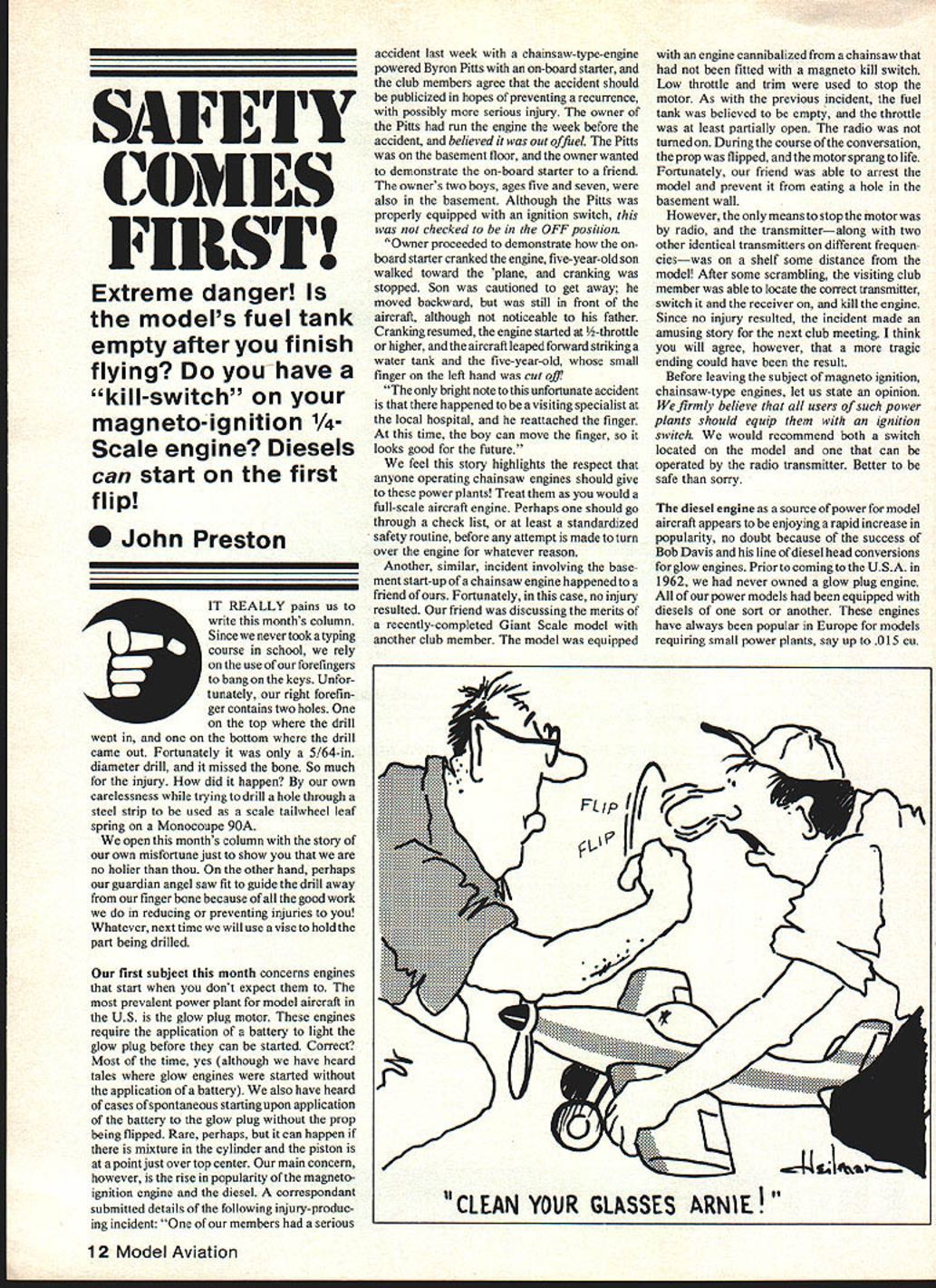
Ken Asman of Willits, CA, learned this the hard way. After hastily ending a control-line flight because of a thunderstorm, Ken returned to the shop with the airplane cleaned up and ready to hang in its rack. Realizing the fuel hadn't run out of the tank, he carried it to the shed, put it on the ground and flipped the prop. The Webra (.09 Rekord) roared to life, startling him so he lost his hold on the plane and had his right wrist badly nipped before the engine stopped.
Ken wrote: "Whoever heard of a cold diesel starting on the first flip? Not I, but I can assure you that from now on the diesel will be treated exactly like a loaded pistol. Fuel + compression = combustion. Even a trace of fuel in the cylinder or crankcase can produce a terrific burst of power if someone carelessly pulls the engine through."
Another letter from Jerry Farr of Abilene, TX, recounts a similar scare where he held on to the model but ended up with a house full of diesel fumes. A good practice is always to let the tank run dry after operating a diesel (and this is good practice for all engine types).
Vision, glasses, and other hazards
Jerry also noted hazards that those of us who wear eyeglasses face:
- Keep a clean rag handy to wipe glasses if you get fuel or grime on them — dirty glasses dim vision a lot.
- A wasp landing on a pilot's glasses can cause a crash if the pilot reacts or loses sight briefly.
- Smoking can be a problem: cigarette smoke getting under glasses can blind you long enough to cause a dinged airplane.
Drinking and flying
A final topic Jerry raised was drinking alcoholic beverages while flying model aircraft. Many clubs prohibit drinking at the field; others ignore it. Drinking impairs reflexes. I doubt any of us would want to be around someone who is legally drunk at the flight line. How do you differentiate between legally drunk and slightly impaired without a breathalyzer? The answer is simple: don't drink while you fly. If an accident occurs, you will never know if it could have been avoided by staying sober.
If it could have been avoided — had you not had that cool, refreshing one prior to takeoff — the regret will be lasting. The FAA has strict rules about drinking and flying full-scale aircraft; shouldn't we exercise the same caution for models?
AMA Safety Committee
I was pleased to learn the AMA Executive Council approved the formation of a Safety Committee at its January 31 meeting. I have been asked to be a member of this committee and have accepted. Others representing different facets of the hobby have also been asked, and I will mention names when acceptances are known. Most mail on the subject has favored the idea.
One letter objected, asserting a committee might generate unenforceable regulations and raise product prices without improving safety. The letter suggested an AMA committee devoted solely to education might be more useful. I agree education should be a goal, but not the committee's sole aim.
Show Team members were upset by what they believed was hasty action in banning pyrotechnics at model airshows. That ban has been replaced by operating guidelines on pyrotechnics. Issues like this are the type the Safety Committee should handle. An Air Show team member has been asked to sit on the committee.
FAI Pylon Racing — helmet requirements
Another issue for the Safety Committee: new rules for FAI Pylon Racing (class F3D). The rules reportedly require course officials and competitors to wear a crash helmet with a chin strap capable of withstanding the impact of a flying pylon model.
I am not suggesting the committee conduct live-impact helmet tests on volunteers. Rather, the committee should develop a workable interpretation of the requirement. Numerous helmet safety standards exist; the committee should determine which standards best meet the spirit of the FAI rule. Whether helmets approved under those standards must be worn at U.S. events also needs resolution. Any comments are welcome.
Recommendations (summary)
- Treat chainsaw-type and magneto-ignition engines like full-scale aircraft engines; use a checklist or standardized safety routine.
- Equip such engines with an ignition switch on the model and a radio-operable kill switch.
- Treat diesels with extreme caution — even a trace of fuel plus compression can cause immediate combustion.
- Let fuel tanks run dry after operating a diesel (good practice for any engine).
- Keep glasses clean and be mindful of visual hazards (insects, smoke).
- Don't drink while you fly.
Till next month, have a safe one.
John Preston c/o Model Aviation 515 Fifteenth St., N.W. Washington, DC 20005
Transcribed from original scans by AI. Minor OCR errors may remain.

