
Safety Comes First
P.O. Box 33094, Pensacola FL 32508-3094
Gary A. Shaw
John Kimsey forwarded a safety alert via the Internet: "Do not fill gas cans in pickup trucks with bed liners." Chevron USA has reported several instances of metal cans exploding at service stations, resulting in at least 23 injuries or deaths. A warning in Chevron's Marketing Bulletin 36-1904 stated that the insulating effect of the trucks' plastic liners prevents grounding of the static charge that is generated by gasoline flowing into a metal can. As the charge builds, it can create a static spark between the can and the gas nozzle that could result in an explosion or fire.
Although it has been suggested that placing a rubber mat under the can while it is in the pickup bed may eliminate the danger, this is not a recommended safety precaution; there is at least one report that it is ineffective. Chevron advises that cans be filled on the ground, away from vehicles and people.
Invisible Propellers
By the time you read this, the flying season should be underway throughout much of the country, and many winter building projects will be headed for the field. Before you get too far out of the workshop doors, look at the model, new or old, and check to ensure that you painted the prop tips. What else will allow you to see the arc of the prop as it whizzes through the air only inches (or less) from your precious knuckles? It's surprising how many people overlook this important safety requirement before starting the engine.
Batteries and Dual Rates
I've used stories to illustrate what happens to receivers/transmitters when batteries run down and/or dual-rate switches are improperly set—sometimes ugly and/or unsafe events. Since it's spring, and time to fly, the following from Mark Farrow of Bay of Quinte Aeromodellers, Belleville, Ontario, Canada, might be of interest:
"A flier on the flightline cried out, 'I lost my plane!' We all agreed, as no one could locate it against the white clouds. He pushed down his antenna and returned his Tx (transmitter) to the impound. Ten minutes later, a small plane returned over the field. As no one was on the flightline, we assumed it must be the one that flew away. The fellow grabbed his Tx, turned it on, and landed his long-lost plane. Must have got homesick. Moral: Check the condition of your batteries regularly!
"A pattern model that was doing a huge loop came over the top, and went straight in wide open about 500 feet away. The explosion literally shook the ground in the pits, and the engine had to be pried out of the hard ground—cause unknown. Two weeks later, the same fellow flew his backup plane down the field. On a level pass, the plane suddenly headed earthward and plowed a swath in the hay field, with parts all over the place. Cause? The dual rates (crash switches, as some label them) were set for zero throw. Moral: Conduct a preflight of plane and equipment each time you set up!"
Get Ready for the Season
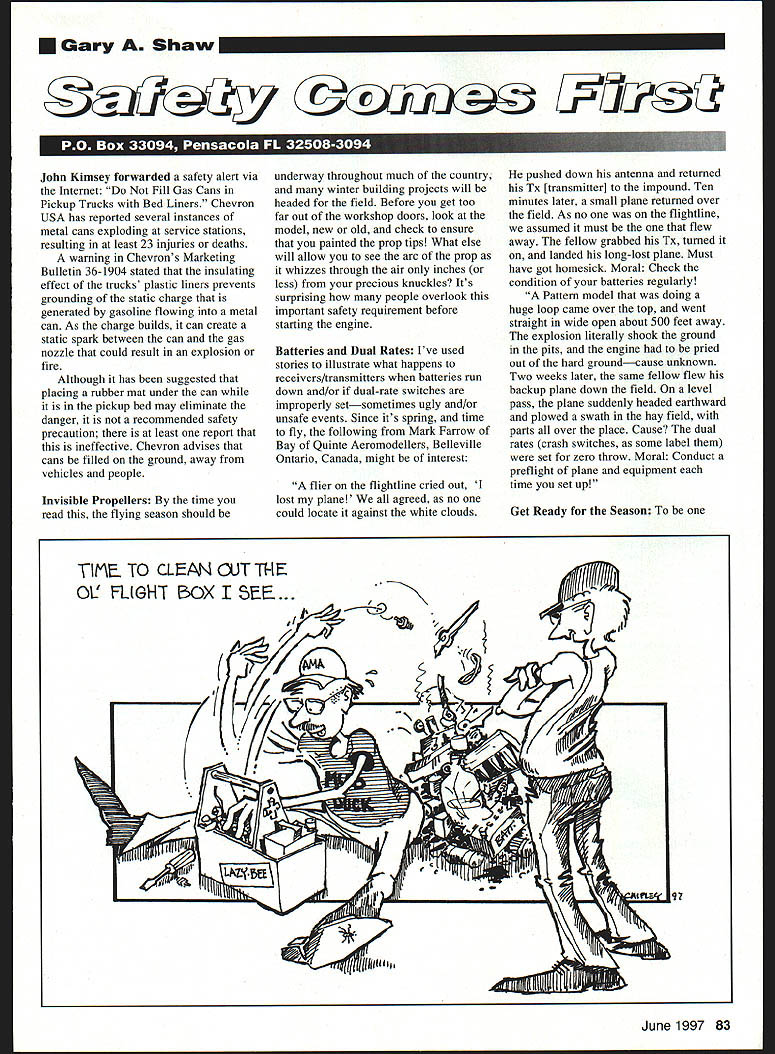
To be one step ahead of the other guy in the spring, and ready to go when the first good ol' days of summer arrive, why not do a general cleanup? Throw out all those broken props, fried plugs, and rubber bands from 1990. When you are wiping off those ancient layers of grass, oil, and dirt, do not forget to carefully check the wires supplying power to all those reliable electrical components you've had for so many years. Are they frayed, broken, or cracked?
The fuel and electricity are okay together in your field box as long as nothing gets the opportunity to turn it into a boom box—just a few fumes and a spark and look out! Check it out to prevent a possible mishap.
Will You Replace It?
If you are involved in modeling for a while, you are bound to hear about (or see) things happening that could have easily been prevented. One of the most irritating and potentially dangerous blunders happens when someone at a flying field turns on a transmitter before retrieving the frequency pin. Forwarded to me recently was an article by Darrell Stebbins of the Barons Model Club, Spokane, WA, that highlights the issue:
"You are all aware that it takes a lot of time and effort to build an RC aircraft—even one of the simple trainers. It takes a lot of money and some effort to get the ready-built ARFs ready to fly. And to build a precision scale model or a competition aerobatics aircraft, now we're talking lots of bucks and almost untold time and effort; so you should also be aware that if you stupidly turn on your transmitter without having the field frequency clip attached to your antenna when any of these airplanes are in the air, and you cause that airplane to crash, you are obligated to replace that aircraft. Why on earth should the pilot of the airborne airplane with the frequency clip on his transmitter antenna not expect you to compensate him for your stupidity?
"This is a big-time mistake, and you know better. You've certainly had it explained to you. You have cost an innocent victim a lot of time and money, as well as possibly cutting his whole flying season off.
"If he wants you to rebuild the airplane, do it. If he wants you to replace a damaged engine, do it. If he will need a new radio, get it for him. Put yourself in your victim's place. Would you smile sweetly and say, 'Oh, that's all right. I've got lots of money and time, so it really doesn't make any difference'?
"This is serious stuff. When you want to turn on your radio at the field, get the clip! If it is in use, wait for it. And if you try to fly without securing the clip and having it on your antenna, you will have no recourse if the guy who does have it turns on his transmitter.
"When you arrive at the field, place your transmitters in the transmitter rack. Don't take them out again without having the frequency clip. When your flight is over, check to make sure your transmitter is turned off. Place it back in the transmitter rack and return the frequency clip to the frequency board. If you are adjusting your engine or doing a range check, make sure you have the frequency clip. When you leave for the day, make sure you leave the clip at the field."
That gets the point across. I'll leave you with a piece of advice and a bit of humor: Always be considerate and patient with a beginner pilot who comes to the flying field with a trainer. Someday he'll be a reckless, egotistical pilot—just like you.
Transcribed from original scans by AI. Minor OCR errors may remain.

