
Gary A. Shaw
Box 33094, Pensacola FL 32508-3094
Safety Comes First
THE WEATHER'S PERFECT in Florida as I write this in early May, and many clubs are taking advantage of cool temperatures by conducting scheduled and unscheduled events throughout the state; I had an opportunity to judge Pattern events during a contest at Pensacola. There's nothing like sharp pilots demonstrating what Precision Aerobatic flying is all about: grace, power, beauty, agility, and money were a few thoughts traveling through my brain as I watched several contestants. What a graceful sport! With all of the high-tech equipment, not much is left to chance—just to skill!
Jason Shulman took first place in Federation Aeronautique Internationale (FAI) class. Jason's one of the most talented and safe young fliers I've seen in years, and, in my opinion, what makes him safe is practice! If you ever get the opportunity to observe him, sit back and enjoy! Nothing compares to watching a Jekyll do a very slow rolling circle about three feet off the deck!
During the rest of the event, I got nothing more than sunburn and a case of four-alarm heartburn after sitting in the sun for three hours, drinking Coke™ and eating Polish sausages. Maybe there's a safety lesson to be learned.
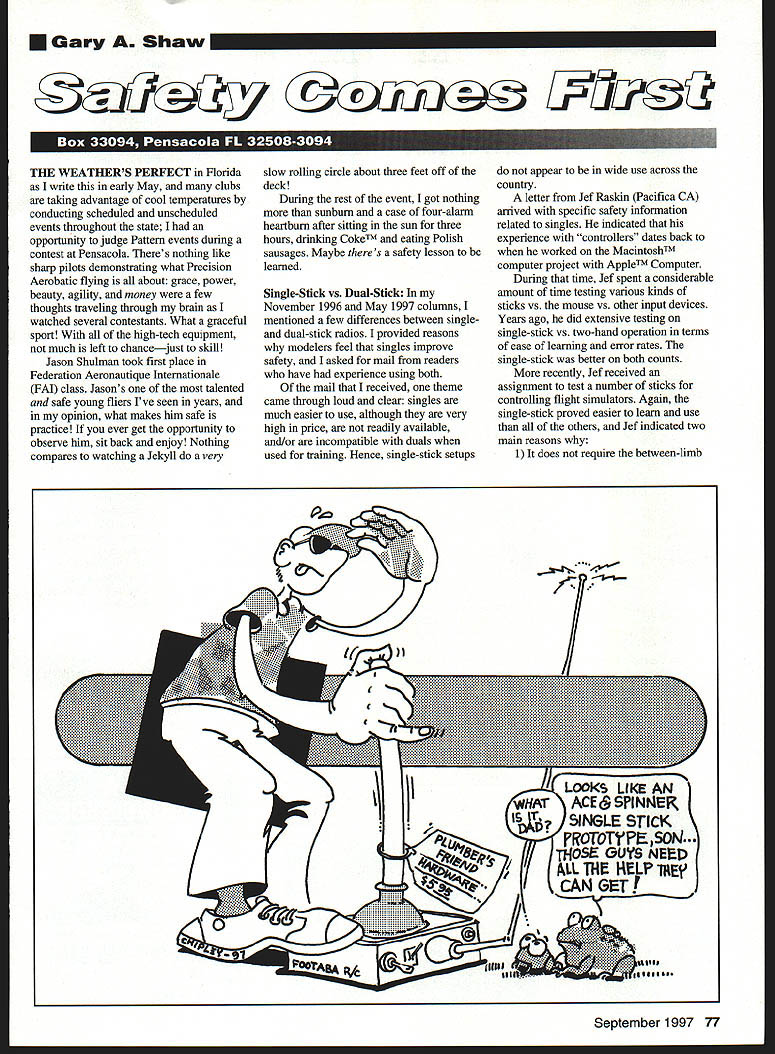
Single-Stick vs. Dual-Stick
In my November 1996 and May 1997 columns, I mentioned a few differences between single- and dual-stick radios. I provided reasons why modelers feel that singles improve safety, and I asked for mail from readers who have had experience using both.
Of the mail that I received, one theme came through loud and clear: singles are much easier to use, although they are very high in price, are not readily available, and/or are incompatible with duals when used for training. Hence, single-stick setups do not appear to be in wide use across the country.
A letter from Jef Raskin (Pacifica CA) arrived with specific safety information related to singles. He indicated that his experience with "controllers" dates back to when he worked on the Macintosh™ computer project with Apple™ Computer.
During that time, Jef spent a considerable amount of time testing various kinds of sticks vs. other input devices. Years ago, he did extensive testing on single-stick vs. two-hand operation in terms of ease of learning and error rates. The single-stick was better on both counts.
More recently, Jef received an assignment to test a number of sticks for controlling flight simulators. Again, the single-stick proved easier to learn and use than all of the others, and Jef indicated two main reasons why:
- It does not require the between-limb coordination two-stick setups do.
- It maps yaw rotation around the vertical axis of the craft onto the yaw stick. Jef said it is also easy to use for rudder turns—in fact, almost automatic. A great boon when handling some scale craft, especially sailplanes, said Jef. He expressed the opinion that anything that speeds learning and decreases errors improves safety, strongly recommends single-stick systems, and hopes manufacturers make them available.
Regarding prohibitive cost, Jef said there is no reason single-stick systems should be expensive to manufacture—it's just that dual sticks are customary.
I agree. Raymond Miles forwarded a note indicating he has used single-stick since returning to the hobby in 1970.
I'll add two cents worth on the subject. My first radio was a three-channel World Engines "Digit Midget" (or whatever it was called). It did ailerons, of course; a fourth channel was never mentioned and eventually would be needed. Anyhow, club electronic experts installed a fourth channel; one-stick took the fright away. Again, some five years later I purchased a two-stick World Engines radio. For the life of me, I could not coordinate my left hand for steering and throttle. The takeoffs never occurred because of the snaking action, and that was accompanied by the loss of throttle control at the same time. Absolutely horrendous.
I then bought a Pro Line five-channel single-stick "Competition Series" radio. I still have that radio. It is updated and all the rest, and it is a joy to use. I have absolutely no problems tracking on takeoff, with three functions on one stick. Not only that, but that type of radio does not have to be held in front of you with both hands.
The single version allows one to "cradle" the radio on your lower arm as a rest, allowing the left thumb to curl around the throttle lever. For the life of me, I cannot understand why this is not the preferred way to fly! Many of our club people usually stand close by to watch me operate the unit. Their comments are always, "you look so comfortable, and it looks so easy." Well, I am, and it is. But I remain the only person in the club to have ever used a single-stick system.
If you want to consider the "safety aspect," yes, I most likely would have run into someone, or something, with the two-stick system. I gave it a good try, but it was not for me.
You are correct: Ace is the only company that still makes single-stick, but I suppose one could be ordered upon request. The only difference I noticed when Airtronics and a few others made them was the price—about $10 more. I don't think that was any problem; there was just no call for them.
My current Pro Line has never given me a bit of trouble, as every three or four years I have it gone over. It does not even have servo reversing. I suppose I could have something done to the unit to correct that, but it's no problem for me. I do understand why it's there.
Thanks, Raymond. From what's been passed to me regarding potential advantages, it seems to be something requiring serious consideration. How about the manufacturers out there? Drop me a line with the pros and cons from your standpoint.
Problems with Spray Cans
While scanning the Internet for hobby-related topics, I saw an article by Gene Wilkinson that described a major pitfall of buying paint in spray cans. After sitting on the shelf for a few months, cans typically clog up, rendering them useless. Considering the expense of paint, and the safety concerns of trying to clear plugged nozzles with pins (never do that) or solvents, I found Gene's solution to be very helpful. If you're considering throwing out the old paint cans, consider the following before adding more HAZMAT to the local landfill:
How often have you picked up a can of spray paint to do some touch-up and discovered that the only thing you could get out of it was a feeble sputter? Probably quite a number of times. Over a period of years it has happened to me a lot, but I always seemed to rationalize that it was an old can of relatively cheap paint, so what the heck?
A year or so ago, I had to special-order a can of spray paint to match the UltraCote covering I was putting on my new airplane. I did so grudgingly because this stuff cost me $11 for just one can, and I only used it to paint the cowling and wheel pants. After I finished, 90% of the paint was left.
As is usual with new airplanes, it eventually became "field-worn" and needed some touch-up. I got out that expensive can of paint to spruce up the scuffed cowling, shook the can real well, and was greeted with an anemic dribble of paint out of the nozzle! Needless to say, I was steamed! Eleven bucks down the drain!
The more I thought about it, the more exasperated I got, and finally ended up writing a caustic letter to the manufacturer stating that the least they could do would be to figure out a way for the customer to clear out a clogged spray can (they admonish you in the instructions not to stick pins in the nozzle). To my surprise, I received a nice and informative letter from the manufacturer (in this case, Chevron Hobby Products) explaining just how to go about clearing a clog in the feed tube of the spray can! I followed their directions, and by golly, they worked! I'll pass the instructions on, so perhaps others may benefit.
- Pound a small nail (2d or smaller) through a board so that the nail protrudes about a half-inch on the other side of the board.
- Remove the spray button from the spray can, then place the top of the can over the nail exactly where the spray button would go. The can is now inverted with the spray valve resting on the nail.
- Wrap a rag around the top of the can so it is pretty well sealed around the board. This is to prevent paint from spraying out all over the place.
- While tightly holding the rag around the can, push the can down on the nail several times, and any undispersed pigment should clear out and hopefully be contained by the rag.
This will work only if the undispersed pigment is at the top end of the pickup tube at the spray button end. It may not be successful if the clog is at the bottom of the pickup tube.
That's all for this month. Thanks for reading and keep 'em flyin'!
Transcribed from original scans by AI. Minor OCR errors may remain.

