
Gary A. Shaw Box 4520, Milton FL 32572-4520
Safety Comes First
Out of Control
When I arrived at a nearby flying field recently, I saw modelers running for cover as an airplane went solo (no one was in control). The rather large model was on its fifth circuit of the field when the onboard battery went dead. After another 10–15 rounds with no one in control, the aircraft landed near some vehicles, but no one was injured.
Discussion with the pilot while he picked up pieces indicated that he probably left the receiver battery on while driving to the field. He didn't check switch position or battery status with a voltmeter before flying—strike one. When asked by one of the people who dove for cover why he didn't check his battery before flying, the modeler responded, "What are you worried about? You're insured!"—strike two.
After loading the model's remains into his van, the guy brought out what resembled a low-wing Big Stick. Later in the afternoon, he fueled it up and climbed into the sky. Shortly after takeoff, he rolled the airplane inverted and began a loop, and the wing quickly separated from the fuselage as the model shot straight into the dirt. Inspection of the wing revealed that the modeler forgot to preflight his airplane and ensure that his wing bolts were snug—strike three. No one was sorry to see him go home!
Winter Airplane Storage
From the pages of the Itasca R/C Club Newsletter (Bob Blase, Editor) are a few tips to help get you ready for next season.
Since the snow will be flying very soon (if it hasn't already), many consider the flying season to be over. For those who don't intend to fly on skis, the following suggestions may help preserve your model over the winter and allow you to safely get back in operation when the snow disappears next season.
Airplane
- Give the entire airplane a thorough cleaning to remove all traces of exhaust residue.
- Check the covering to be sure fuel is not creeping under seams around the firewall and around the exhaust outlet, soaking the balsa. If so, make repairs during the off season while you have some extra time.
- Inspect the fuselage and flying surfaces closely for cracks or other damage.
- Check servo arms, control horns, clevises, pushrods and/or control cables for excessive wear or damage.
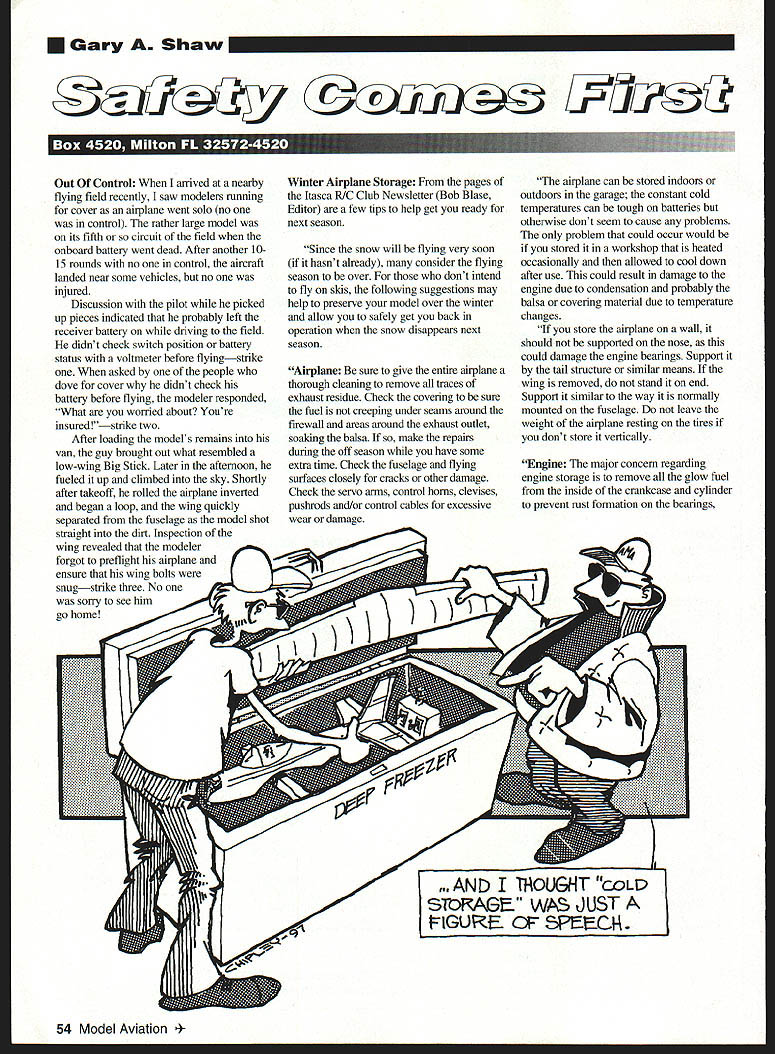
- The airplane can be stored indoors or outdoors in a garage; constant cold temperatures can be tough on batteries but otherwise usually don't cause problems.
- Avoid storing the airplane in a workshop that is heated occasionally and then allowed to cool, as condensation could damage the engine and temperature changes can affect balsa or covering material.
- If you store the airplane on a wall, do not support it on the nose—this could damage the engine bearings. Support it by the tail structure or similar means.
- If the wing is removed, do not stand it on end. Support it as it would be mounted on the fuselage.
- Do not leave the weight of the airplane resting on the tires if you don't store it vertically.
Engine
- The major concern is to remove all glow fuel from the crankcase and cylinder to prevent rust on bearings and crankshaft.
- Best practice is to remove the engine from the airplane, remove the glow plug and backplate, and flush the inside with a solvent such as kerosene. With the backplate off, check for signs of rust or bearing failure.
- After cleaning, generously oil the bearings and cylinder with after-run oil (for example, Marvel Mystery Oil).
- After the engine is well-oiled, reinstall the backplate and glow plug and place the engine in a sealed plastic bag along with the mounting hardware until next season.
- If you decide not to remove the engine from the airplane, at minimum remove the glow plug, pour some oil into the carburetor, and spin the engine clockwise and counterclockwise to distribute the oil through the bearings. Add some oil through the glow plug hole and turn the engine over slowly a few times. Reinstall the glow plug.
- Remove wooden props and put a plastic bag over the engine to keep dust and dirt out.
Batteries
- Ideally, cycle transmitter and receiver batteries and record their capacity as a reference for next season.
- If battery capacity is doubtful, cut the connector off and dispose of them; buy new ones next season.
- If practical, leave batteries on a trickle charger to maintain their charge during the off season.
- If trickle charging isn't practical, try to fully charge them at least every one to two months.
- When ready to fly again, cycle the batteries first to ensure they have adequate capacity.
Transmitter/Receiver/Servos
- Check servo wiring and connectors for signs of corrosion; replace corroded connectors.
- Check servo output shafts for looseness.
- Inspect the receiver antenna for damage; if in doubt, repair or replace it.
- Extend the transmitter antenna and clean it with alcohol. Collapse the antenna and repeat cleaning several times—there are contact fingers inside each antenna section that may become coated with oil, preventing proper contact and greatly reducing transmitting range.
Fuel
- Cap fuel containers tightly and store them in a cool place out of direct sunlight.
- Some recommend against storing fuel in very cold temperatures; the editor noted no problems storing it cold in past experience.
Starter Battery
- If you have an electric starter hookup, remove the 12-volt lead-acid starter battery, clean the terminals, and check the electrolyte level. Add distilled water if necessary.
- This battery must be charged if stored outdoors during winter. A monthly charge will help prevent freezing and extend battery life.
Miscellaneous
- Discard old rubber bands and plan to buy a new box next season.
- Check your supply of spare glow plugs, props, etc., and make a parts list to replace items used during the summer.
- If you run into problems or are unsure about something, call another club member for advice. Make repairs during the winter and save the warm weather for flying!
Homecoming
A flier on the flightline cried out, "I lost my airplane." We all agreed; no one could locate it against the white clouds. He pushed down his antenna and returned his transmitter to the impound. A small airplane returned above the field 10 minutes later, and since no one was on the flightline, we assumed it must be the one that flew away. The fellow grabbed his transmitter, turned it on, and landed his long-lost airplane. It must have gotten homesick.
Point To Ponder
By Mark Farrow, Bay of Quinte Aeromodellers: "I want to die peacefully in my sleep like my grandfather. Not screaming in terror like his passengers."
Transcribed from original scans by AI. Minor OCR errors may remain.

