
Gary A. Shaw
Safety Comes First
Box 4520, Milton FL 32572-4520 E-Mail: gshaw@worldnet.att.net
SINGLE-STICK vs. Dual-Stick
In my November 1996 and May 1997 columns I mentioned differences between single- and dual-stick radios, provided a few reasons why some modelers feel that single-sticks improve safety (decreased learning times, improved control accuracy), and asked for mail from readers who have had experience using both.
One theme came in loud and clear from the single-stick crowd: singles are much easier to use, are perceived to be safer because of effortless hand-eye coordination, offer decreased learning times, and feel better. Hence, when used exclusively, singles were associated with fewer mishaps because of the absence of cross-control requirements associated with duals (commonly known as "dumb thumbs").
Chuck Smith of Chicago, Illinois, let me know that he feels the topic of single vs. dual is woefully out of place in this column unless the intent is to make all transmitters safer to use. I'm disappointed that he didn't get the message in the November 1996 and May 1997 issues, which touched on accidents related to tipovers of duals (throttles being pushed to full), ease of learning and error rates, and improved ergonomic design.
Essentially, anything that speeds learning and decreases errors improves safety—a worthy subject to write about. Although written under the assumption that singles need no transition to duals, Chuck provided some good advice that can be applied regardless of what setup you prefer.
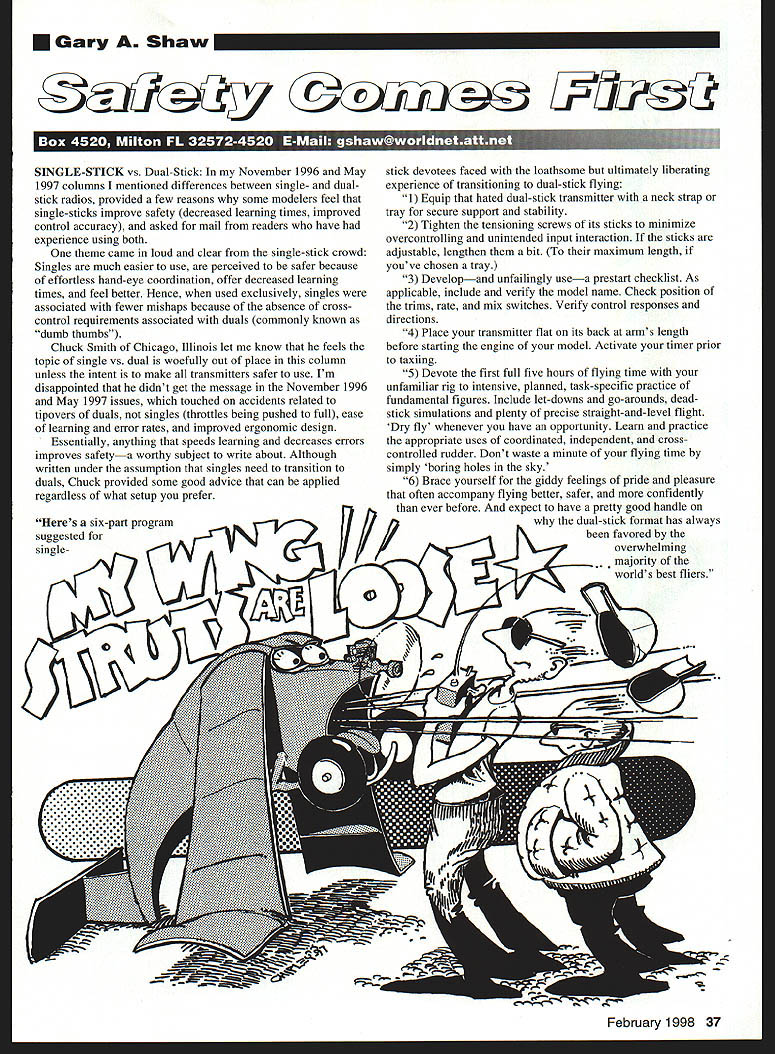
Here's a six-part program suggested for single-stick devotees faced with the loathsome but ultimately liberating experience of transitioning to dual-stick flying:
- Equip that hated dual-stick transmitter with a neck strap or tray for secure support and stability.
- Tighten the tensioning screws of its sticks to minimize overcontrolling and unintended input interaction. If the sticks are adjustable, lengthen them a bit (to their maximum length, if you've chosen a tray).
- Develop—and unfailingly use—a prestart checklist. As applicable, include and verify the model name. Check position of the trims, rate, and mix switches. Verify control responses and directions.
- Place your transmitter flat on its back at arm's length before starting the engine of your model. Activate your timer prior to taxiing.
- Devote the first full five hours of flying time with your unfamiliar rig to intensive, planned, task-specific practice of fundamental figures. Include let-downs and go-arounds, dead-stick simulations, and plenty of precise straight-and-level flight. "Dry fly" whenever you have an opportunity. Learn and practice the appropriate uses of coordinated, independent, and cross-controlled rudder. Don't waste a minute of your flying time by simply "boring holes in the sky."
- Brace yourself for the giddy feelings of pride and pleasure that often accompany flying better, safer, and more confidently than ever before. And expect to have a pretty good handle on why the dual-stick format has always been favored by the overwhelming majority of the world's best fliers.
When Your Airplane Tells You
The following is from the hard-working folks at Sam Says, Dennis Woodcock, Editor (Box 6351, Salinas CA 93912-6351):
Once upon a time your author had a new Pattern airplane. On the first few days of flying it, everything was fine. But one day, on the first flight, it required several clicks of down trim (odd) after takeoff, and after each turn or maneuver, the pitch trim would be off again (very odd). Only when it took full down-stick to fly inverted (jeepers!) was I smart enough to realize that something was wrong. After landing, the problem was obvious; I had not bolted the wing to the fuselage!
But the airplane did "try to tell me"; I just wasn't listening. Only new, tight-fitting wing dowels had saved the model from destruction — it certainly wasn't the pilot. Recapping later, I thought of a number of things that would have caused similar symptoms: servo or servo tray loose, bad servo centering, broken elevator hinges, loose control horn, etc. The point is that all of those things are bad! And with the airplane not behaving properly, why did I keep flying?
Just suppose you're getting an occasional glitch from your radio—something that doesn't normally happen. This could be an antenna problem. It could be metal-to-metal vibration causing homegrown interference, or a loose crystal. Will any of these get better while you keep flying? And speaking of vibration, what if you start hearing it in the air? It's your airplane talking to you—loose muffler, engine mount, worn wing dowel holes, loose cowl mounting. Again, such problems don't get better, only worse.
One more example—this has happened to all but the most careful pilots. Your engine goes lean and sags at the top of a loop. It's telling you that the mixture is too lean. But you don't listen and keep flying. A minute later, while doing another loop, you're suddenly dead-stick!
The sky gods know—we have enough problems that pop up suddenly, and we don't have any opportunity to prevent them. Other times the airplane "tells you" that there is, or will be, a problem. Unless you really enjoy repairing or rebuilding—listen! Cutting a long story short to check out a possible problem is much quicker (and vastly cheaper) than building another airplane!
Splitting Fuel Jugs
A modeler wrote to alert me of a problem he's encountered—plastic fuel jugs splitting open while in storage. He had three containers split open in the last few years, resulting in large fuel spills in his workshop and in the trunk of a vehicle. The splits varied in length from 1/2 inch to almost two inches, which resulted in slow trickles rather than a gush.
Although he thinks that the jug failures may be caused by manufacturing defects rather than high oil or low temperatures, he didn't specify the brand name of the fuel; the three occurrences were from separate manufacturers (probably a generic blown-plastic product used by numerous companies).
To combat this problem, he routinely transfers all of his fuel into heavy-duty UL/TC-approved containers before transporting them in his car. He feels that the additional trouble and expense is necessary to avoid more spills in his workshop or car.
Since his letter was among several I've received discussing fuel jug integrity, I'm wondering if others have had the same type of occurrences.
Maintenance Replies
On a humorous but serious note, the following are complaints submitted by US Air Force pilots and the replies from maintenance crews.
- Problem: Left inside main tire almost needs replacement.
Signed off: Almost replaced left inside main tire.
- Problem: Test flight OK, except autoland very rough.
Signed off: Autoland not installed on this aircraft.
Transcribed from original scans by AI. Minor OCR errors may remain.

