
Safety Comes First
Gary A. Shaw Box 4520, Milton FL 32572-4520
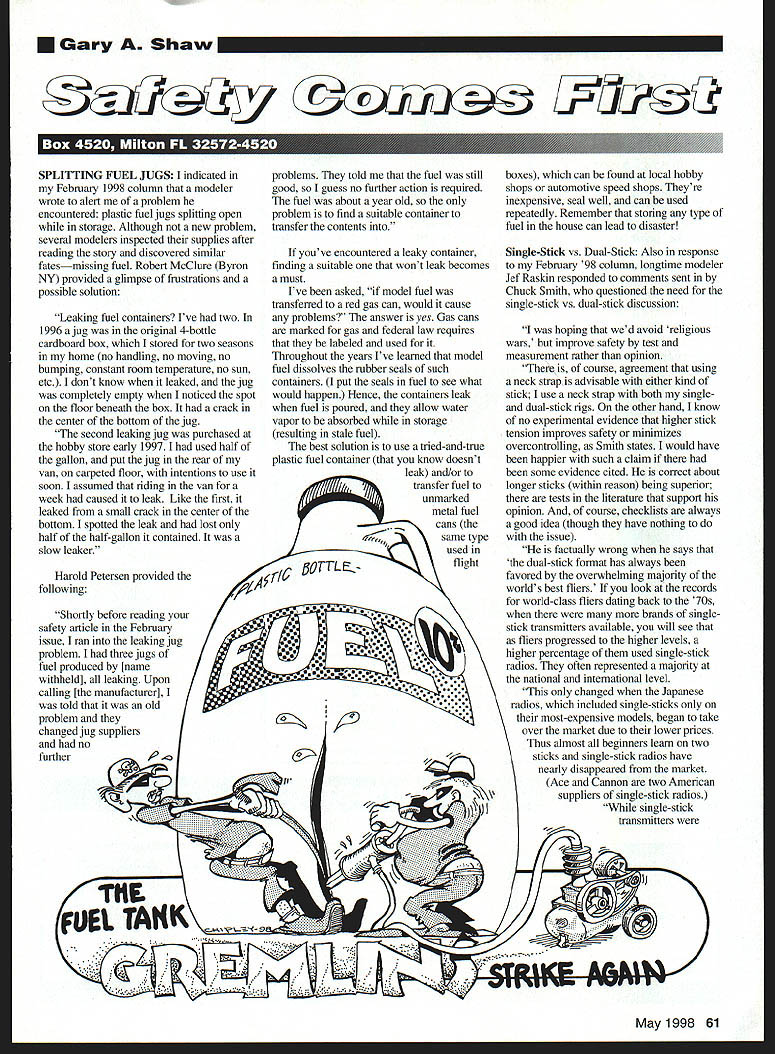
Splitting Fuel Jugs
A February 1998 column alerted modelers to an issue with plastic fuel jugs splitting open during storage. Several readers inspected their supplies after reading the story and discovered similar problems—missing fuel.
Robert McClure (Byron, NY) provided a first-hand account:
"Leaking fuel containers? I've had two. In 1996 a jug was in the original four-bottle cardboard box, which I stored for two seasons in my home (no handling, no moving, no bumping, constant room temperature, no sun, etc.). I don't know when it leaked, and the jug was completely empty when I noticed the spot on the floor beneath the box. It had a crack in the center of the bottom of the jug.
"The second leaking jug was purchased at the hobby store early 1997. I had used half of the gallon and put the jug in the rear of my van on carpeted floor, intending to use it soon. I assumed that riding in the van for a week had caused it to leak. Like the first, it leaked from a small crack in the center of the bottom. I spotted the leak and had lost only half of the half-gallon it contained. It was a slow leaker."
Harold Petersen also wrote:
"Shortly before reading your safety article in the February issue, I ran into the leaking-jug problem. I had three jugs of fuel produced by [name withheld], all leaking. Upon calling [the manufacturer], I was told that it was an old problem and they changed jug suppliers and had no further problems. They told me that the fuel was still good, so I guess no further action is required. The fuel was about a year old, so the only problem is to find a suitable container to transfer the contents into."
If you encounter a leaky container, transferring the fuel to a suitable, non-leaking container is essential.
I have been asked, "If model fuel is transferred to a red gas can, would it cause any problems?" The answer is yes. Gas cans marked for gasoline are required by federal law to be labeled and used for that purpose. Over the years I've learned that model fuel can dissolve the rubber seals in such containers (I tested by putting seals in fuel). As a result, the containers can leak when fuel is poured and they can absorb water vapor during storage, producing stale fuel.
Recommended solutions:
- Use a tried-and-true plastic fuel container that you know does not leak.
- Or transfer fuel to unmarked metal fuel cans (the same type used in flight boxes), available at hobby shops or automotive speed shops. They are inexpensive, seal well, and can be reused.
Remember: storing any type of fuel in the house can lead to disaster. Store fuel safely and appropriately.
Single-Stick vs. Dual-Stick
In response to the February 1998 column, longtime modeler Jef Raskin replied to comments from Chuck Smith, who questioned the need for discussion about single-stick versus dual-stick controls.
Raskin wrote: "I was hoping that we'd avoid 'religious wars' and improve safety by test and measurement rather than opinion.
"There is, of course, agreement that using a neck strap is advisable with either kind of stick; I use a neck strap with both my single- and dual-stick rigs. On the other hand, I know of no experimental evidence that higher stick tension improves safety (minimizes overcontrolling). Smith states he would have been happier with such a claim if there had been some evidence cited. He is correct about longer sticks (within reason) being superior; there are tests in the literature that support this opinion. And, of course, checklists are always a good idea (though they have nothing to do with the issue).
"He is factually wrong when he says that the dual-stick format has always been the favored choice of the overwhelming majority of the world's best fliers. If you look at the records for world-class fliers dating back to the 1970s, when there were many more brands of single-stick transmitters available, you will see that as fliers progressed to higher levels, a higher percentage of them used single-stick radios. They often represented a majority at national and international levels.
"This only changed when Japanese radios, which included single-sticks only on their most-expensive models, began to take over the market because of lower prices. Thus almost all beginners learned on two sticks and single-stick radios nearly disappeared from the market. (Ace and Cannon are two American suppliers of single-stick radios.)
"While single-stick transmitters were available, the best fliers tended to prefer them. The main reason we have gone to two-stick systems is that they are cheaper—not because they are better. If safety is a real concern, then on the basis of tests which are not difficult to replicate, the AMA and modelers should be asking that single-stick radios be made more widely available—especially from popular manufacturers such as Futaba, Airtronics, and Hi-Tec.
"Chuck Smith advocated a logical way of learning to fly a new mode. If he does not fly single-stick, then I suggest he follow his own suggestions and learn to fly a one-stick rig.
"My Ace transmitter was custom-built so that it can be flown with rudder on the left stick or in single-stick mode by twisting the knob on the right stick. Since I am an instructor, I have to fly single-stick; Model I and Model II—whatever a student brings to the field. With practice, you can learn to fly well in all the systems.
"The point I make is that testing shows single-stick is easier to learn and causes fewer human errors, thus improving safety."
Flying Somewhere Else
As winter turns to spring, many modelers plan to fly at other fields—visiting friends, attending contests, traveling abroad, etc. Clay Ramskill offers practical advice about flying outside familiar surroundings:
"Our flying field is certainly not the worst in the area—it's not the best, either. We fly there because we like the field and the people; it's comfortable to us. But sometime we're probably going to fly at other fields.
"Perhaps the easiest, most painless way to do this is by invitation from a member of another club. Whenever possible, accept such an invitation. You will enjoy meeting other people, seeing how they do things, and getting the experience of flying from a different locale. This is not as easy as it seems—the different surroundings, the lack of the usual visual cues you're used to (whether you know it or not), and unfamiliar people and aircraft put a heavy load on your nervous and sensory systems. If you're there by invitation with a friend, it really helps.
"The worst-case scenario is when you've moved to a new city—you may have made a phone call or two, but you basically arrive at some club's field as a total unknown and end up 'showing your stuff' to watchful club members who are evaluating you. Not a relaxing situation!
"In between these extremes are several ways to fly from another field. Check flyers posted at hobby shops or in Model Aviation for events; common types include:
- Open House:
- A club opens its field for others to come watch or fly. This is usually a low-stress way to visit and meet other fliers. Check the flyer to see whether visitors may fly or only observe.
- Fly-in:
- More common and usually more structured than open houses. Fly-ins are meant to attract other fliers to socialize and often raise funds for the host club. Expect a landing fee, frequency impound, aircraft inspection, and rules briefing. There may be raffles, food, prizes, and flying demos. Generally there is no competitive flying at a fly-in.
- Fun Flys:
- These range from casual, silly events to serious, competitive gatherings with specialized aircraft. Make sure you know what kind of fun-fly it is before you participate.
- Competitive Events:
- Highly structured and usually run under AMA rules. Promotions will indicate the number and type of AMA competitive events to be flown. These cover the full range of modeling—Racing, Combat, Pattern, Rubber-powered Free Flight, etc. Be familiar with AMA procedures before entering. If possible, visit during practice time, talk to the contest director and regulars, or position yourself to observe. If you fly, have a competent helper who knows the rules and can spot things you may not see. Follow established pilot procedures and ask if you don't understand something."
Becoming a member of a flying club or joining an established group is the best way to get introduced to other fields and events. Model Aviation, club newsletters, and local hobby shops often list events; most groups are friendly and helpful.
Finally, remember the golden rule: the field belongs to the host club. Respect their rules, be polite, and exercise good sportsmanship. How you act as a visitor will reflect on your home club.
Pull out your spring flight-box checklist and get ready for another season! Don't have a checklist? Sounds like a topic for another column.
Transcribed from original scans by AI. Minor OCR errors may remain.

