
Gary A. Shaw Box 4520, Milton FL 32572-4520
Safety Comes First
HEAT — DEAD BATTERIES or Polarization?
While scanning the Internet recently, I saw an interesting tidbit provided by The Society of Antique Modelers (SAM 26, Bob Angel, editor) which explained why numbers and letters on electronic displays sometimes seem to disappear. If memory serves, I've trashed or quit using a couple pieces of equipment that didn't seem to be reliable; it seems I may have wasted a few bucks!
"My stopwatch was lying face-up in the hot sun, and I noticed the display had turned completely black and unreadable. Later, out of direct sun, it seemed to recover from the heat. We never had this problem with a mechanical watch. A couple of months later, my tachometer was impossible to read unless I twisted it just so. Someone suggested new batteries and I cringed, having replaced a set recently, at a cost of almost half the tach itself.
"It finally dawned on me that I was wearing polarized sunglasses, and the tach lens must be polarized. By rotating the tach about 45° vertical, I could make the display turn black and unreadable. Same with my stopwatch. Two polarized lenses will do that. Odd thing is that the sunglasses and the instrument lenses seem to be polarized at a 45° angle, rather than horizontally/vertically as I've noticed in the past."
In previous columns I've written a few words regarding what modelers can do to enhance the visibility of an airplane once it's in the air. If you can quickly figure out an airplane's orientation relative to the ground, you're much more likely to recover from a difficult and/or potentially dangerous situation.
While watching airplanes fly recently at a local field, I noticed one in particular stood out much more than others because of some sort of reflective metalized material placed on the model's leading edges. Upon landing, I asked the pilot what the material was (metalized striping tape) and where he got it. I was told it was readily available in local auto parts stores for five bucks (covers up to five airplanes) or through Northeast Sailplane Products for $2.50/roll (covers one airplane—see ad this issue for address). I suggest you start with your local automotive store and pick up a roll to use on all your models; it really works great!
Whammo! From the desk of Jim McNeill, District V VP
"I have a painful subject to discuss with you: Safety. I was in a very Southern state a few days ago to visit a Giant Scale Fly-In. Many important people were there. Many fabulous models etc.
"A gentleman went off by himself to crank up and fly his model. He was entirely by himself. He had been told by the CD over and over not to go off by himself, but always have someone with him to hold the model. It was a very large model with a very large engine and a very large propeller. Whammo! He cut himself on the arm between the elbow and the shoulder. Spectators mentioned it looked like his arm was cut off. He bled profusely—cut a major artery. Modelers rushed over, tried a tourniquet which did not work. One spectator wiped the blood off his one hand and reached in and squeezed the artery. Within two minutes by the clock an ambulance arrived with trained medical personnel. He was hustled off to a clinic center and is now OK. He could have easily bled to death.
"Keep in mind the engine doesn't have to be large to cut you. I was by myself a few years ago at a field and cut myself with an .020 engine in a model. When I drove home by myself, I had to hold the cut drive hand. A rubber-powered model might be OK, but an engine-powered one might not. We have barely enough good modelers in our fine District V, including you; we don't want to lose a single one. The lecture is over."
X-Acto Knife Handles
Having built several airplanes of my own in the past, I can relate to the following tip provided by Sam Turner of Land-O-Lakes, Florida:
I always felt that the X-Acto knife handles that hold the #11 blades were too thin for modeling. In addition, they would always roll off the table and try to spear my feet.
Well, I solved both problems:
- Drill a 1/8" hole in the top of the handle and insert a circular binder ring from an office-supply store. This provides a neat way to hang the knife on the edge of the workbench and also keeps the knife from rolling off the table.
- Slide a piece of rubber tubing over the handle. This builds up the handle size and, as a side benefit, helps keep the collet from unscrewing and dropping the blade at inconvenient times.
It takes just five minutes to make these changes and provides a much better tool.
Editor's note: The rolling-knife problem can also be solved with triangular grips sold for the purpose at many office-supply/graphic-arts dealers. Simply slide the grip over the end of the knife, and you're set. The brightly colored grip makes it easier to locate the knife on a crowded workbench, too.
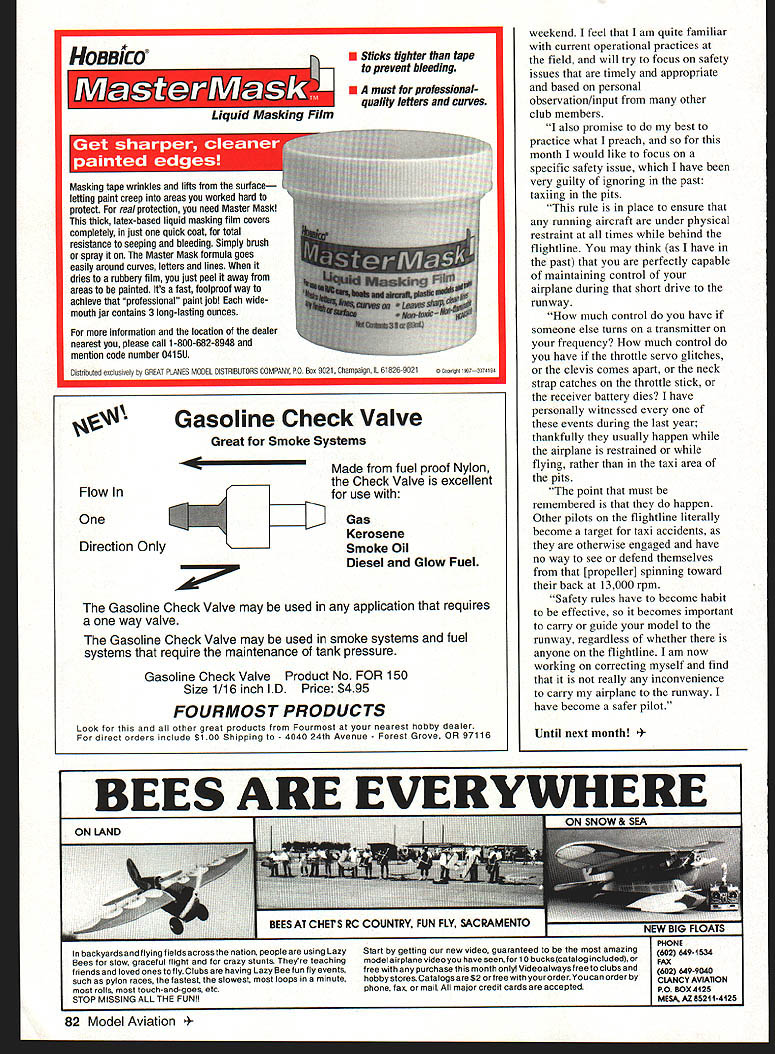
Don't Taxi in the Pit Area!
I can go to just about any flying field in the country and find experienced and inexperienced modelers taxiing their airplanes in and out of the pits. What's odd about this is that they seem to have little or no concern about what they are doing, or why they should care.
Tell me: What happens to those in the path of the airplane when the battery dies, you trip, or the receiver doesn't properly receive on the way to or from the field? I know, it'll never happen to you, right? Wrong. It happens all the time, but it is something that should never lead to an accident.
Offering a similar opinion is Mike Sauter, Secretary/Treasurer of the Loudoun County (Virginia) Aeromodelers Association:
"If I fly a lot, and if the weather cooperates, I try to make it out to the field every weekend. I feel that I am quite familiar with current operational practices at the field, and will try to focus on safety issues that are timely and appropriate and based on personal observation and input from many other club members.
"I also promise to do my best to practice what I preach, and so for this month I would like to focus on a specific safety issue, which I have been very guilty of ignoring in the past: taxiing in the pits.
"This rule is in place to ensure that any running aircraft are under physical restraint at all times while behind the flightline. You may think (as I have in the past) that you are perfectly capable of maintaining control of your airplane during that short drive to the runway.
"How much control do you have if someone else turns on a transmitter on your frequency? How much control do you have if the throttle servo glitches, or the clevis comes apart, or the neck strap catches on the throttle stick, or the receiver battery dies? I have personally witnessed every one of these events during the last year; thankfully they usually happen while the airplane is restrained or while flying, rather than in the taxi area of the pits.
"The point that must be remembered is that they do happen. Other pilots on the flightline literally become a target for taxi accidents, as they are otherwise engaged and have no way to see or defend themselves from that propeller spinning toward their back at 13,000 rpm.
"Safety rules have to become habit to be effective, so it becomes important to carry or guide your model to the runway, regardless of whether there is anyone on the flightline. I am now working on correcting myself and find that it is not really any inconvenience to carry my airplane to the runway. I have become a safer pilot."
Until next month!
Transcribed from original scans by AI. Minor OCR errors may remain.

