
Safety Comes First
Gary A. Shaw
Box 4520, Milton FL 32572-4520
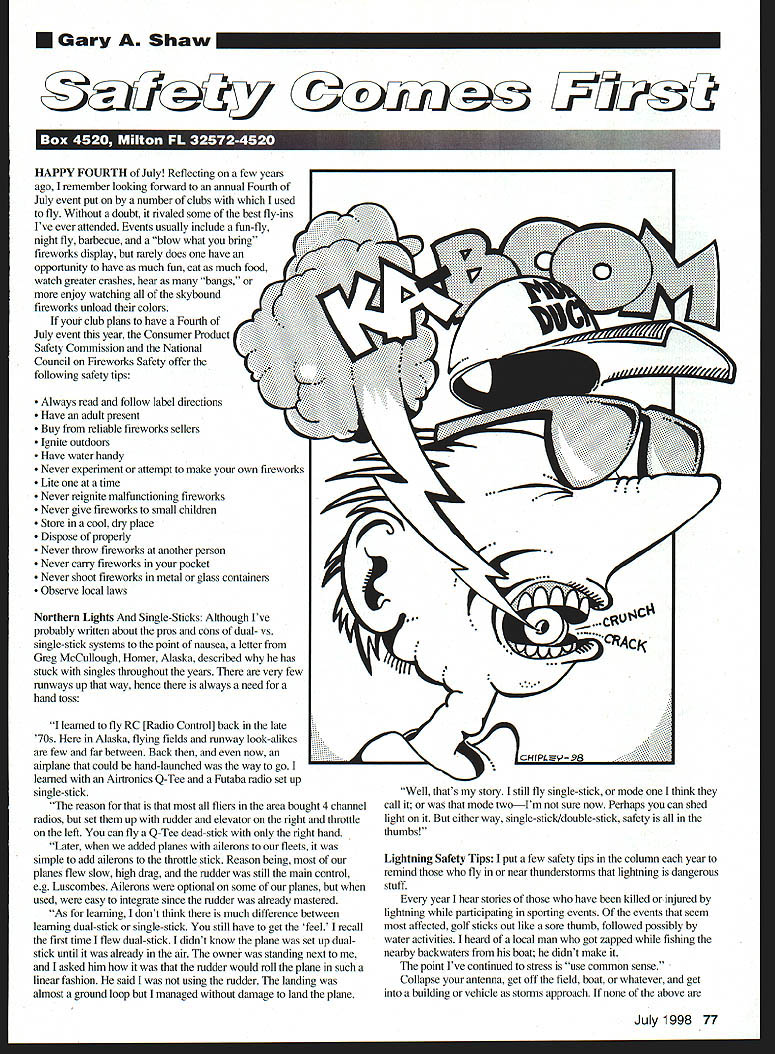
HAPPY FOURTH of July! Reflecting on a few years ago, I remember looking forward to an annual Fourth of July event put on by a number of clubs with which I used to fly. Without a doubt, it rivaled some of the best fly-ins I've ever attended. Events usually included a fun-fly, night fly, barbecue, and a "blow what you bring" fireworks display, but rarely did one have an opportunity to have as much fun, eat as much food, watch great crashes, hear as many "bangs," or enjoy watching all of the skybound fireworks unload their colors.
If your club plans to have a Fourth of July event this year, the Consumer Product Safety Commission and the National Council on Fireworks Safety offer the following safety tips:
- Always read and follow label directions
- Have an adult present
- Buy from reliable fireworks sellers
- Ignite outdoors
- Have water handy
- Never experiment or attempt to make your own fireworks
- Light one at a time
- Never reignite malfunctioning fireworks
- Never give fireworks to small children
- Store in a cool, dry place
- Dispose of properly
- Never throw fireworks at another person
- Never carry fireworks in your pocket
- Never shoot fireworks into metal or glass containers
- Observe local laws
Northern Lights And Single-Sticks
Although I've probably written about the pros and cons of dual- vs. single-stick systems to the point of nausea, a letter from Greg McCullough, Homer, Alaska, described why he has stuck with singles throughout the years. There are very few runways up that way, hence there is always a need for a hand toss:
"I learned to fly RC [Radio Control] back in the late '70s. Here in Alaska, flying fields and runway look-alikes are few and far between. Back then, and even now, an airplane that could be hand-launched was the way to go. I learned with an Airtronics Q-Tee and a Futaba radio set up single-stick.
"The reason for that is that most all fliers in the area bought 4-channel radios, but set them up with rudder and elevator on the right and throttle on the left. You can fly a Q-Tee dead-stick with only the right hand.
"Later, when we added planes with ailerons to our fleets, it was simple to add ailerons to the throttle stick. Reason being, most of our planes flew slow, high-drag, and the rudder was still the main control, e.g., Luscombes. Ailerons were optional on some of our planes, but when used, were easy to integrate since the rudder was already mastered.
"As for learning, I don't think there is much difference between learning dual-stick or single-stick. You still have to get the 'feel.' I recall the first time I flew dual-stick. I didn't know the plane was set up dual-stick until it was already in the air. The owner was standing next to me, and I asked him how it was that the rudder would roll the plane in such a linear fashion. He said it was not using the rudder. The landing was almost a ground loop but I managed without damage to land the plane.
"Well, that's my story. I still fly single-stick, or mode one I think they call it; or was that mode two—I'm not sure now. Perhaps you can shed light on it. But either way, single-stick/double-stick, safety is all in the thumbs!"
Lightning Safety Tips
I put a few safety tips in the column each year to remind those who fly in or near thunderstorms that lightning is dangerous stuff.
Every year I hear stories of those who have been killed or injured by lightning while participating in sporting events. Of the events that seem most affected, golf sticks out like a sore thumb, followed possibly by water activities. I heard of a local man who got zapped while fishing the nearby backwaters from his boat; he didn't make it.
The point I've continued to stress is "use common sense." Collapse your antennas, get off the field, boat, or whatever, and get into a building or vehicle as storms approach. If none of the above are available, make yourself the lowest point on the ground, crouching down with feet together, hands on knees, and wait out the storm. Avoid hilltops, power lines, etc. Wait until the storm is long gone before resuming activities.
How long should you wait? Good question. I'm aware of a person sunbathing under a blue sky being killed by a lightning bolt that traveled from a storm 10 miles away. Sad but true. If lightning approaches, pack up.
Float Fun
Although I've limited experience flying aircraft from the water, I tried a unique craft a while back — exhilarating. If you should have access to a boat, a model can be retrieved if anything happens. I learned a good rudder setup is essential if you want to safely steer a model.
I realized after landing the aircraft and lining up at the dock that since line-up is done at a relatively high speed, the airplane took command because the vertical stabilizer still had authority. As the model came closer I throttled down and lost the ability to steer via the rudder, and it smacked the dock. I was slightly excited since I approached the dock too high at a rate of speed and didn't have time to shut the engine down before crashing. I almost jumped off the dock to get out of the way. Although no major damage was done to the dock or airplane, inspection indicated I had forgotten to put the water rudder down, hence no contact with water—duh! I needed to get some advice from someone with more experience.
While searching the Internet for tips on float-flying, I found a bit of advice that might steer you in the right direction. A newsletter entitled The Monocle, Darrel Stebbins, editor (Spokane WA) provides the following:
"Water rudders: One is adequate in most cases, but two are better on large aircraft or when you have windy conditions. To improve taxiing, do so with full up elevator. This forces the keel of the float down and increases the effect of the rudder(s). Water rudders should be retractable or built to kick up as speed increases. This decreases water looping. While on this, use the rudder stick very sparingly at high speeds. On full-scale aircraft, when one water rudder is used, it always seems to be mounted on the right float."
Bringing Batteries Out of Winter Storage
I've often been asked how to check batteries to see if they are still good when charged up after the winter. Not having an abundance of knowledge in this area, I usually say that I cycle mine often and keep an eye out for declining capacity. Since I hate losing models because of battery failure, my normal fallback to the question is, "when in doubt, throw them out."
Providing a better explanation for those who are more electronically inclined is a short piece provided by modeler C.L. "Red" Schofield.
"What should I do to them when I put them back in operation? When your batteries are coming out of storage, before charging, check the voltage without a load on the battery. It should read well over 4.0 volts even if it has not been charged all winter. They should be essentially fully charged—'flat' as we say in the business.
"In this condition if the battery is going bad it will probably have shorted and you will read zero volts on that cell. It may be a soft short, one that could be blown away merely by the simple action of slow charging. Don't do it. It is just laying there waiting to bite you.
"Replace the pack. Cut out the 'good' cells if you want and use them in something less critical than your model. If you have access to a cycler, running through a couple of charge/discharge cycles is a good idea just to make sure you are getting the capacity you are supposed to. Anything less than 80% of rated is suspect.
"Once at the field, preflight battery checks are in order, particularly at the beginning of the season. Since those that religiously check their flight packs with an expanded-scale voltmeter seem to crash less (due to battery failure), one must assume that the ritual is smiled upon by the RC gods."
Enjoy the summer and keep the wheels on the bottom!
Transcribed from original scans by AI. Minor OCR errors may remain.

