
Gary A. Shaw
Safety Comes First
Box 4520, Milton FL 32572-4520
Where Is It?
A friend of mine recently wrote to tell me that while flying his model on Easter Sunday, he saw a full-scale aircraft coming across the flying site, and he turned the model downwind to get out of the way. While going downwind, he looked back toward the full-scale to make sure the coast was clear; when he looked back in the direction of his model, he couldn't find it.
After a brief search, the demolished airplane was found almost 3/4 mile away, just short of the exit gate. Luckily, it came down inside the gate and not across the street, in one of many housing developments.
What set him up for a crash? A windy day and lack of good contrast to help with visibility. Remember, contrasting colors such as a red top, yellow tips, or white with a black strip on the bottom can make all the difference in the world.
Crash Etiquette
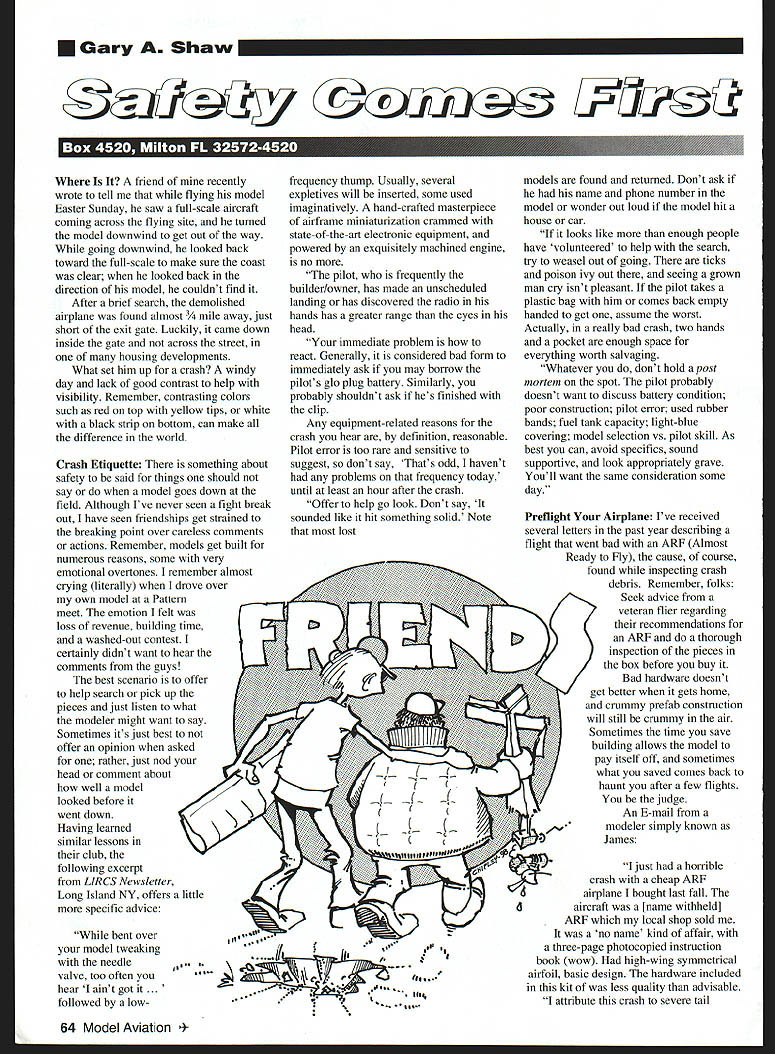
There is something to be said for how one should — and should not — behave when a model goes down at the field. Although I've never seen a fight break out, I have seen friendships get strained to the breaking point over careless comments or actions. Models get built for numerous reasons, some with very emotional overtones. I remember almost crying (literally) when I drove over my own model at a pattern meet. The emotion I felt was loss of revenue, building time, and a washed-out contest. I certainly didn't want to hear the comments from the guys!
The best scenario is to offer to help search or pick up the pieces and just listen to what the modeler might want to say. Sometimes it's best not to offer an opinion when asked for one; rather, just nod your head or comment about how well the model looked before it went down.
Having learned similar lessons in their club, the following excerpt from LIRCS Newsletter, Long Island, NY, offers some specific advice:
"While bent over your model tweaking the needle valve, too often you hear 'I ain't got it --' followed by a low-frequency thump. Usually, several expletives will be inserted, some used imaginatively. A hand-crafted masterpiece of airframe miniaturization crammed with state-of-the-art electronic equipment, and powered by an exquisitely machined engine, is no more.
"The pilot, who is frequently the builder/owner, has made an unscheduled landing or has discovered the radio in his hands has a greater range than the eyes in his head.
"Your immediate problem is how to react. Generally, it is considered bad form to immediately ask if you may borrow the pilot's glow plug battery. Similarly, you probably shouldn't ask if he's finished with the clip.
"Any equipment-related reasons for the crash you hear are, by definition, reasonable. Pilot error is too rare and too sensitive to suggest, so don't say, 'That's odd, I haven't had any problems on that frequency today,' until at least an hour after the crash.
"Offer to help go look. Don't say, 'It sounded like it hit something solid.' Note that most lost models are found and returned. Don't ask if he had his name and phone number in the model or wonder out loud if the model hit a house or car.
"If it looks like more than enough people have 'volunteered' to help with the search, try to weasel out of going. There are ticks and poison ivy out there, and seeing a grown man cry isn't pleasant. If the pilot takes a plastic bag with him or comes back empty-handed to get one, assume the worst. Actually, in a really bad crash, two hands and a pocket are enough space for everything worthwhile salvaging.
"Whatever you do, don't hold a post mortem on the spot. The pilot probably doesn't want to discuss battery condition, poor construction, pilot error, used rubber bands; fuel tank capacity; light-blue covering; or model selection vs. pilot skill. As best you can, avoid specifics, sound supportive, and look appropriately grave. You'll want the same consideration some day."
Preflight Your Airplane
I've received several letters in the past year describing flights that went bad with ARFs (Almost Ready to Fly), the cause, of course, found while inspecting crash debris. Remember: seek advice from a veteran flier regarding their recommendations for an ARF and do a thorough inspection of the pieces in the box before you buy.
Bad hardware doesn't get better when it gets home, and crummy prefab construction will still be crummy in the air. Sometimes the time you save building allows the model to pay for itself, and sometimes what you saved comes back to haunt you after a few flights. You be the judge.
An e-mail from a modeler known simply as James:
"I just had a horrible crash with a cheap ARF airplane I bought last fall. The aircraft was a [name withheld] ARF which my local shop sold me. It was a 'no-name' kind of affair, with a three-page photocopied instruction book (wow). It had a high-wing symmetrical airfoil, basic design. The hardware included in this kit was of less quality than advisable. I attribute this crash to severe tail flutter; it had a horrible flapping noise for about five seconds in steady, level flight after a five-minute hard flight. The noise was louder than the two-stroke engine at full rpm.
"After the flutter, the elevator went into a dive position (bent control rod?). I still had control over all of the surfaces, including the elevator, but not enough elevator to make a turn back to the field.
"Hindsight tells me I should have just flown it upside down until I got back to the field (it only took me 20 hours to think of that — duh!). It dug a trench in the ground about two fields away from the airfield, and was in about 15 pieces.
"I am sad, of course, but that is what you get for buying a cheaply built airplane! My engine and radio are still in good condition, though."
Remember, although James doesn't mention it, a healthy preflight inspection prior to the first flight might have prevented the loss.
Two are Better Than One
Having flown a few pattern events in past summers, I learned the value of having more than one servo installed to control a surface. Not only did they provide more accuracy in flight, I also knew I had a "safety net" if one failed.
I became even more convinced as I saw models get bigger and faster. With all the forces placed on high-performance aircraft these days, it simply takes more (or larger) servos to do the job. If you haven't considered the safety factor an extra servo can provide, especially with big models, you need to think about it.
Supporting my conclusion is a letter provided by Ron Lockhart, published via the Internet in The Radiator, Atlantic City Skyblazers, Atlantic City, NJ:
"Take the case of the lonely aileron servo. Normally one servo is mounted in the center of a wing to drive two ailerons. To get the servo output wheel motion to each aileron, we often use a set of aileron torque rods. Sometimes linkage from the servo goes to a bellcrank for each aileron, and then to the aileron. Yet another method is to run Nyrod casings from the servo into the wing and bend them 90° to get them to the ailerons.
"All of these linkage methods have their problems. The main one is the slop or play that can be felt at the aileron. Bad stuff — slop/play/looseness in ailerons (or any control surface). It contributes to possible control surface flutter, linkage and servo wear, and maybe servo failure. It makes the airplane harder to fly, because the airplane wanders in heading and altitude.
"Each linkage point — the torque-rod bearing, the bellcrank pivot, each pushrod that flexes, etc. — adds to the undesirable play at the aileron. Curved Nyrod casings add drag and make it hard for the servo to find neutral.
"How about two aileron servos, one for each aileron? Mount them partly outboard in the wing, ahead of the aileron. Both servos can be plugged into the receiver aileron channel using a Y cord. It's that simple.
"If your radio has a provision for a left and right aileron channel, use it. That has benefits that could be the subject of another article. The super-simple linkage is the beauty of this system. One short pushrod goes from the servo to the aileron horn in a straight line. Minimal/no slop! Great!
"The two-servo system is not perfect, though. You have to find another servo (yes, the same kind) and build servo mounts into the wing. That isn't tougher than torque rods, bellcranks, and such — just different. Depending on how far out on the wing the servos are mounted, you may need to lengthen the servo cords (using an aileron extension is the easy way to reach the receiver).
"Extra weight? Two servos may not be much heavier than one with the extra linkage. Since each servo is doing half the work (actually less than half, since linkage drag is reduced) you could use smaller servos to save weight.
"Will two aileron servos be better than one for your model? As with all things, it depends. The bigger and faster a model is, and the more precisely you want the aircraft to fly, the more benefit you will find in using two servos. There is also some benefit in having the redundancy of two servos in case of a servo or linkage failure. In some installations, not having the one center-mounted aileron servo protrude into the fuselage area is helpful. Two is better than one, probably more often than we think!"
Until next month, enjoy the hobby!
Transcribed from original scans by AI. Minor OCR errors may remain.

