
Safety Comes First
Box 4520, Milton FL 32572-4520
I enjoy attending a good fun-fly. It's an opportunity to sit back and watch some good flying, pick up a few tips, see some new airplanes, meet new friends, and enjoy an afternoon. No matter what type of event, club fun-flys offer wholesome fun and an opportunity for individuals and families to get out and enjoy some fresh air.
During a recent weekend here in Florida, I had an opportunity to attend an event put on by a local chapter of the International Miniature Aircraft Association (IMAA), an organization that represents hobbyists who fly the really big stuff. If memory serves me right, to qualify to fly in this category, the length of a wing has to meet or exceed 80 inches. It's not hard to find airplanes that from a distance almost appear large enough to take a human pilot for a ride!
Although the IMAA event that I went to was well-attended by pilots, I couldn't help but notice the small number of airplanes that actually flew. After looking around, it became clear that a 10- to 15-knot crosswind across the field had grounded all but the most advanced pilots. Actually, given the large size of the models involved, from a cost-per-airplane and safety perspective, it was nice to see pilots sit the weather out and enjoy a soda.
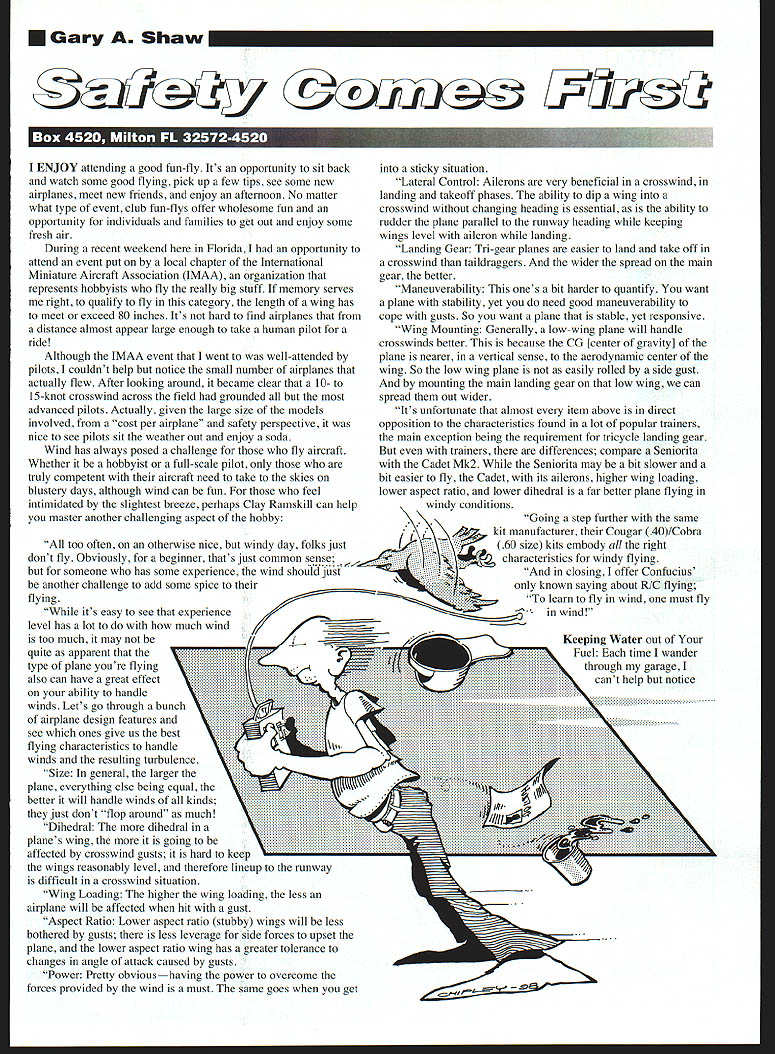
Wind has always posed a challenge for those who fly aircraft. Whether it be a hobbyist or a full-scale pilot, only those who are truly competent with their aircraft should take to the skies on blustery days, although wind can be fun. For those who feel intimidated by the slightest breeze, perhaps Clay Ramskill can help you master another challenging aspect of the hobby.
All too often, on an otherwise nice but windy day, folks just don't fly. Obviously, for a beginner, that's common sense; but for someone who has some experience, the wind should just be another challenge to add some spice to their flying.
While it's easy to see that experience level has a lot to do with how much wind is too much, it may not be quite as apparent that the type of plane you're flying also can have a great effect on your ability to handle winds. Let's go through a bunch of airplane design features and see which ones give us the best flying characteristics to handle winds and the resulting turbulence.
Design factors that affect wind handling
- Size: In general, the larger the plane, everything else being equal, the better it will handle winds of all kinds; larger models just don't "flop around" as much.
- Dihedral: The more dihedral in a plane's wing, the more it is going to be affected by crosswind gusts; it is hard to keep the wings reasonably level, and therefore lineup to the runway is difficult in a crosswind situation.
- Wing loading: The higher the wing loading, the less an airplane will be affected when hit with a gust.
- Aspect ratio: Lower aspect-ratio (stubby) wings will be less bothered by gusts; there is less leverage for side forces to upset the plane, and the lower aspect ratio wing has a greater tolerance to changes in angle of attack caused by gusts.
- Power: Pretty obvious—having the power to overcome the forces provided by the wind is a must. The same goes when you get into a sticky situation.
- Lateral control: Ailerons are very beneficial in a crosswind, in landing and takeoff phases. The ability to dip a wing into a crosswind without changing heading is essential; as is the ability to rudder the plane parallel to the runway heading while keeping the wings level with aileron while landing.
- Landing gear: Tri-gear planes are easier to land and take off in a crosswind than taildraggers. And the wider the spread on the main gear, the better.
- Maneuverability: You want a plane with stability, yet good maneuverability to cope with gusts. So you want a plane that is stable, yet responsive.
- Wing mounting: Generally, a low-wing plane will handle crosswinds better. This is because the CG (center of gravity) of the plane is nearer, in a vertical sense, to the aerodynamic center of the wing. So the low-wing plane is not as easily rolled by a side gust. And by mounting the main landing gear on that low wing, we can spread them out wider.
It's unfortunate that almost every item above is in direct opposition to the characteristics found in a lot of popular trainers, the main exception being the requirement for tricycle landing gear. But even with trainers, there are differences; compare a Seniorita with the Cadet Mk2. While the Seniorita may be a bit slower and a bit easier to fly, the Cadet, with its ailerons, higher wing loading, lower aspect ratio and lower dihedral is a far better plane for windy conditions.
Going a step further with the same kit manufacturer, their Cougar .40 / Cobra (.60) size kits embody all the right characteristics for windy flying.
And in closing, I offer Confucius' only known saying about R/C flying: "To learn to fly in wind, one must fly in wind!"
Proper Fuel Storage and Sealing
On some days the fuel jugs I've stored on a shelf look as if they're ready to pop, and on other days they look as if they're imploding.
Having stored enough fuel on that shelf to last a few months (and using a new gallon every couple of weeks), I can attest to the fact that every drop was fresh and worked flawlessly in everything from sport airplanes to helicopters. Why, then, the weird-shaped containers in the garage if everything was okay? Proper sealing!
If you've flown and couldn't keep an engine running, perhaps you experienced contaminated fuel. It's the demise of many fine aircraft—thrown propellers, hand-in-the-propeller incidents, stalled (crashed) aircraft, etc. If those things sound familiar, don't worry.
While scanning the Internet, I came across an article (author unknown) that provides an easy solution: keep air and water out of your fuel. A little "water in the gas" will really mess up the way a radio-control engine runs.
The problem is that the alcohol in fuel is hygroscopic; that is, it will absorb water. It will greedily absorb water that condenses in the fuel bottle, and will even grab water out of humid air.
Some air gets into a fuel bottle during normal fueling operations; it's unavoidable. That's not the real problem, though. The big problem comes while the fuel bottle sits in a garage for a week or so between flying sessions. If there is any leakage in the bottlecap and fueling fittings, air will flow in and out of the fuel bottle as the garage (and the bottle) heats and cools. Each time "new" air goes in, so does water vapor. This condition worsens as the fuel level in the bottle gets low—more air, less fuel to assimilate the water involved.
If your bottle isn't trying to collapse itself on cool mornings or blow up when really warm, you don't have a good seal! And if you see droplets of water inside the bottle above the fuel on those cool mornings, you've got problems. There are a couple of ways to solve this without worrying about making a new cap.
- Replace your refueling hardware with the original bottlecaps between flying sessions.
- Store your fuel in a climate-controlled area.
I'm lazy; I prefer to leave the fueling system all set up, right in my field box, ready to go. So a better sealing system is needed for the bottle.
The normal refueling system involves drilling a bottlecap, putting in a couple of fittings to provide a fuel pickup and a vent, and sealing them as best we can. This is where the problem seems to be: either the fueling fittings don't seal right or the cap itself isn't sealing properly.
Fuel manufacturers, such as Morgan, put in a little red plastic wedge before shipping the fuel. The white bottlecap depends on sealing right on the top of the neck of the bottle; the red insert retains this sealing action to the inside of the neck of the bottle. I'll utilize one of those red inserts to make the "leakproof" cap. The white outer cap is used to hold in the red insert, which will perform all sealing functions.
I'll mount my refueling fittings in the red insert using some rubber or silicone to seal them. Squeezing that filler of rubber (I used a piece of computer mousepad) or silicone as we tighten the fittings, we get a tight seal around the fittings and the neck of the bottle.
The white bottlecap is drilled to provide a 3/16-inch hole in the middle. A hole saw makes quick work of this. Drill the red insert (and rubber, if you use it) for the fittings, about 7/16 inch apart. On top, you need a plywood disk, just the size of the inside of the red insert. 1/8-inch Lite-Ply works; 1/8-inch A/C plywood would be better. This disk must also be drilled for the fittings.
If using rubber as the sealer, you're set. Using silicone, assemble loosely until the silicone sets, then tighten.
The fittings can be obtained at your hobby shop—whatever conforms to the fueling method you use. I used the red and green plastic ones designed to go through a firewall.
Just be sure that there is a solid seal when the system is not in use. A short piece of fuel tube between the two fittings eliminates the pump and fueling lines from the system, and you're in business!
Until next month, enjoy smooth air!
Transcribed from original scans by AI. Minor OCR errors may remain.

