
Safety Comes First
Gary A. Shaw Box 4520, Milton FL 32572-4520
Ni-Cd Knowledge
I can't tell how many times I've been asked questions related to Ni-Cd (nickel-cadmium) battery use and management. One would think that after answering the same questions time and time again, something would stick and the answers would come easy. Since I don't think of the subject often (I'm programmed), and I'm not blessed with gray matter that accommodates theory, formulas, etc., I usually refer to what those who know have written.
I was asked how fit a receiver battery is for safe use, and what needs to be done to keep batteries healthy. I've learned to follow a monthly protocol, and often have to refer to literature when figuring out capacities or available power/demand (which varies with size of pack and demand placed on it).
My routine requires that I cycle receiver and transmitter packs monthly. To accomplish this I've purchased additional chargers and cyclers; however, even though I go through the routine religiously, I'm not convinced that my batteries live longer because of it. I do know that I reduce a pack's tendency to develop memory (Ni-Cd), and I am aware of how many minutes (capacity) each pack is capable of delivering. What I can't tell is when a cell is ready to give up; I've had some register good capacity one day and be dead the next. At minimum, I know how long I've owned the cells, and make it a habit to change them every couple of years. Most brands last at least a few years if used frequently.
Regarding how to calculate capacities, I default to those who use the math often. Helping keep the count correctly this month is modeler Larry Dungan, via the Alaska Radio Control Society newsletter.
Let's review batteries. Capacity of any given nickel-cadmium battery is the amount of electrical energy that can be delivered over a period of time. Energy is measured in amperes or milliamperes (mA) and time is measured in hours. Capacity, C, is measured in ampere-hours, or more commonly for our use, milliampere-hours (mAh).
We can compute the actual operational capacity of a fully charged battery pack by converting the time it took to discharge the pack to hours (divide minutes by 60) and multiplying the result by the discharge current. For example:
- If pack A took 105 minutes to discharge at 300 mA, then 105/60 = 1.75 hours.
- 1.75 hrs × 300 mA = 525 mAh operational capacity.
Every Ni-Cd battery pack has a rated capacity (225 mAh, 450 mAh, 550 mAh, 1200 mAh, etc.). If the operational capacity of the pack, as determined by a battery cycler such as the Ace Digipace, meets or exceeds the rating of the battery pack, then everything is okay. If it does not, then perhaps the pack should be checked or replaced.
Time to Winterize Your Equipment
Winter's just around the corner, which to most of us means that the flying season is coming to a close. It's almost time to prepare for next year's flying safety, or winter flying if you're so inclined. Regardless of which mode you're in, now is a good time to go through the field box and check equipment to determine what needs repairing, replacing, or tossing.
While scanning the internet, I happened upon an article written by Ron Kohler, TCRC Safety Officer, who put the subject in perspective:
Before we hangar our favorite birds for the winter, there are some things that should be done. We need to give them a thorough inspection.
- Check the structure, control system components, fuel system, and mounting components for serviceability. Repair or replace loose, worn, or broken items. Make sure that the airframe is completely reliable again.
- Drain and flush the fuel system. "Pickle" the engine with a good after-run oil.
- Dry oil-soaked wood with a generous coating of K2r™ spot remover. It really does work!
- Before putting our transmitters and batteries on the shelf, they need to be cycled and checked for capacity. Connectors need to be inspected and repaired as necessary.
What you remember today that you forgot to do yesterday could be the cause of a preventable accident. A little extra effort now will contribute to a safe and enjoyable flying season next year.
Safety Tips for Cold-Weather Flying
With winter approaching, there are a few tips and safety reminders to consider each time you decide to fly in freezing conditions. Clay Ramskill provided the following words on the internet:
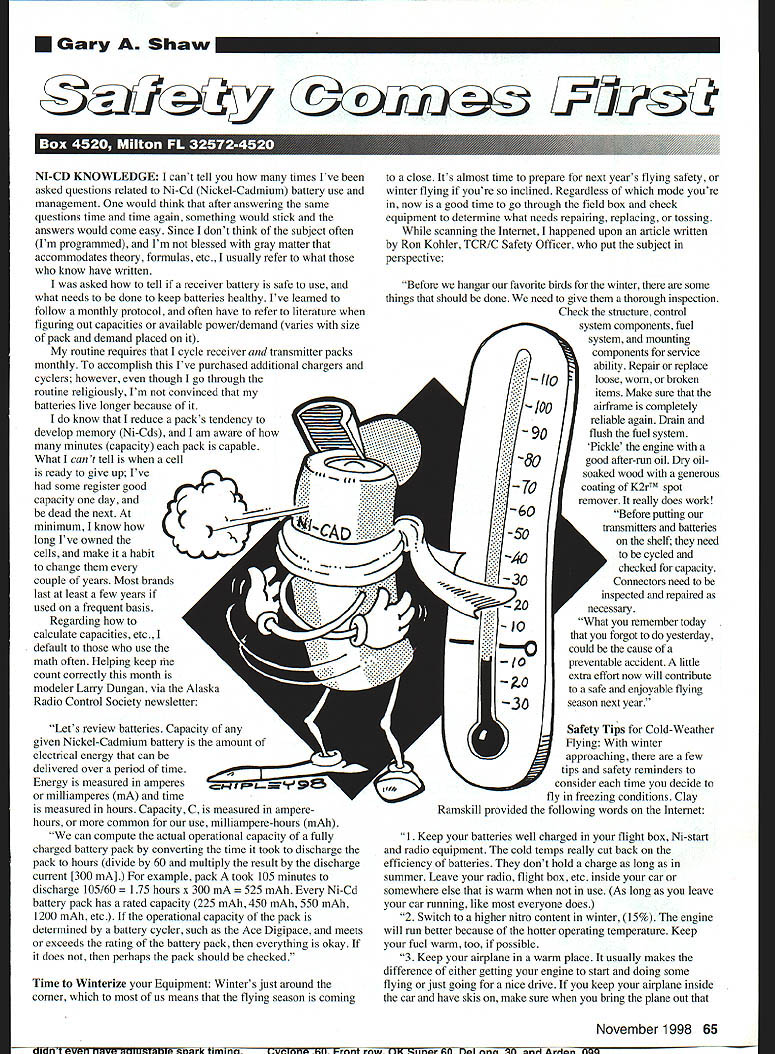
- Keep your batteries well charged in your flight box — Ni-start and radio equipment. The cold temps really cut back on battery efficiency. They don't hold a charge as long as in summer. Leave your radio, flight box, etc., inside your car or somewhere else that is warm when not in use (as long as you leave your car running, like most everyone does).
- Switch to a higher nitro content in winter (about 15%). The engine will run better because of the hotter operating temperature. Keep your fuel warm, too, if possible.
- Keep your airplane in a warm place. It usually makes the difference between getting your engine to start and doing some flying or just going for a nice drive. If you keep your airplane inside the car and have skis on, make sure when you bring the plane out that you immediately push it around in the snow until the skis are cold; otherwise the snow sticks to the skis and the airplane won't glide too well.
- After you get the engine running, leave the Ni-start or plug lead on for a little while. Let the engine run at idle rpm until it warms up. You don't need to rev it up high or stab at the throttle. Just let it run for a few minutes. You may have to set the idle speed slightly higher even for the warm-up period.
- Be cautious when running the engine with the antenna down. Wet ground, snow, pulse glow drivers, etc., can cause radio glitches during winter operations.
I've learned to invest in a radio cover that protects your hands and radio from the elements. I used to freeze my hands on a cold transmitter until I discovered that you can buy or make a radio glove. If you don't like to sew (grin), look to your hobby shop for help. I've purchased covers that work great from a company named Radio Glove; they fit almost all radios and have a clear plastic window on top so you can see switches. Don't risk frostbitten fingers!
If it's really cold, dress warmly and wear a ski mask to protect your ears and face; those body parts, and fingers, freeze quickly when temperatures drop and windchills rise.
Years ago, my friends and I used to dash from our cars, start a model, fly it until we couldn't take it any more (which was about 15 minutes), then scramble for the cars as soon as we got the aircraft on the ground. We were in such a hurry because we didn't wear gloves, were lightly dressed, and thought we could "tough it out" — dumb.
Cold is cold, and it gets even worse when air and fuel blow over you. Don't hurry and get careless. Nothing hurts worse than whacking a cold finger with a prop. If you're not prepared, stay at home and work on next summer's wings!
Before you go to the field in the winter, take the time to check out how cold affects equipment. Charge everything up and put it in the backyard or an unheated garage for a short outside trial. Check servos under range checks, try out glow starters, electric starters, etc. Some radios become cold-sensitive and don't work properly; I've owned some that glitched and put servos in all kinds of weird configurations. If you find electronics a little fidgety at home, don't think things will get any better at the field. If you have several brands of radios, try each one until you're satisfied with the results.
I hope you enjoy the rest of the season. If you spend it in the workshop, remember to use good ventilation when sanding, gluing, painting, and cleaning. If you spend it outdoors, check local conditions and wind chills before wasting the trip; a quick glance at the mercury might make the difference between flying a model or having a "nice drive."
Until next month, keep the skis on the bottom!
Transcribed from original scans by AI. Minor OCR errors may remain.

