
Safety Comes First
Box 4520, Milton FL 32572-4520
Holiday Wishes
MERRY CHRISTMAS! It's that time of year again — time to tear shopping hints from modeling magazines and leave them posted in obvious places around the house. If you really want attention, try sticking the ad for something you want for Christmas on the bathroom mirror; trust me, your "better half" will get the message!
On the top of my wish list this year is a computer flight simulator program (keeps winter rust off the flying skills), a new Radio Glove to protect hands from frostbite, or a foam glider (grin). Okay, maybe I'll settle for a few of my favorite glow plugs, a couple of propellers, and a case or two of reliable fuel. Guess I'm just an optimist. You know, maybe I can count on glow plugs?
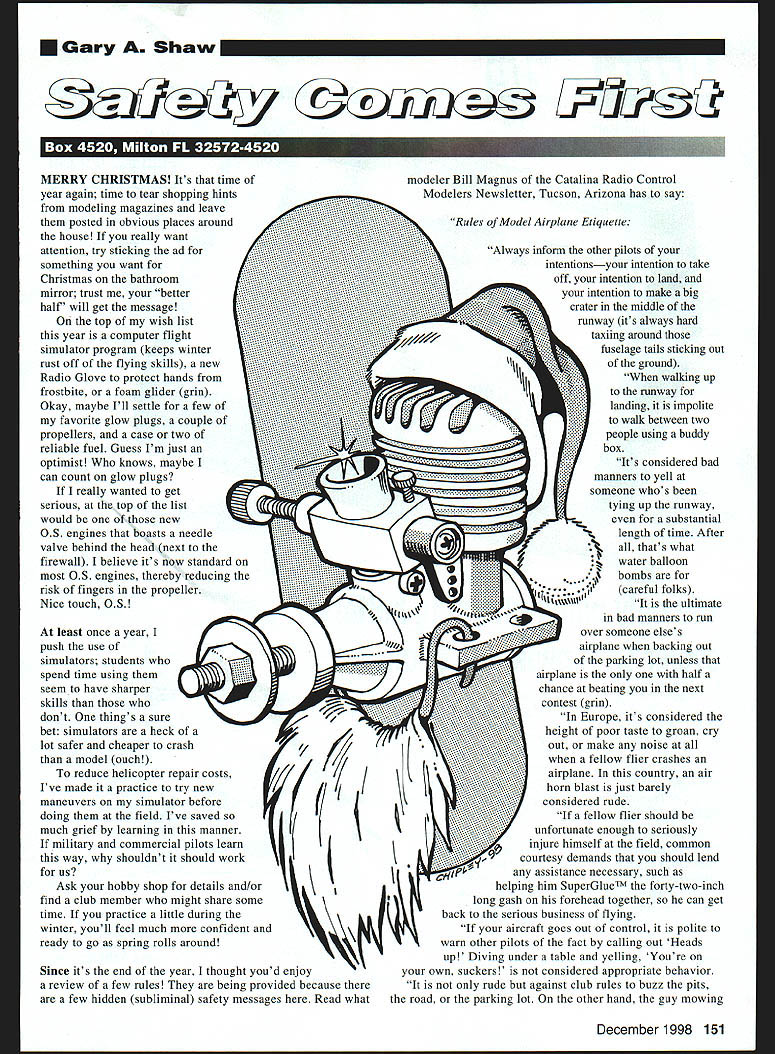
If I really wanted to get serious, at the top of the list would be one of those new O.S. engines that boasts a needle valve behind the head (next to the firewall). I believe it's now standard on most O.S. engines, thereby reducing the risk of fingers in the propeller. Nice touch, O.S.!
Simulators
At least once a year I push the use of simulators; students who spend time using them seem to have sharper skills than those who don't. One thing's a sure bet: simulators are a heck of a lot safer and cheaper to crash than a model (ouch!).
To reduce helicopter repair costs, I've made it a practice to try new maneuvers on my simulator before doing them at the field. I've saved so much grief by learning in this manner. If military and commercial pilots learn this way, why shouldn't it work for us?
Ask your hobby shop for details or find a club member who might share some time. If you practice a little during the winter, you'll feel much more confident and ready to go as spring rolls around!
Rules of Model Airplane Etiquette
These are provided courtesy of modeler Bill Magnus of the Catalina Radio Control Modelers Newsletter, Tucson, Arizona — and they contain a few subliminal safety messages:
- Always inform the other pilots of your intentions — your intention to take off, your intention to land, and your intention to make a big crater in the middle of the runway (it's always hard taxiing around those fuselage tails sticking out of the ground).
- When walking up to the runway for landing, it is impolite to walk between two people using a buddy box.
- It's considered bad manners to yell at someone who's been tying up the runway, even for a substantial length of time. After all, that's what water balloon bombs are for (careful folks).
- It is the ultimate in bad manners to run over someone else's airplane when backing out of the parking lot, unless that airplane is the only one with half a chance at beating you in the next contest (grin).
- In Europe, it's considered the height of poor taste to groan, cry out, or make any noise at all when a fellow flier crashes an airplane. In this country, an air horn blast is just barely considered rude.
- If a fellow flier should be unfortunate enough to seriously injure himself at the field, common courtesy demands that you lend any assistance necessary, such as helping him SuperGlue the forty-two-inch long gash on his forehead together, so he can get back to the serious business of flying.
- If your aircraft goes out of control, it is polite to warn other pilots of the fact by calling out "Heads up!" Diving under a table and yelling "You're on your own, suckers!" is not considered appropriate behavior.
- It is not only rude but against club rules to buzz the pits, the road, or the parking lot. On the other hand, the guy mowing the lawn is always fair game.
Columnist's note: humor, folks. Always be considerate and patient when a beginner pilot comes to the flying field with a trainer. Someday he'll be a reckless, egotistical pilot just like you.
Somehow I find a little disturbing that I can relate to much of the above. I guess I've been in the hobby too long.
Pre-season Checks
On a serious note, I hope that if you read last month's column you took some time to go through your flight box — replace or throw out broken and/or worn-out propellers, rubber bands, glow plugs, etc. It's surely easier to check equipment prior to storing it for the winter than to remind yourself in the spring after the weather gets better.
Safety on the Field
At the flying field, watch someone start an unsecured model, sit down in front of it, and watch it run. I've seen several people do nothing while holding running models. In one case, a pilot set his transmitter a few feet away and smoked a cigarette — what appeared to be a standoff between him and the airplane.
You know what I'm referring to: a model striking someone's body when a radio glitch, battery short, or transmitter bump occurs. You don't want to hear or see what it's like when a propeller hits.
If you buy a cheap piece of steak and put it on the ground and run a lawnmower over it, what gets discharged out the chute will have a similar appearance and texture to what could come off the blades. Do you want to sit in front of a model? Sounds disgusting. The situation is preventable. Use some common sense: have a friend hold the model you're starting. Once it's started, turn it toward the runway away from the pits. Never taxi toward the pits; never leave a running model unattended.
Electric Gliders: Hand-Launching
A friend purchased a real beauty electric glider; it arrived with bells and whistles installed. From the perspective of quality, this kit has it all and is a gem to fly. Each time we take the model up, I'm amazed by how quickly it climbs to altitude and how well it performs in thermals. Electric flight has really come of age.
Although these gliders are fun to fly, I learned a valuable lesson regarding hand-launching: to launch an electric glider, turn it on, advance the throttle speed control to full power, toss it in the air, and watch it climb out. Man, do they perform! However, be careful not to hit your head with the propeller as you arc your arm back in preparation for the toss.
A few centimeters from my ear was all it took to realize that carbon-fiber propellers on electrics can, and do, cut just as well as their powered cousins. Be careful while launching and enjoy the sail.
Winter Building and Painting
If you're getting ready to do some spray-painting this winter, be sure to have plenty of ventilation; paint fumes can be hazardous if allowed to accumulate in small spaces. Enjoy the winter building season and avoid mishaps; wear protective equipment and clothing, and add ventilation whenever you intend to paint!
That's all for now. Merry Christmas and have a Happy New Year!
Transcribed from original scans by AI. Minor OCR errors may remain.

