
Gary A. Shaw
Box 4520, Milton FL 32572-4520
Safety Comes First
Taxi in the Pits?
In contrast to recent summers, I spent a fair amount of time at the field this year, with a number of new student pilots. When teaching another to fly, my style has always been to set a good example through adherence to field rules and the AMA Safety Code.
During several recent trips to the field, I've noticed that it's become somewhat standard practice to land a model and taxi it back to the car. The field I commonly go to has a paved runway to which vehicles can pull up. It's convenient and safe, provided pilots respect a yellow line that runs near the centerline and separates runway from pits. If you cross that line, it puts you behind the flightline—a no-no in most clubs.
Because the vehicles are nearby, pilots routinely start up, taxi out, fly, and taxi back to their cars. Why do I care? On one occasion, a quarter-scale model's throttle got stuck while taxiing toward the cars, and the model was moving at high speed toward an area where people sat in lawn chairs watching. The pilot averted disaster by pulling back on the stick and taking off just feet before plowing into people (who were diving for cover) and their vehicles.
In another incident, a pilot landed his model and did a high-speed turn toward the yellow line (pit area) to try to shorten the distance he had to walk to recover his model. What got everyone's attention was the narrow spacing among several pilots on the line flying their airplanes, and the size (sudden proximity) of the model (1/4-scale); its 22-inch (or so) propeller arc prompted the other pilots to get out of the way. No one got hurt, and the models being flown were returned safely to the field. However, there was the potential for severe injury.
As I explain to my students, and occasionally to veteran modelers, a pit area is for assembly and disassembly of an aircraft. The only other thing permitted there is social activity. Notice that I didn't include assembly and run-up. Run-ups should usually be done when the model is in the run-up area. In my case, that is the asphalt not far from the vehicles, although for many other clubs it's the reserved area next to the taxiway.
Once started, the model should be taxied away from the pits toward the runway. After landing and taxiing back to the pilot station (always face the model down the runway), models should be shut off and transported back to the pits. It's plain, safe, and simple. Everyone errs now and then, but to err on the side of arrogance or ignorance is not acceptable!
A modeler wrote to tell me about what happens when things go wrong and people are standing in the arc of a prop. That's one reason why I said that models should be started in a designated starting area, not in the pits.
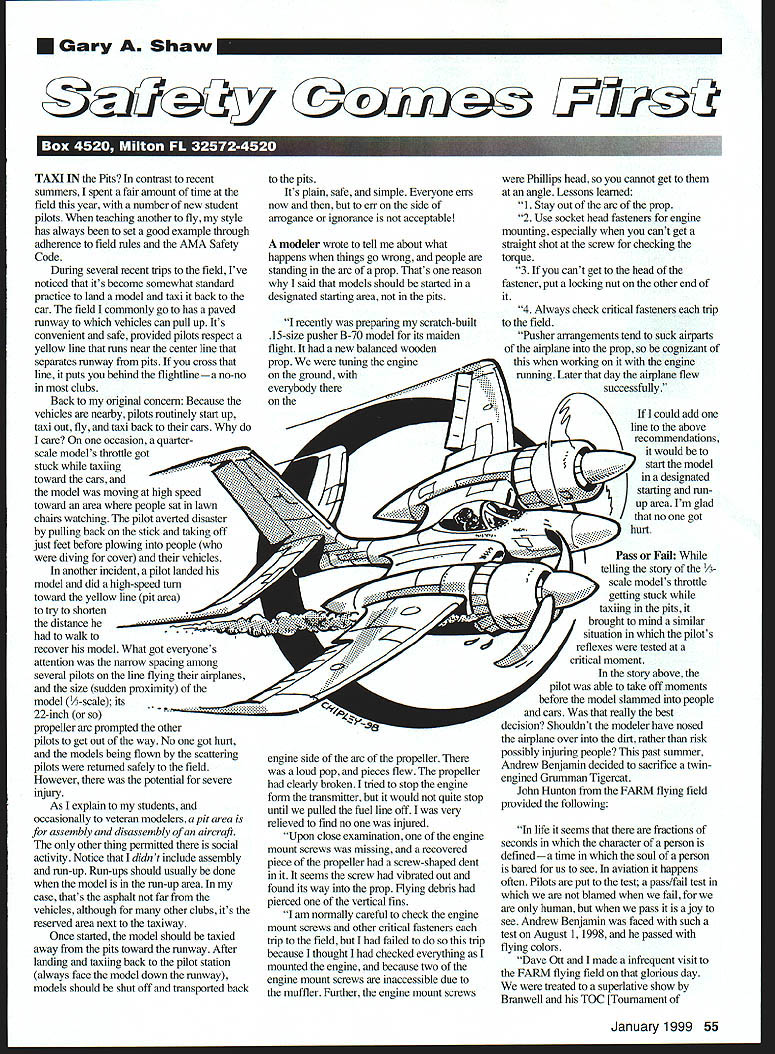
"I recently was preparing my scratch-built .15-size pusher B-70 model for its maiden flight. It had a new balanced wooden prop. We were tuning the engine on the ground, with everybody there on the engine side of the arc of the propeller. There was a loud pop, and pieces flew. The propeller had clearly broken. I tried to stop the engine from the transmitter, but it would not quite stop until we pulled the fuel line off. I was very relieved to find no one was injured.
"Upon close examination, one of the engine mount screws was missing, and a recovered piece of the propeller had a screw-shaped dent in it. It seems the screw had vibrated out and found its way into the prop. Flying debris had pierced one of the vertical fins. I am normally careful to check the engine mount screws and other critical fasteners each trip to the field, but I had failed to do so this trip because I thought I had checked everything as I mounted the engine, and because two of the engine mount screws are inaccessible due to the muffler. Further, the engine mount screws were Phillips head, so you cannot get to them at an angle. Lessons learned:
- Stay out of the arc of the prop.
- Use socket head fasteners for engine mounting, especially when you can't get a straight shot at the screw for checking the torque.
- If you can't get to the head of the fastener, put a locking nut on the other end of it.
- Always check critical fasteners each trip to the field.
"Pusher arrangements tend to suck air/parts into the prop, so be cognizant of this when working on it with the engine running. Later that day the airplane flew successfully."
If I could add one line to the above recommendations, it would be to start the model in a designated starting and run-up area. I'm glad that no one got hurt.
Pass or Fail
While telling the story of the 1/4-scale model's throttle getting stuck while taxiing in the pits, it brought to mind a similar situation in which the pilot's reflexes were tested at a critical moment. In the story above, the pilot was able to take off moments before the model slammed into people and cars. Was that really the best decision? Shouldn't the modeler have nosed the airplane over into the dirt, rather than risk possibly injuring people? This past summer, Andrew Benjamin decided to sacrifice a twin-engined Grumman Tigercat.
John Hunton from the FARM flying field provided the following:
"In life it seems that there are fractions of a second in which the character of a person is defined—a time in which the soul of a person is bared for us to see. In aviation it happens often. Pilots are put to the test; a pass/fail test in which we are not blamed when we fail, for we are only human, but when we pass it is a joy to see. Andrew Benjamin was faced with such a test on August 1, 1998, and he passed with flying colors."
Dave Ott and I made an infrequent visit to the FARM flying field on that glorious day. We were treated to a superlative show by Branwell and his TOC (Tournament of Champions) model, which will do anything he wishes between 2–30 feet from the ground and perhaps within a 100-foot circle. We think we even saw his model fly backward.
"Later, all eyes were on Andy Benjamin's beautiful twin Grumman Tigercat, which has about a ten-foot span, retracts, and twin Quads (or something similar). Andy was flying the airplane smoothly, but he was having trouble with one engine, which would drop out somewhat at less than full throttle. So he was making full-throttle passes across the field and pulling up fast past the crowd to do his maneuvers safely.
"Andy's Tigercat was turning in to the left to make another fast pass. At the very instant the model was pointing right at us, we heard a shout from Andy, then the strange noise one engine was suddenly making, like it was running away at high rpm. Andy had felt the problem and shouted a warning even before the strange sound got to us. Something was wrong with the right engine.
"The loss of power from the right engine produced just enough asymmetric force to bring the model out of the turn. It was hot and low and headed right toward us for an instant. A decision had to be made by Andy as to whether to continue his turn away from the dead engine, right toward us, and try to correct the problem and land farther down the runway, of which there was plenty left. The other decision was to turn into the dead engine, safely away from the onlookers, and probably sacrifice the model.
"Andy opted for the second decision. The remarkable thing was that the obvious decision for utmost safety of the people was made so quickly, without hesitation, in a reflexive manner. The model was only headed in our direction for an instant, but this was the defining instant and the safest decision was inevitably made.
"Andy struggled with the model, and through good piloting, almost made it around to the field. The model can probably be repaired. One can only imagine, however, how much damage could have been done if the other decision had been made, to try and save the crippled model, if the model had crashed into the spectators and been uncontrollable.
"If modelers got medals, Andrew Benjamin would deserve one for his reflexive safety action. Would you pass a similar test? We all hope so.
Until next month.
Transcribed from original scans by AI. Minor OCR errors may remain.

