
Safety Comes First
Winter Battery Woes
By the time this column arrives, many of us will be hibernating next to a furnace, reading a book, or making progress on a long-lost project rediscovered in the basement.
Although most will stay inside during the winter, many will charge up and venture out for a little fun. Before you pack everything up and head to the field, remember a few winter flying basics:
- It's cold — protect all exposed skin. Moist skin can stick to metal that has been cooled to freezing or below, and frostbite is a real risk. Dress warmly, keep your hands in gloves as long as possible, and be careful when handling metal parts.
- Fluids such as after-run oil and fuel get thicker when cold. It takes longer to fuel/defuel and to get an engine started in winter compared to summer months. Starter-box batteries lose charge quickly when turning engines for longer periods, and flight packs use more juice when pushing stiff flight systems. Keep things as warm as possible, and check flight-pack battery levels often.
Although I haven't flown in winter for years, I used to fuel the airplane and turn it over before leaving the garage. Can you have fun? You bet!
But what can happen if you ignore the effects of cold? A review of the following web-page excerpt entitled "Crash" might be in order:
"One favorite that springs to mind was the day that I found out Ni-Cd batteries don't last as long in cold weather. I was flying a Sportster 20 off a foot of snow using floats. It was on the athletic field of a local school (don't do this either). I did one nice crisp hammerhead and the airplane proceeded to scream straight down, full throttle, from about 300 feet, and crash dead smack onto the top of a baseball backstop.
"The trampoline action of the backstop was simply amazing. Little bits of that airplane were catapulted 50 feet back into the air in a truly lovely bomb-burst maneuver.
"Once I got to the crash site, I found another interesting feature: I could only see one or two big (and light) pieces, but there were all these little mole-holes in the otherwise-pristine blanket of white. At the bottom of this one would be a wheel, that one might hold a servo, another a battery. So I spent the next 30 minutes carefully harvesting an acre of the schoolyard, while I froze my assets."
Flash Boom
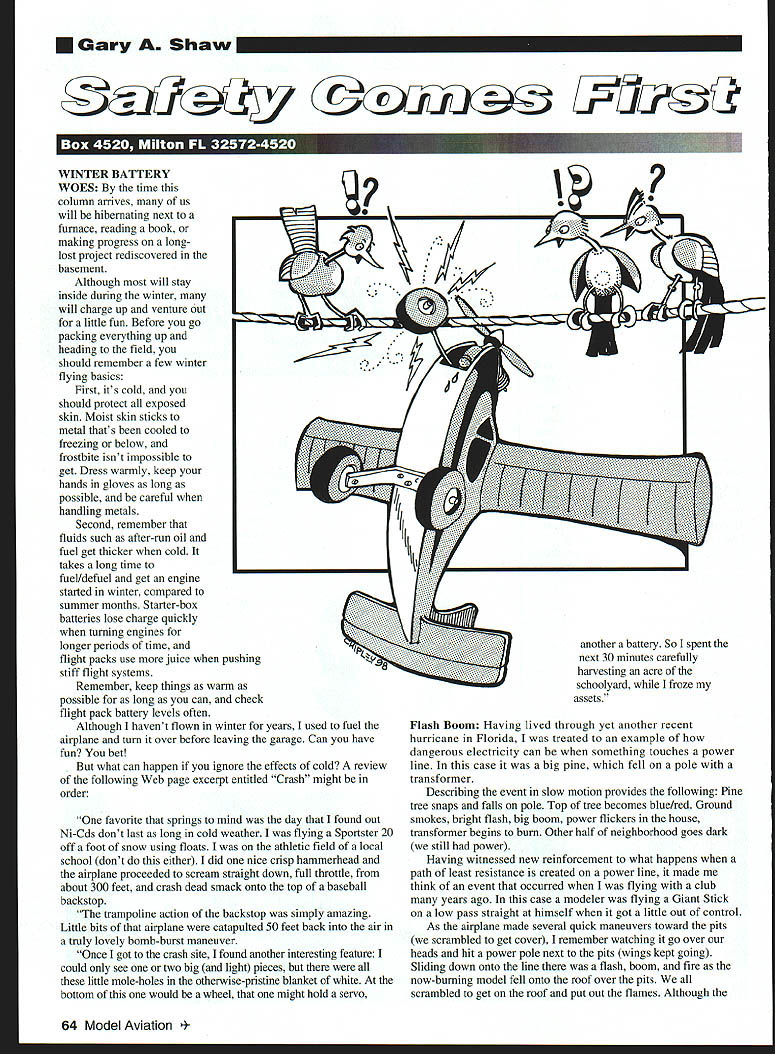
Having lived through yet another recent hurricane in Florida, I was treated to an example of how dangerous electricity can be when something touches a power line. In this case it was a big pine that fell on a pole with a transformer.
Describing the event in slow motion provides the following: the pine tree snapped and fell on the pole. The top of the tree became blue/red. The ground smoked, there was a bright flash, a big boom, and the power flickered in the house. The transformer began to burn. Half the neighborhood went dark (we still had power).
Having witnessed reinforcement of what happens when a path of least resistance is created on a power line, it made me think of an event that occurred when I was flying with a club many years ago. In this case a modeler was flying a Giant Stick on a low pass straight at himself when it got a little out of control. As the airplane made several quick maneuvers toward the pits, we scrambled to get cover. I remember watching it go over our heads and hit a power pole next to the pits. The wings kept going. Sliding down onto the line there was a flash, boom, fire, and the now-burning model fell onto the roof over the pits. We scrambled to get on the roof and put out the flames. Although the airplane was destroyed, little else was damaged that day.
Weeks later I recall watching a rocket descend on its parachute onto the same pole. Although it didn't cause sparks, the owner attempted to get on the roof to retrieve it. Fortunately, modelers present dissuaded individual retrieval efforts and a call was made to the local power company. Although the rocket spent a few nights dangling from the line before being rescued, it was safely retrieved and flew again.
The point of my mentioning this is to remind readers that electricity is dangerous, especially when you're dealing with power lines. A few modelers have similar experiences. Crazy Harold was flying a trainer along the wrong side of the field, behind the pits, one day. He misjudged the distance to the high-tension power lines, landed, skidded, and came to rest hanging a hundred feet off the ground by the nose gear. The story goes that it hung all summer before a storm finally blew it down.
At an upscale soaring competition, some participants got a nice expensive high-tech composite beauty tangled in nearby high-tension power lines. It fell with its wings touching two lines—flash—kaboom! Carbon fiber is electrically conductive, and in that brief instant it was blown into snowflake-sized cinders.
Moral of the stories: be careful whenever you're dealing with power lines. Call the power company and ask for help.
Safety Comes First
Woof! I often hear modelers comment that fire is not an issue with models, since they don't burn if crashed. To help set the record straight, here are a few examples of things that do burn—some crash-related and some not.
Much of what we use is flammable—solvents, paints, various fuels, wood, etc.—both in the shop and in the field. Richard Brown writes:
"I have an older friend who flies full-scale aircraft who tells this story. He and a friend flew control-line models when they were young. It was common practice during the winter to preheat the engine by squirting a little fuel on the cylinder head and igniting it.
"The friend was attempting to preheat his brand-new P-40 and must have gotten a little fuel on the airframe (which had been lovingly painted in nitrate dope). Woof! Twenty seconds later he had an engine sitting in a pile of glowing embers."
From Mark D. Vanderbilt:
"A from-our-field guy had a giant Ugly Stick with a G-62 on it. The original wing was blown out of his pickup and never found. He made a new foam-core wing, but for some reason didn't put a dihedral brace in it.
"When the wing broke at about 200 feet, the fuselage punched a hole about two feet deep in the same rock-hard field. Then the gasoline caught fire and burned what was left."
From an unknown modeler:
"When I was about five, my father had finished a brand-new gasoline-powered RC stunt/racing airplane. We went out to an empty parking lot, and I remember watching the airplane fly all over the sky—it was great. Then it decided to go into a full-power dive.
"When we got to the crash site, there were small (less than one-inch-square) pieces of plastic and other debris blown about 20 feet, and right in the center of the debris was about a two-foot-diameter ring of flames.
"Even after all the time that he had put into it, he cracked up because it just looked so funny!"
A parting thought from Skid Wroe: Laugh, lest we cry. Fly safely, use your brains, but keep the glue handy.
Transcribed from original scans by AI. Minor OCR errors may remain.

