

SAFETY COMES FIRST!
Let's be safe in the workshop, too!
- John Preston
Our topic this month is safety in the workshop. In case you are wondering, this topic was not chosen because of our incident with the broken drill bit (see June column), but rather because we received a complete discussion on this subject from Jim Coplan. Jim hails from the Pittsburgh area of Pennsylvania and is primarily a CL modeler.
However, before turning the column over to Jim, an article in the Gold Coast Flyer (editors: Art and Charlotte Johnson) on the subject of hot transmitters is worthy of note. It reads as follows:
"When Irv Allison checked why his transmitter, just removed from the cabinet at home, did not work, he found the wiring inside burnt up and one of the battery cells exploded. It apparently shorted out just sitting on the shelf but fortunately did not set the house on fire. Mario Yedelinic had a similar experience out at the field one day. Those Ni-cads produce a lot of heat with a direct short."
A while ago we heard of an incident in which it was alleged that a brand-new radio, just purchased and still in its box, set fire to a station wagon. At the time this story seemed difficult to believe, but now we wonder. If any readers have had similar experiences, we'd be interested to hear them.
And now, over to Jim Coplan for a look into the inner sanctum — the workshop.
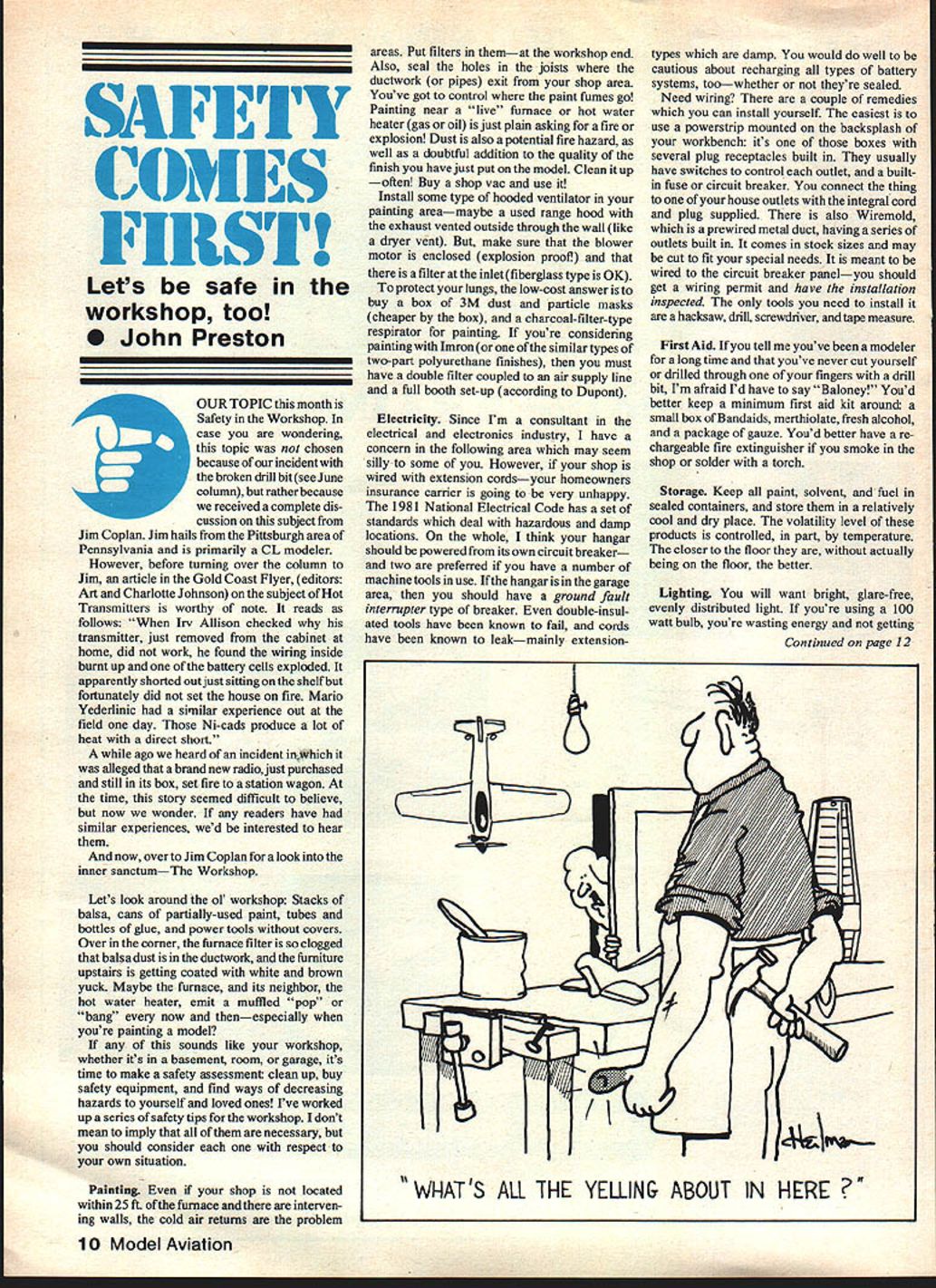
Let's look around the ol' workshop: stacks of balsa, cans of partially used paint, tubes and bottles of glue, and power tools without covers. Over in the corner, the furnace filter is so clogged that balsa dust is in the ductwork, and the furniture upstairs is getting coated with white and brown yuck. Maybe the furnace, and its neighbor the hot water heater, emit a muffled "pop" or "bang" every now and then — especially when you're painting a model!
If any of this sounds like your workshop, whether it's in a basement, room, or garage, it's time to make a safety assessment: clean up, buy safety equipment, and find ways of decreasing hazards to yourself and loved ones. I've worked up a series of safety tips for the workshop. I don't mean to imply that all of them are necessary, but you should consider each one with respect to your own situation.
Painting
Even if your shop is not located within 25 ft. of the furnace and there are intervening walls, the cold air returns are the problem areas. Put filters in them — at the workshop end. Also, seal the holes in the joists where the ductwork (or pipes) exit from your shop area. You've got to control where the paint fumes go! Painting near a "live" furnace or hot water heater (gas or oil) is just plain asking for a fire or explosion.
Dust is also a potential fire hazard, as well as a doubtful addition to the quality of the finish you have just put on the model. Clean it up — often! Buy a shop vac and use it.
Install some type of hooded ventilator in your painting area — maybe a used range hood with the exhaust vented outside through the wall (like a dryer vent). But make sure that the blower motor is enclosed (explosion proof!) and that there is a filter at the inlet (fiberglass type is OK). To protect your lungs, the low-cost answer is to buy a box of 3M dust and particle masks (cheaper by the box), and a charcoal-filter-type respirator for painting. If you're considering painting with Imron (or one of the similar types of two-part polyurethane finishes), then you must have a double filter coupled to an air supply line and a full booth set-up (according to DuPont).
Electricity
Since I'm a consultant in the electrical and electronics industry, I have a concern in the following area which may seem silly to some of you. However, if your shop is wired with extension cords — your homeowners insurance carrier is going to be very unhappy. The 1981 National Electrical Code has a set of standards which deal with hazardous and damp locations. On the whole, I think your hangar should be powered from its own circuit breaker — and two are preferred if you have a number of machine tools in use. If the hangar is in the garage area, then you should have a ground-fault interrupter type of breaker. Even double-insulated tools have been known to fail, and cords have been known to leak — mainly extension types which are damp. You would do well to be cautious about recharging all types of battery systems, too — whether or not they're sealed.
Need wiring? There are a couple of remedies which you can install yourself. The easiest is to use a power strip mounted on the backsplash of your workbench; it's one of those boxes with several plug receptacles built in. They usually have switches to control each outlet, and a built-in fuse or circuit breaker. You connect the thing to one of your house outlets with the integral cord and plug supplied.
There is also Wiremold, which is a prewired metal duct, having a series of outlets built in. It comes in stock sizes and may be cut to fit your special needs. It is meant to be wired to the circuit breaker panel — you should get a wiring permit and have the installation inspected. The only tools you need to install it are a hacksaw, drill, screwdriver, and tape measure.
First Aid
If you tell me you've been a modeler for a long time and that you've never cut yourself or drilled through one of your fingers with a drill bit, I'm afraid I'd have to say "Baloney!" You'd better keep a minimum first aid kit around: a small box of Band-Aids, merthiolate, fresh alcohol, and a package of gauze. You'd better have a rechargeable fire extinguisher if you smoke in the shop or solder with a torch.
Storage
Keep all paint, solvents, and fuel in sealed containers, and store them in a relatively cool and dry place. The volatility level of these products is controlled, in part, by temperature. The closer to the floor they are, without actually being on the floor, the better.
Lighting
You will want bright, glare-free, evenly distributed light. If you're using a 100-watt bulb, you're wasting energy and not getting sufficient light. Many hardware stores sell utility 4-ft. fluorescent strips for under $15. They come with the light tubes, plus the cord to hook up to your light socket, and (usually) a switch.
Rules for safe operation of machine tools
- Know how to operate a tool before you use it (read the directions!).
- If a tool — such as a lathe — has any optional safety equipment, consider buying it.
- Bandsaws have a tendency to "throw" a blade, or to break near the weld. Find an industrial supplier (such as DoAll) and go visit them. Explain what you are doing, and they can supply all of the tools and blades for your needs.
- Spend as much as you can afford in order to get a quality item. It will work better and last longer.
- Don't wear loose garments! They get caught in the machinery!
- Have a telephone installed in a convenient, unobstructed spot — and have emergency numbers posted next to it: fire, police, ambulance.
- To protect your eyes, get a pair of safety glasses with chip shields for use when you're working with any kind of machine tool.
Drugs, drinking, etc.
If you are on medications which alter pain tolerance or affect various of your vital functions — try to work before taking them. Be alert and safe. If you must have an occasional snort, leave the shop and relax with it someplace else. This is also true with certain Class I narcotics — including the leafy kind. Smoking while using volatile materials is stupid and deadly dangerous! Use an unlit pipe for a pacifier.
Rags and things
Never leave solvent-soaked rags in an open container. Don't reuse rags — they are cheap, and oily ones need special cleaning (which is expensive). Put used blades and other sharp implements in a container of their own — and dispose of them accordingly. The trash man will appreciate it!
Miscellaneous
Wouldn't your drill press look better with a cover on it? And just think: if it were safetied, you'd be able to invite your special someone into your shop to help out with the hobby, or join us in the participation — or both!
By the way — when was the last time you vacuumed the walls and ceiling of your shop? Dust is an enemy — messy, toxic, and explosive! Just remember: the flying field isn't the only place for safety. Enjoy the hobby — be safe in all you do, at home or away!
Next month
The topic will be safety at the RC flying field. I've had a number of letters on this subject, and one from Paul Samaras of the Jefco Aeromodelers indicates that this club could set the standard for us all.
Back in the April 1981 issue, we asked you to direct any correspondence to us via AMA HQ, because it looked like we were about to change our residence. Instead, we have changed our plans, and it looks like we will stay put, at least for a while. So, once again, we ask that any letters on the subject of safety should be sent to my "old" address:
John Preston 7012 Elvira Court Falls Church, VA 22042
FLY SAFELY
Transcribed from original scans by AI. Minor OCR errors may remain.

