
Safety Comes First
Gary A. Shaw
Box 4520, Milton FL 32572; E-mail: fly_safe@worldnet.att.net
Look Out for Full-scale
When you're flying, it's easy to focus on a model and forget that the sky is inhabited by more than Radio Control (RC) aircraft. There's always some type of full-scale aircraft buzzing by, often at the same altitude at which you enjoy flying models.
The value of a spotting buddy is worth its weight in gold wherever RC and full-scale aircraft fly in close proximity. A spotter not only lets you know which RC aircraft to avoid, but when—and which direction—to fly to get out of the way of full-scale airplanes.
The use of a spotter is probably mandatory if you fly in a club with much RC activity, but the concept may be new to those of you in smaller clubs. I hope you never fly alone. Take the time to introduce yourself, and ask if someone will spot for you while you tear up the sky! You'll probably make a new friend and avoid an encounter with a full-scale aircraft.
Unpleasant Creatures
No matter what time of year it is in the South, I'm on the lookout for snakes, fire ants, hornets, and alligators whenever I go into deep grass or woods.
Many of you fly at sites that require mowing. When the grass is kept low, life is good; when it gets high, or if a model goes into the deep brush, life gets tough.
More than once I've been told stories of snakes near crashed models, causing would-be retrievers to retreat. Fire ants are equally formidable; their mounds appear overnight, and any bites on exposed skin cause a dance unique to this part of the country—their sting really hurts!
My least favorite is ground-nesting hornets, which swarm anything that gets near their hole. I feel truly sorry for those unfortunate enough to receive their wrath. No one deserves to receive numerous stings, and many—if not all—who have experienced this first-hand search very cautiously.
Water-crash rescues need to be handled with expertise because of alligators. The farther south you go in the U.S., the more important this becomes.
I had an opportunity to go fishing at night on Lake Apopka, near Orlando, FL. While on the water, a friend turned on his spotlight and shined it around the lake; the number of eyes staring back at us gave me a creepy feeling that was hard to shake. Some of those eyes looked as though they were the size of silver dollars! Imagine what they were attached to!
You don't usually see alligators during the day, but be careful around water and proceed with caution.
If you have to go into the woods to retrieve something, make sure you wear long pants and shoes that protect from bites. The more skin you have covered up, the less likely you are to be injured should you encounter something.
Fixed-wing Meets Helicopter
Not long ago, I visited a flying field while I was traveling in California. Sitting down to enjoy a soda, I heard the sickening sound that can only be made when two models collide in midair.
Looking up cautiously, I saw debris coming down; there was so much, it looked like a ticker-tape parade in New York City.
It wasn't long before two modelers with transmitters in hand met in the pits, yelling at one another. It looked as though a helicopter on low approach to the runway collided with a 1/3-scale aircraft that was also coming in for a landing.
The crash seemed to be caused by lack of communication between the pilots. In this particular club, helicopter takeoffs and landings are to be made from special pads and aircraft use the runway. The helicopter approached the end of the runway and hovered at approximately 100 feet. The model came in right behind the helicopter, and splat—confetti in the sky.
The crash was incredible; the airplane literally disappeared, and the helicopter fell to the ground. The helicopter autorotated to a sliding stop and a tip-over.
I stood there, looking up at everything that was coming down. The airplane's engine fell on the runway, a battery pack hit a parked car behind the pits, and what looked like a servo tray attached to pieces of a tail slapped onto the clubhouse roof. Everyone picked up pieces for an hour before giving up. Some modelers ventured into an adjacent field in search of servos, but found nothing.
What was recovered amounted to the off/on switch, one servo in a five-place servo tray, the fuel tank, and assorted pieces of fuselage. The receiver, four servos, and the wheels have not been found.
It's a good testament to the power of composite blades. It was one of the most spectacular midair explosions I've ever seen. I hope helicopter blades of this variety never hit you.
I'm told damage to the helicopter consisted of a bent main shaft, cracked rotor blades, and a bent canopy—all easily repairable.
The moral of the story? Make sure you communicate your intentions to other modelers, regardless of what type of aircraft you fly.
I fly helicopters, and I know that fixed-wing pilots hate it when we hover over the runway. Aircraft can't safely perform flybys or land when a helicopter is there. Hovering is normally only allowed in designated areas, to minimize confusion between pilots.
Use a spotter whenever two or more models are in the air. No spotters were accompanying the pilots that day. Perhaps the two would have met under different circumstances if there had been spotters.
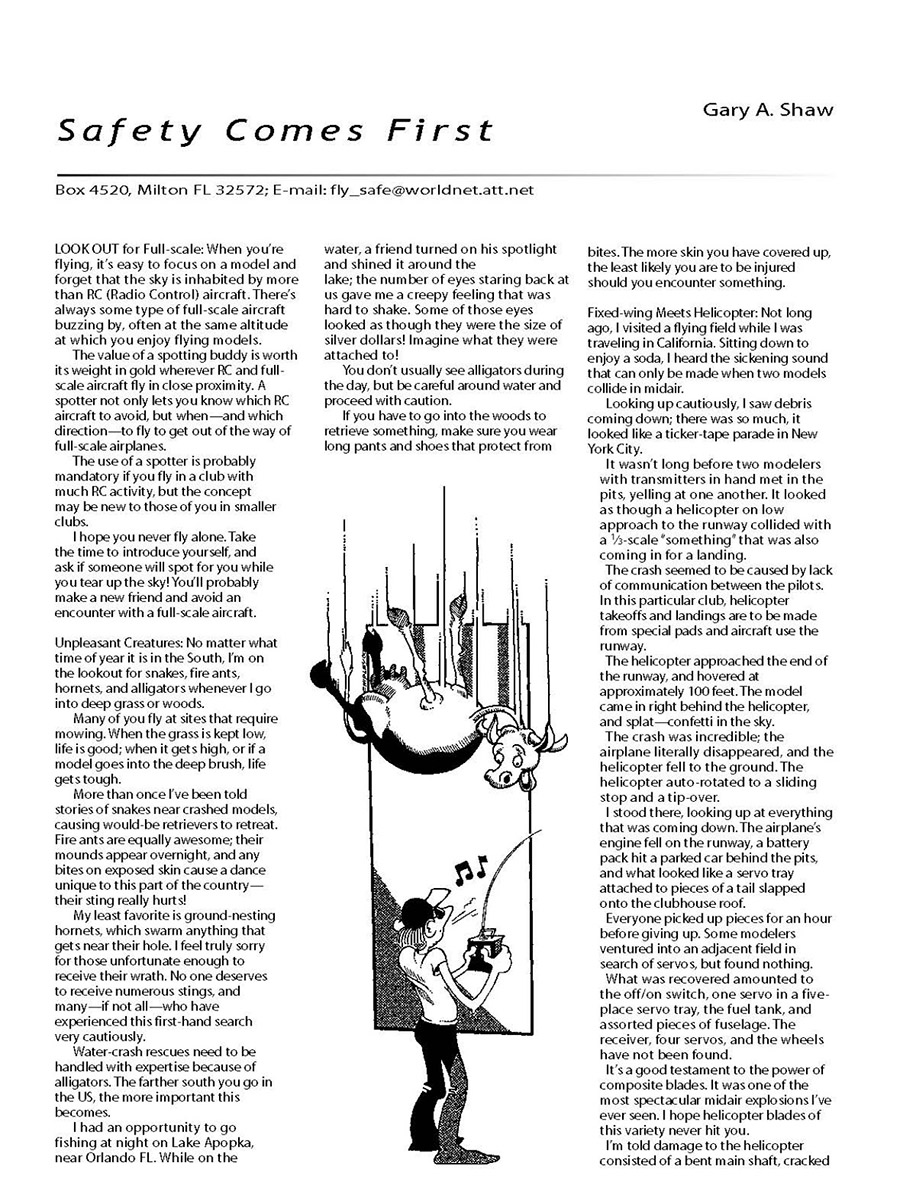
Flying Cow
Every now and then it's fun to put a little humor in the column.
To brighten things up, a modeler in Virginia sent me this E-mail. I'm not sure the story is true, but it makes for good reading at the end of a safety column.
"Earlier this year, the dazed crew of a Japanese trawler was plucked out of the Sea of Japan, clinging to the wreckage of their sunken ship. Their rescue, however, was followed by immediate imprisonment once authorities questioned the sailors about their ship's loss. They claimed that a cow, falling out of a clear blue sky, had struck the trawler amidships, shattering the hull and sinking the vessel within minutes.
"The crew remained in prison for several weeks, until the Russian Air Force reluctantly informed Japanese authorities that the crew of one of its cargo airplanes had apparently stolen a cow wandering at the edge of a Siberian airfield, forced the cow into the airplane's hold, and hastily took off for home.
"Unprepared for live cargo, the Russian crew was ill-equipped to manage a now-rampaging cow within its hold. To save the aircraft and themselves, they shoved the animal out of the cargo hold as they crossed the Sea of Japan, at an altitude of 30,000 feet."
That's all for this month. I hope you're enjoying the winter months and keeping warm at the field.
Remember to keep frostbite to a minimum by covering all exposed skin. Use long johns, gloves, warm clothes, dry socks, and drink plenty of hot chocolate! —M
Transcribed from original scans by AI. Minor OCR errors may remain.

