
Safety Comes First
Gary A. Shaw
Box 4520, Milton FL 32572; E-mail: fly_safe@worldnet.att.net
Dream Airplane Technology
It's a wonderful thing to behold when you get the chance to sit in the seat of an Airbus A300.
What fascinated me most was the lack of a front-column yoke system, traditional in most modern aircraft. A small control arm under the side window, similar to a computer-game joystick (fly-by-wire technology), replaces the yoke system.
I was invited to occupy the captain's seat for a bird's-eye view after I was caught staring into the cockpit. You should have heard the air whoosh behind me as I jumped into the seat! What spectacular technology! Conventional instrumentation has been replaced with cathode-ray-tube displays, talking computerized flight systems, autopilots that can take off and land the airplane, and more.
I commented to the pilot that RC (radio control) flying could use such technological wizardry, but made the point that it is slowly getting there. He indicated that he did fly RC, and he pointed out the similarities that exist between full-scale aircraft systems and RC flight.
The captain watched me move the side-stick control a couple of inches left and right, and commented that the amount of input I made would move the aircraft in a violent maneuver. He explained that sensitivity was controllable and was set so only slight movement provided the control needed (similar to computer radios).
The aircraft also has autothrottles and the ability to take off and land itself. What we wouldn't give for technology like that! RC modeling is almost there—all it takes is cash and setup know-how.
The pilot talked at length about safety and the redundant systems that back each other up, but all I could really think about was how much it would cost to build a scale RC Airbus with just a few of the bells and whistles he was mentioning. More than I could afford, but wouldn't it be a safe and fun airplane to fly?
From the Mailbag
In recent columns I've written about problems I've had with collapsible antennas coming unscrewed from the transmitter base, appropriate cleaning, and signal-strength problems related to not fully extending the antenna. I mentioned I had begun using "rubber ducky" (short-mounted) antennas to eliminate extension problems and cleaning requirements. I've received numerous letters as a result; here are some points readers shared.
Key takeaways:
- Replace worn telescoping antennas when a problem is found; antennas are cheap compared to the loss of an aircraft.
- Range-check at greater distances: test at least 100 meters with the aerial down (the usual 25–30 meters may be insufficient).
- Use proper electrical contact cleaner for telescoping antennas rather than solvents like WD-40.
Mal Richards (Whangarei, New Zealand)
Mal describes problems he encountered from a worn telescoping antenna on a Futaba 9VA.
He was flying a scale Aeronca LB when he had increasing control problems—until he had no control and a very painful crash resulted. He inspected everything and initially suspected a faulty battery. He next used the radio in a .90-powered aerobatic model and had a top aerobatic flier test-fly it; again, all seemed well on takeoff but half a lap later he had no control and another crash.
He sent the radio to the national agent for checking and got it back (with a bill), the report saying all was well. On the next flight, after a range check, the radio again failed when the model got further away. He eventually took the radio to a local electronics expert, who fixed it. The main problem was that the pull-out transmitter antenna was worn where it clipped into place when extended and sometimes did not make contact.
After repair, the expert had a range of 150 meters with the aerial down and the receiver inside a building. It appears the usual range check at some 25–30 meters is insufficient with some transmitters—you should go at least 100 meters with the aerial down.
As an aside, Mal noted a club saying about clip-in Ni-Cd batteries: "It is not if you will crash, but when." It will happen if your batteries are not plugged in.
Mal didn't indicate exactly what the antenna repair was, but in most cases an easier solution is to replace a suspect antenna when a problem is found. Antennas are cheap compared to the loss of an aircraft. Thanks for sharing, Mal!
Jim Petro
Jim sent an email about problems he's encountered with rubber ducky antennas. He had replaced telescoping transmitter antennas with short flexible units and was satisfied for about two years, but then experienced sudden, repeated losses.
The worst period came when three airplanes suffered sudden servo drive to the end of travel and locked. The common denominator was that a rubber ducky was in use each time. On one model (a Stingray slope glider), carbon-fiber construction had already been causing antenna-location problems. Small glitching continued until he swapped in a telescoping antenna; no more glitches followed and all flights were successful.
He checked another rubber-ducky-equipped transmitter and found the same history; replacing the rubber ducky with a telescoping antenna cured it too. He cut open a rubber ducky and found no visible damage. It seems the rubber-ducky antenna's electronic characteristics are tuned with a small "sweet spot" that can drift after a couple of years. After switching back to telescoping antennas, he had no more losses attributable to transmitter issues.
Jim misses his rubber duckies, but the switch saved aircraft.
My radios are making a trip to the dealer for a checkup as a precaution, although I've used a rubber ducky antenna for several seasons with no trouble. Better safe than sorry.
Archie Caldwell (Grass Valley, CA)
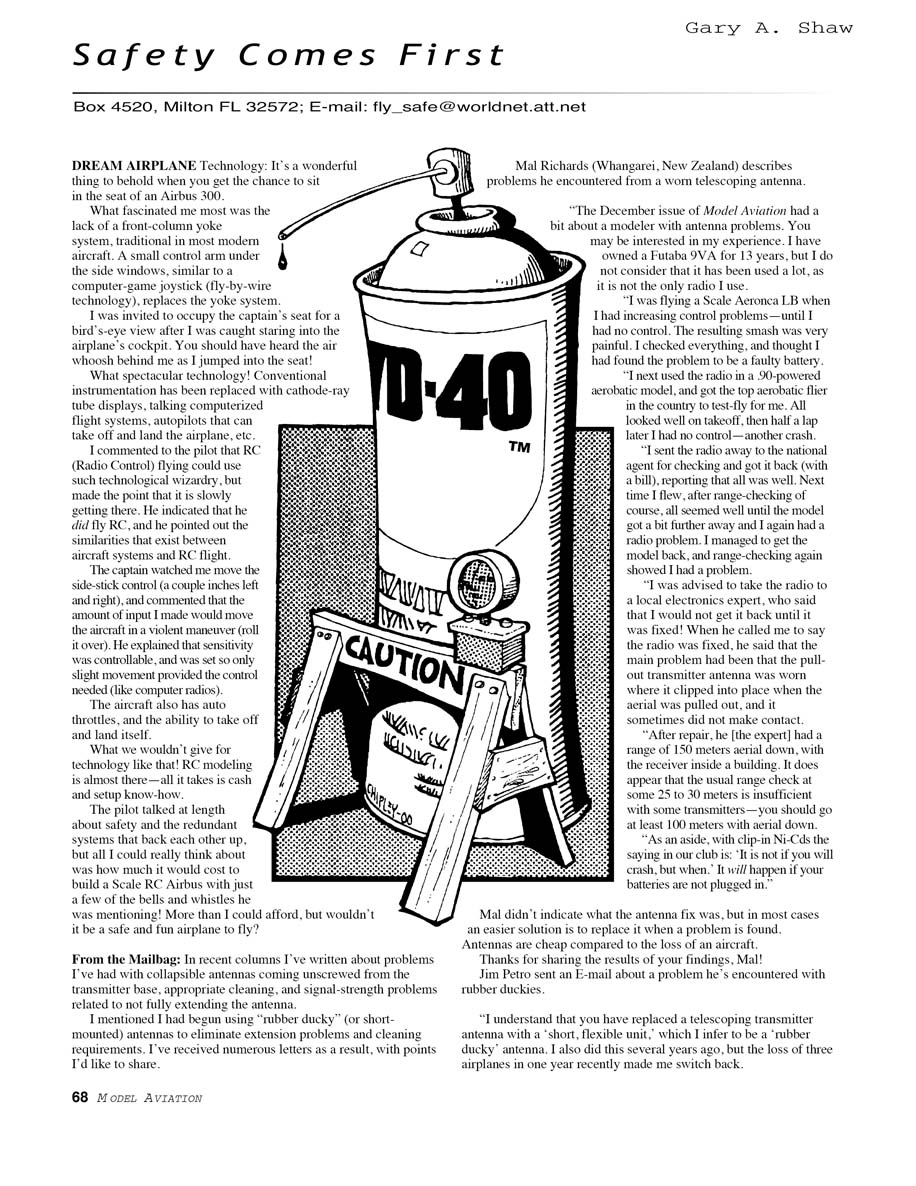
I had written that I used WD-40 to clean my telescoping antenna; several readers told me I was nuts and recommended rubbing alcohol or acetone. Now I use an electrical contact cleaner purchased at Radio Shack, and I haven't had issues since. Archie emailed to warn about WD-40:
He noted that WD-40 is a solvent, not a substitute for proper lubricants or cleaners. When it contacts many electrical components, it can damage or kill them. A friend who repairs tape decks and players recommends replacement if WD-40 has been used, because those items are not easily repaired. Archie also worked for a gun dealer and saw firearms ruined or gummed up by WD-40.
He advised against using WD-40 where a fine lubricant is needed. Archie tossed his cans and recommends others do likewise.
I still have my can, but I won't use it on electronic parts anymore—I hope you won't either.
That's it for this month. Here's wishing you fun winter building and soft ski landings (where intended, of course)!
Until next month ... MA
Transcribed from original scans by AI. Minor OCR errors may remain.

