
Safety Comes First
Box 4520, Milton, FL 32572; E-mail: fly_safe@worldnet.att.net
A Fool's Day
It's been some time since I provided a hand-in-the-prop story. However, since the spring flying season is around the corner, the following letter from Albert Isaacson is a good reminder for those who might become careless around running engines.
“April 1, 2000 was the day I had been waiting for. At the beginning of the year, I had finished my 1/7-scale semiscale model of a Savoia-Marchetti S.56 amphibian. Tom Hunt had agreed to be my test pilot, but we needed a relatively mild morning with winds no stronger than five miles per hour. April first was just that sort of day.
“In August of 1996, RC Modeler had printed my construction article of a scratchbuilt Curtiss SBC-4 Helldiver of my design. The magazine had shown an interest in the Savoia-Marchetti story, but since it too was my design, it had to fly successfully. Thus my rush for that first flight.
“Unfortunately, the field Tom uses, almost an hour and a half from my home, is a rough, grassy one, and the underside of the hull of the Savoia has only about 3/4-inch ground clearance. The wingtip floats are about 1/4-inch higher than that.
“Because of inadequate ground clearance, and about 2° of down-thrust, the two attempts that were made to take off failed, and on the second one, the left wing float caught some grass on the ground and the airplane nosed over. The damage was slight, and in a couple of weeks it would be repaired. The damage to my confidence would take longer.
“I placed the airplane on the field-box stand and started the engine to run the tank dry, but that is not the end of the misadventure, only the beginning. My wife waited patiently in the car as I separated the interplane struts from the top wing and went about looking for more structural damage.
“Sighting down the fuselage from in front of the airplane, in my emotional state I forgot completely that the airplane engine was running.
“I reached forward with my left hand to touch a slight wrinkle in the covering at the gear when it happened.
“The ‘thwack’ I heard and the blood I saw came from the knuckles of my pinky and ring fingers, and were caused by the tip of the blade making a series of thin slices in my skin. I ran to my wife and yelled to get out the first-aid kit.
“She applied some antibacterial gel and Band-Aids, but because of the amount of blood, they would not stick. With my hand held high to try to slow the bleeding, she finally managed to get both fingers wrapped with paper toweling and electrician's tape.
“We both then set about disassembling the airplane and the field-box stand. It took about 10 minutes to get everything into the car, and, with directions from other fliers on the field, another 10 to drive to the nearest hospital.
“The emergency room doctor found when he unwrapped the bandaging that the bleeding had stopped, but because the skin was shredded, it could not be stitched. He ordered X-rays and found the bones had hairline cracks. He then rebandaged the fingers while the nurse gave me a tetanus shot.
“I was placed on penicillin and told to see my family doctor in two days for rebandaging. The ER doctor said it could be up to a year before the skin healed completely and I regained full use of the fingers.
“Because I had read so many articles about safety with props, I was very aware of what not to do, but somehow I was traumatized by the failed attempt of the flight and forgot the number one rule: When the airplane engine is running, never do anything else with the airplane, but pay strict attention to that engine. If there is anything else that needs to be done, shut down the engine first.
“The airplane was easy to repair, but these damaged fingers will remind me of that April first when I was the fool.”
From the Mailbag
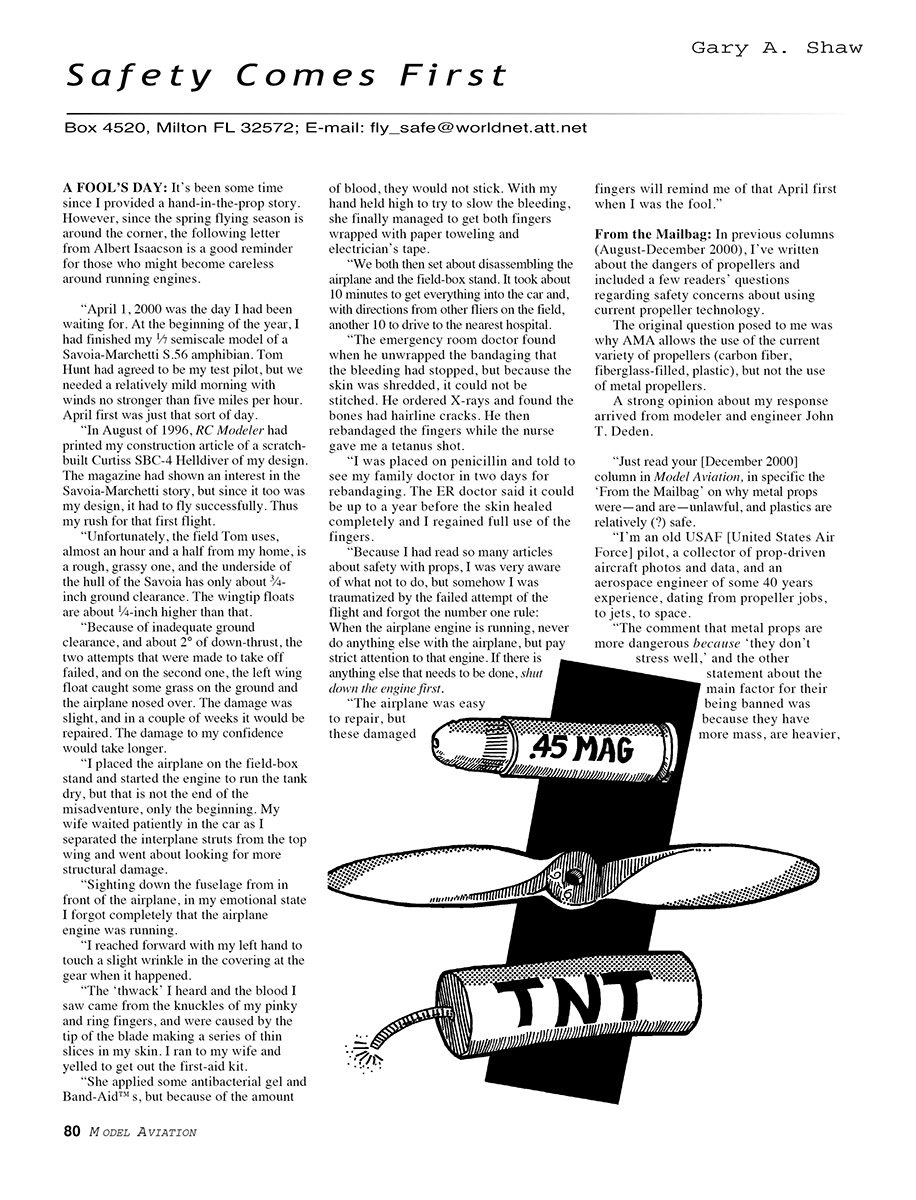
In previous columns (August–December 2000), I've written about the dangers of propellers and included a few readers' questions regarding safety concerns about using current propeller technology.
The original question posed to me was why AMA allows the use of the current variety of propellers (carbon fiber, fiberglass-filled, plastic), but not the use of metal propellers.
A strong opinion about my response arrived from modeler and engineer John T. Deden.
“Just read your [December 2000] column in Model Aviation, in specific the ‘From the Mailbag’ on why metal props were—and are—unlawful, and plastics are relatively (?) safe.
“I'm an old USAF (United States Air Force) pilot, a collector of prop-driven aircraft photos and data, and an aerospace engineer of some 40 years' experience, dating from propeller jobs, to jets, to space.
“The comment that metal props are more dangerous because ‘they don't stress well,’ and the other statement about the main factor for their being banned was because they have more mass, are heavier, and have more kinetic energy, which causes them to have pieces fly/go farther upon breaking is horse manure!
“Examples: Some years back I was alone, flying my sport/Pattern biplane, which used a Saito 80 and a major manufacturer's plastic 14-inch-diameter, six-inch-pitch prop at approximately 9,500 rpm.
“I had completed one fine flight, then gassed up, checked batteries and controls and, using an electric starter, fired up the Saito with throttle in the full-retarded position as usual.
“Engine started, then dead silence, and the engine stopped. Fortunately, my habit is that as quickly as the engine starts, I move to behind the prop arc, which I had done.
“Examining the now-off and silent engine, I found the entire prop missing, including the prop washer and retaining nut. Hmmmm. Where did the prop go, if anywhere?
“Searching the immediate area, I found a six-inch slice of prop and tip buried in the dirt beneath the edge of my flight box, which was some six to eight feet away. (Later I found a neat slit in the lower edge of my left pants leg where that piece of blade passed me by.)
“Now to the rest of the story: Where was the balance of the prop? Looking within 10 or so feet of the model, no luck. Walking straight out from the thrustline of the airplane, I found the balance of the prop partly buried in the earth, halted by a small clump of tough grass.
“‘How far?’ That remainder of the prop had traveled some 40 feet in a fraction of a second! So, plastics have low angular momentum, eh? Baloney! I know a little about it, much more when I was younger and sharper, but the bottom line is: plastic or unobtainium, that major piece of prop had a lot of rotating forward momentum to travel some 40 feet straight ahead of the model in less than, say, two seconds.
“Sounds pretty dangerous to me!
“Some others of our club have had broken plastic prop blade experiences I've been told.
“‘Aluminum metal too easily fatigable? Another false/incorrect statement.
“I have in my possession dozens of photos of bellied-in P-47s, P-51s, and P-38s, not to mention various bombers. All these airplanes had metal props which typically were rotating at least at 1,000 rpm on impact or were feathered (on P-38 and bombers).
“Every photo shows the prop blades neatly bent back and often twisted severely, but not broken! And not fatigued and flying off in various directions!
“Yes, it is true that under certain conditions, like power-on or full-bore full-scale airplane crash, prop blades, as well as many other aircraft parts, fly off in various manners and to various distances, but usually not far at all—and those are very heavy full-scale props.
“And yes, it is true that there are known instances of full-scale airplane props throwing a blade while the engine is running, typically airborne at medium-to-high rpm settings, and indeed when this happens the prop blade can travel many hundreds of feet and can slice through fuselages and wings like a hot knife through butter.
“I saw the results of this happening on a B-24 in Colorado. Really bad! The blade cut off the back of the pilot's head, as well as going completely through the fuselage cockpit area and out. But it was more of a hub failure rather than a blade failure.
“The old original Hurricane and Spitfire props were of high-class laminated wood, and when they broke for whatever reason while rotating, they sent splinters, both large and small—many yards.
“Wood and plastic model props can do the same and that's one very good reason for the safety admonishment to start engines then quickly get behind the prop arc, but also for the safety rule of starting engines, regardless of prop type, with the engine and prop pointed to the runway. (That way only the modeler on the flightline flying is in hazard!)
“Now I readily admit that metal model props I saw long ago were of cast aluminum, which indeed does not have any significant bendability without breaking, but I would hope that anyone producing model props today would have sense enough to either forge the blades, or use highly ductile and highly stressable metal formulations and manufacturing techniques, as do full-scale manufacturers.”
John's point that wood, plastic, and carbon props develop enough energy when parting from the hub to cause bodily harm is noteworthy, although I'll need to get better information before responding to his comments regarding metal flexibility.
My plan is to forward the question to AMA for a qualified answer.
(Editor's note: The question has been turned over to the AMA Safety Committee for consideration.)
That's it for this month. Hope all your landings are on the spot intended!
MA
Transcribed from original scans by AI. Minor OCR errors may remain.

