
Safety Comes First
Gary A. Shaw Box 4520, Milton FL 32572; E-mail: fly_safe@worldnet.att.net
Retrieving Models
I thought you might enjoy an accumulation of model-retrieving events that provide some good lessons. Most models were retrieved safely, but some attempts didn't go so well.
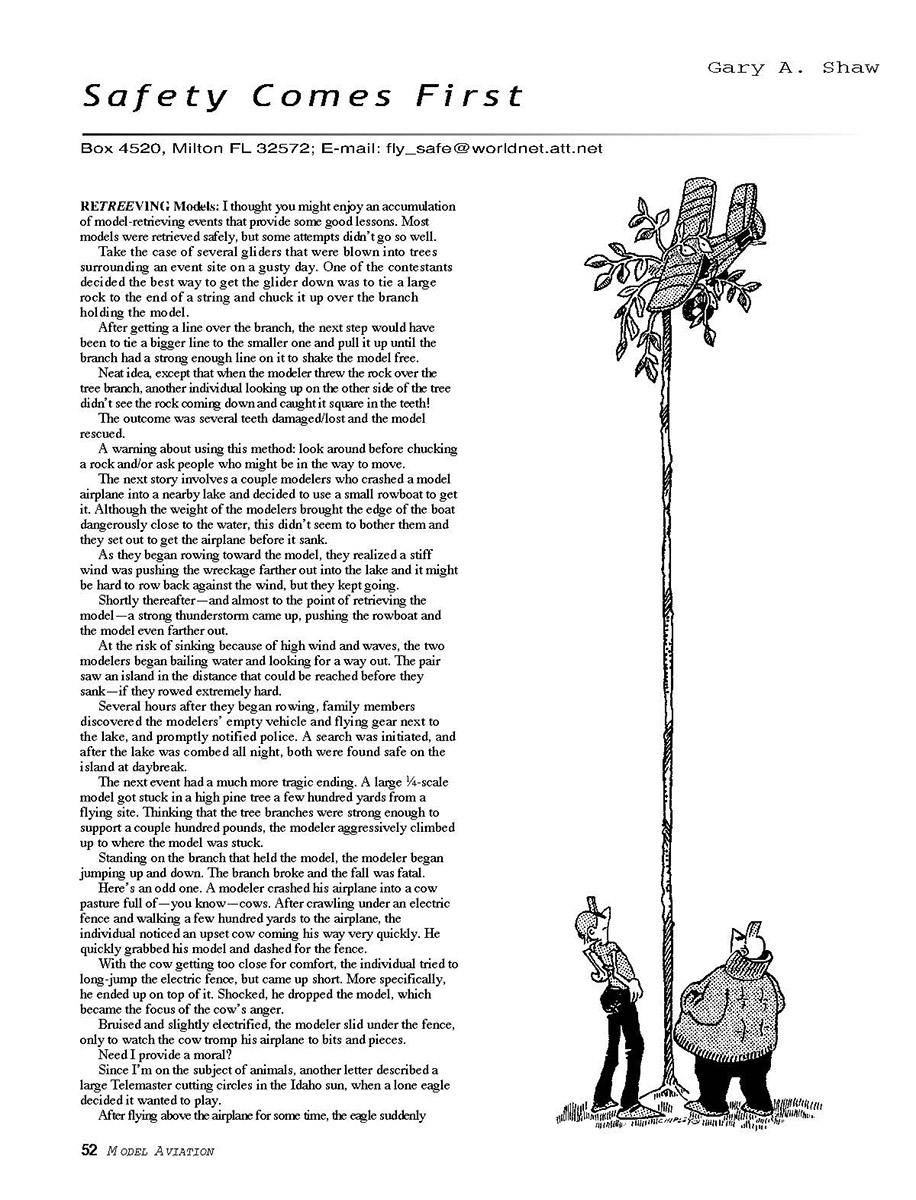
Take the case of several gliders that were blown into trees surrounding an event site on a gusty day. One of the contestants decided the best way to get the glider down was to tie a large rock to the end of a string and chuck it up over the branch holding the model.
After getting a line over the branch, the next step would have been to tie a bigger line to the smaller one and pull it up until the branch had a strong enough line on it to shake the model free. Neat idea, except that when the modeler threw the rock over the tree branch, another individual looking up on the other side of the tree didn't see the rock coming down and caught it square in the teeth! Several teeth were damaged or lost, but the model was rescued.
A warning about using this method: look around before chucking a rock and/or ask people who might be in the way to move.
Another story involves a couple of modelers who crashed a model airplane into a nearby lake and decided to use a small rowboat to get it. Although the weight of the modelers brought the edge of the boat dangerously close to the water, this didn't seem to bother them and they set out to retrieve the airplane before it sank.
As they began rowing toward the model, they realized a stiff wind was pushing the wreckage farther out into the lake and it might be hard to row back, but they kept going. Shortly thereafter—and almost to the point of retrieving the model—a strong thunderstorm came up, pushing the rowboat and the model even farther out. At the risk of sinking because of high wind and waves, the two modelers began bailing water and looking for a way out. They saw an island in the distance that could be reached before they sank—if they rowed extremely hard.
Several hours after they began rowing, family members discovered the modelers' empty vehicle and flying gear next to the lake, and promptly notified police. A search was initiated, and after the lake was combed all night, both were found safe on the island at daybreak.
The next event had a much more tragic ending. A large 1/4-scale model got stuck in a high pine tree a few hundred yards from a flying site. Thinking the tree branches were strong enough to support a couple hundred pounds, the modeler aggressively climbed to where the model was stuck. Standing on the branch that held the model, the modeler began jumping up and down. The branch broke and the fall was fatal.
Here's an odd one. A modeler crashed his airplane into a cow pasture. After crawling under an electric fence and walking a few hundred yards to the airplane, he noticed an upset cow coming his way very quickly. He grabbed his model and dashed for the fence. With the cow getting too close for comfort, the individual tried to long-jump the electric fence, but came up short—more specifically, he ended up on top of it. Shocked, he dropped the model, which became the focus of the cow's anger. Bruised and slightly electrified, the modeler slid under the fence, only to watch the cow tromp his airplane to bits and pieces. Need I provide a moral?
Since I'm on the subject of animals, another letter described a large Telemaster cutting circles in the Idaho sun when a lone eagle decided it wanted to play. After flying above the airplane for some time, the eagle suddenly pulled in its wings and dove toward the airplane. In a split second, the left wing turned into confetti and the airplane descended quickly. During the airplane's descent, it became entangled in a high tree. To recover it, the modeler purchased numerous pieces of male and female PVC pipe that he fit together and fed up through the branches to push the model free. The model was successfully dislodged—and I'm told—flew again.
My predecessor (John Preston) had asked readers for alternative methods of retrieving models, and he published submitted material in his February 1991 column. A review of the column reveals that the most novel idea (and the most dangerous) was using a rifle to shoot branches off trees that held stuck models. Another idea was captured on tape, beginning with the shot of a full-scale helicopter hovering over a tree that held an Ugly Stik. An unknown person descended onto one of the helicopter's skids, reached down, and plucked the undamaged model from the tree. That's very expensive, and not too common (thank goodness).
Let's look at one of the strangest—but most successful—methods of getting a model off a half-frozen lake. A large model crashed onto a frozen pond. The modeler went home, brought out a flat jon boat, and slid out onto the ice until he reached his model. After retrieving it, he pulled the boat back to shore, packed everything up, and went home. I wasn't told if he had flotation equipment, or a way to contact anyone should he become stranded. However, he did get his model safely, which is what we all hope happens in the long run.
'Nuff said!
Tick Alert — How to Remove a Tick
I run this subject into the ground each spring, but increases in the number of tick-borne Lyme disease cases in recent years lead me to believe we can all benefit from prevention advice.
If you find ticks attached to you this season, the following information from the Lyme Disease Foundation can be of help to you and your doctor.
- Using fine-point tweezers, grasp the tick's mouthparts (place of attachment) as close to the skin as possible.
- Gently pull the tick straight out with steady pressure. Do not twist or jerk the tick.
- Place the tick in a small vial with a blade of grass and label with the date, your name and address, and keep for tick identification.
- Wash your hands! Disinfect the tweezers and the bite site.
- Contact your doctor. The Lyme Disease Foundation Medical Advisory Committee recommends treatment on the bite of ticks capable of transmitting Lyme disease.
Cautions:
- Check pets carefully, especially around the eyes and ears.
- Children should be told to seek adult help for proper tick removal.
- Adults should have someone nearby remove attached ticks.
- It is better to use tweezers for removal than to pull the tick off with your fingers.
- If you must remove the tick with your fingers, use a tissue or leaf to avoid contact with potentially infectious tick fluids.
- Do not prick or burn the tick, as this may cause the release of infectious tick secretions.
- Do not try to smother the tick, as it has enough oxygen to last through the entire feeding.
Ticks that primarily transmit disease:
- Black-legged tick (Ixodes scapularis)
- Western black-legged tick (Ixodes pacificus)
Tick size:
- Larva (rarely infected)
- Nymph
- Adult
- Engorged adult (maximum size)
Lyme disease symptoms — early infection:
- Flu-like symptoms: headache, fever, muscle or joint pain, unusual tiredness, loss of appetite, or swollen glands
- Skin: single rash at the bite site. About 50% of infected people do not get a rash. This rash occurs in many shapes and colors. It appears as red or purplish on light skin and as a bruise on dark skin. Discoloration at the bite site within hours of tick removal may be skin irritation and not disease.
- Eye: conjunctivitis
Disseminated infection:
- General: fatigue, loss of appetite, vomiting
- Brain: severe headaches, cranial nerve paralysis (e.g., facial droop, photosensitivity), loss of reflexes, radiating sensations, memory problems, stroke (rare), inflammation of the spinal cord, brain, or nerves
- Eye: inflammation of various parts or optic nerve, retinal detachments, double vision
- Skin: single or multiple rashes (per bite) occurring over the body; benign skin tumors
- Joint and muscle: pain—mild to severe and/or migratory, inflammation, loss of tone
- Heart: irregular beats, heart block, inflammation
- Liver: hepatitis, elevated liver enzymes
Chronic infection:
- General: chronic fatigue
- Brain: cognitive or behavioral changes, disorders of the peripheral nerves, severe headaches, inflammation of the brain
- Eyes: loss of vision
- Skin: degeneration of the skin on the hands or feet, recurring rashes
- Joints: disabling pain, intermittent or chronic
Pregnancy: The Lyme bacterium can cross the placenta and infect the unborn. Reported potential complications include miscarriage, stillbirth, and death after birth.
For more information on Lyme disease or other tick-borne diseases, send a self-addressed stamped business-size envelope to the Lyme Disease Foundation, 1 Financial Plaza, Hartford CT 06103, or call the Lyme Disease National Hotline: 1-800-886-LYME.
Transcribed from original scans by AI. Minor OCR errors may remain.

