

Safety Comes First
Dave Gee
Box 7081, Van Nuys CA 91409; E-mail: Safetycolumn@cs.com
George Crabtree and shop safety
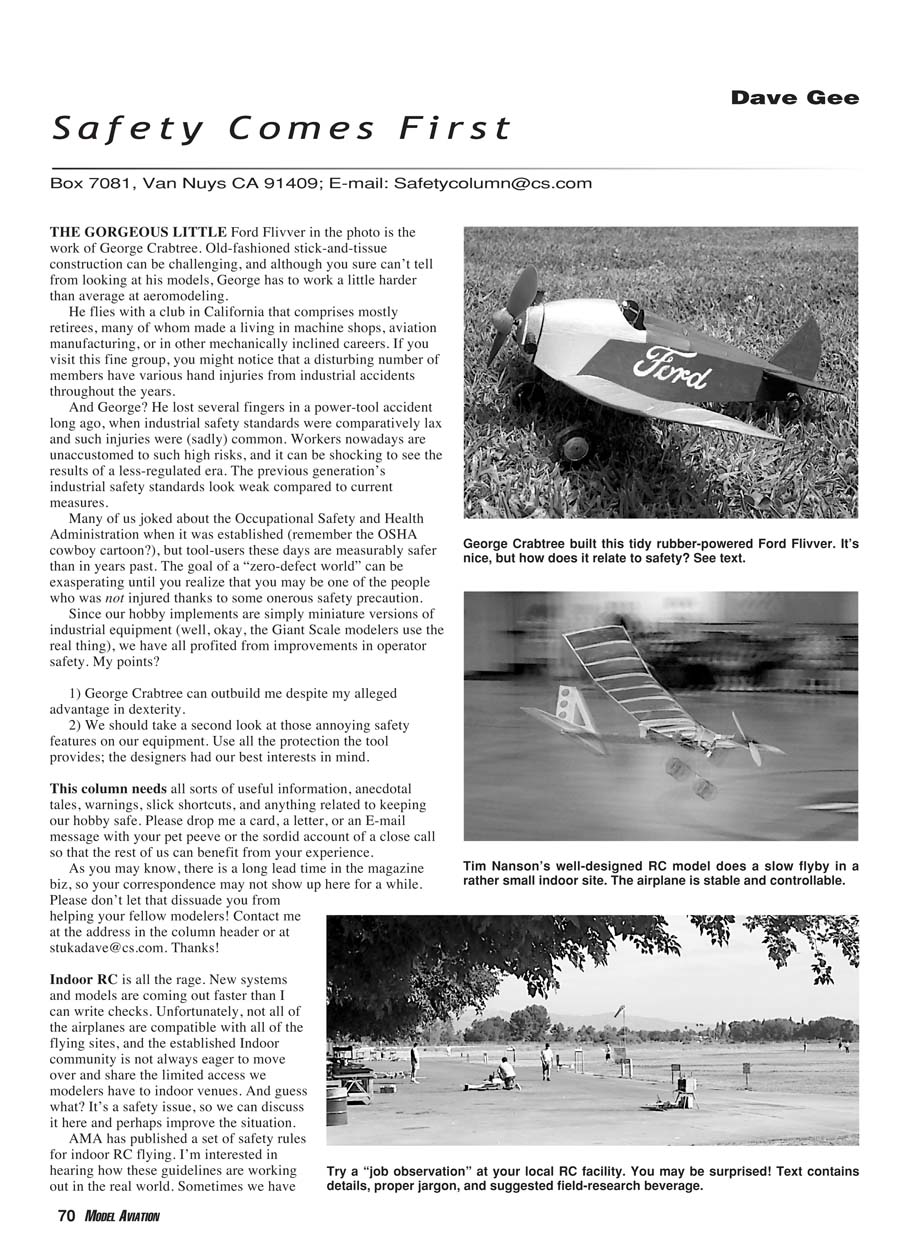
The gorgeous little Ford Flivver in the photo is the work of George Crabtree. Old-fashioned stick-and-tissue construction can be challenging, and although you sure can't tell from looking at his models, George has to work a little harder than average at aeromodeling.
He flies with a club in California that comprises mostly retirees, many of whom made a living in machine shops, aviation manufacturing, or other mechanically inclined careers. If you visit this fine group, you might notice that a disturbing number of members have various hand injuries from industrial accidents over the years.
George lost several fingers in a power-tool accident long ago, when industrial safety standards were comparatively lax and such injuries were sadly common. Workers nowadays are unaccustomed to such high risks, and it can be shocking to see the results of a less-regulated era. The previous generation's industrial safety standards look weak compared to current measures.
Many of us joked about the Occupational Safety and Health Administration when it was established (remember the OSHA cowboy cartoon?), but tool users today are measurably safer than in years past. The goal of a "zero-defect world" can be exasperating until you realize that you may be one of the people who was not injured thanks to some onerous safety precaution.
Since our hobby implements are simply miniature versions of industrial equipment (well, okay, the Giant Scale modelers use the real thing), we have all profited from improvements in operator safety. My points:
- George Crabtree can outbuild me despite my alleged advantage in dexterity.
- We should take a second look at those annoying safety features on our equipment. Use all the protection the tool provides; the designers had our best interests in mind.
This column needs all sorts of useful information, anecdotal tales, warnings, slick shortcuts, and anything related to keeping our hobby safe. Please drop me a card, a letter, or an E-mail message with your pet peeve or the sordid account of a close call so that the rest of us can benefit from your experience.
As you may know, there is a long lead time in the magazine biz, so your correspondence may not show up here for a while. Please don't let that dissuade you from helping your fellow modelers! Contact me at the address in the column header or at stukadave@cs.com. Thanks!
Indoor RC: growth and challenges
Indoor RC is all the rage. New systems and models are coming out faster than I can write checks. Unfortunately, not all of the airplanes are compatible with all of the flying sites, and the established indoor community is not always eager to move over and share the limited access we modelers have to indoor venues. And guess what? It's a safety issue, so we can discuss it here and perhaps improve the situation.
AMA has published a set of safety rules for indoor RC flying. I'm interested in hearing how these guidelines are working out in the real world. Sometimes we have the use of a giant building in which there is plenty of room for flightlines and spectator zones, but more often, an indoor meet is held in a gym that might be fine for MiniSticks but is perhaps a bit cramped for large RC models. It's hard to lump all indoor RC models into one category since they run the gamut from 2-gram microfilm airplanes to 4-foot scale models, not to mention the popular 3-D foamies. I have a newly released RTF which will happily operate in my living room.
This part of our hobby is growing with amazing speed, with new systems and model types emerging constantly. The most successful indoor RC models I've seen have low wing loadings and are quite compatible with FF indoor models such as Embryos and Peanuts. I'm glad that the trend seems to be toward smaller and lighter; this makes the safety officer's job easier.
Indoor RC design seems to be going in two broad directions. One is an offshoot of classic FF indoor models and might have magnetic actuators and perhaps infrared control in lieu of radio. Rubber or CO2 power is sometimes used instead of electric systems.
The other type is essentially downsizing outdoor gas-model techniques. These aircraft will feature tiny servos and a lightened structure that might still bear a resemblance to "regular" RC models.
These divisions are blurring now as the two schools of design grow closer.
There have been more than a few spirited discussions about sharing the indoor air. Spectator safety is only one part of the controversy, but I think it should be the overriding factor when decisions are made.
A definite line must be drawn between outdoor slow flyers and indoor models. In the early days of indoor RC, I saw various highly skilled pilots trying to fly airplanes that were too big for the room and get away with it, but it was clearly an iffy proposition, and the fliers generally learned a lesson and brought lighter models next time.
At the very least, a model should be able to perform figure eights in the venue with room to spare. If you can barely make a racetrack course and are always skimming the walls, perhaps your aircraft (and the spectator beneath it) longs for the great outdoors.
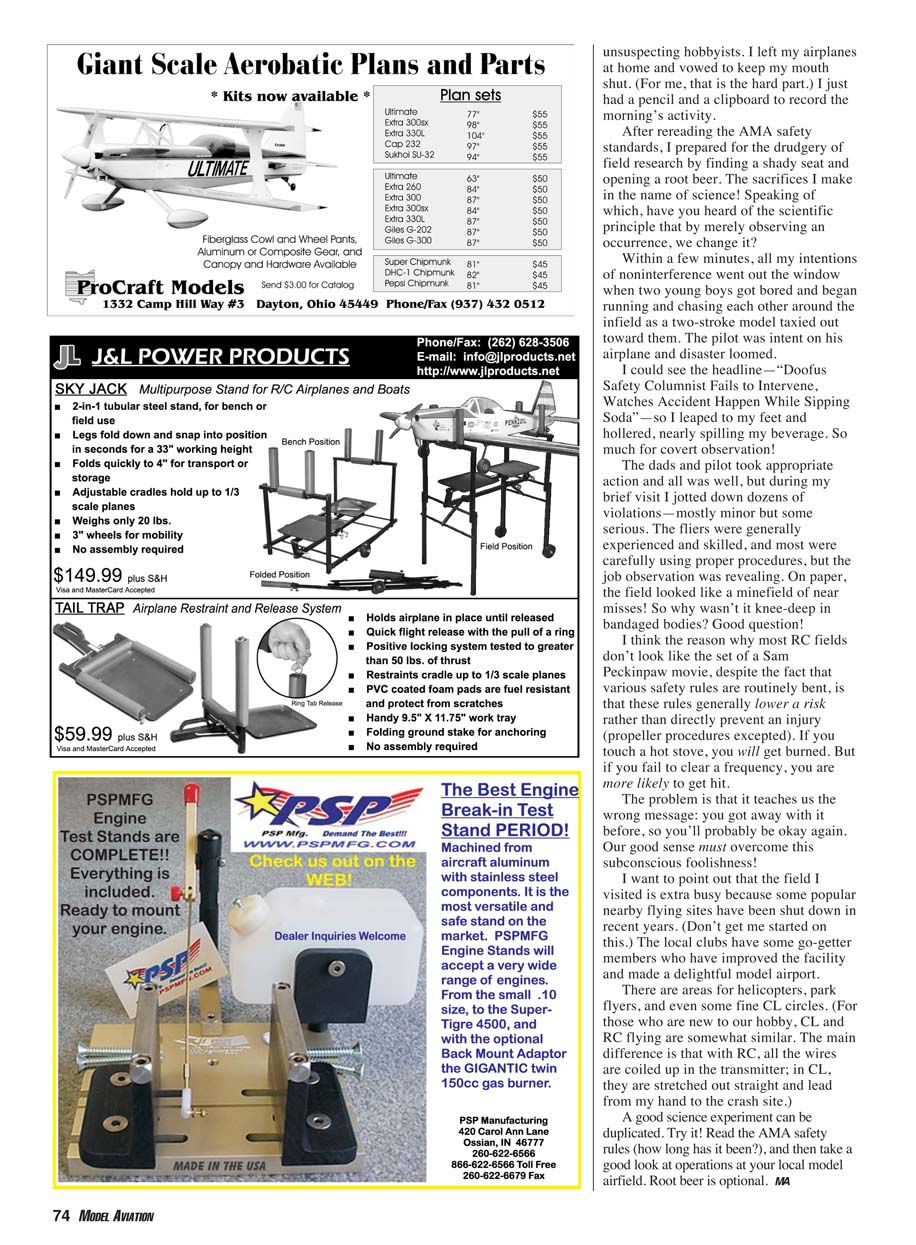
Look at the photo of Tim Nanson's indoor RC model. This is a cutting-edge design for such airplanes. It is large—spanning 36 inches—but only weighs 10 ounces. That big undercambered wing lets it fly at extremely low speeds, and Tim has a geared motor so that the propeller spins slower. Large tail surfaces allow him to maintain good control at low speeds.
The power system has a breakaway mounting. This model would have minimal "energy transfer" in an impact, thus it is a safely designed craft. The covering is plastic kitchen wrap, and Tim says it keeps the airplane fresh and crispy.
Those of you with experience with and/or opinions on these matters, please speak up. AMA rules are becoming inadequate, and we can help the situation by pooling our knowledge to suggest some updates.
Buzzwords: root cause and upstream measures
Industrial safety personnel sometimes talk about the "root cause" of accidents. Not the moment when something went wrong, but the circumstances that led up to it—the decisions and situations that set up the problem.
When you figure that out, you get "upstream measures." That is where action is taken before an accident happens to avoid the set of circumstances that could lead to misfortune. It pays off big-time in industry and works at home as well.
Sometimes a "job observation" is used to analyze current practices in hopes of heading off future problems. A worker's technique and procedures are carefully watched with an eye toward potentially hazardous situations. It is not easy to be the watcher or the watchee, but the benefits are worth the effort.
Field observation: an anecdote
Being a hardworking, eager-beaver columnist, I went to the local field to perform a "job observation" on some unsuspecting hobbyists. I left my airplanes at home and vowed to keep my mouth shut. (For me, that is the hard part.) I just had a pencil and a clipboard to record the morning's activity.
After rereading the AMA safety standards, I prepared for the drudgery of field research by finding a shady seat and opening a root beer. The sacrifices I make in the name of science! Speaking of which, have you heard of the scientific principle that by merely observing an occurrence, we change it?
Within a few minutes, all my intentions of noninterference went out the window when two young boys got bored and began running and chasing each other around the infield as a two-stroke model taxied out toward them. The pilot was intent on his airplane and disaster loomed.
I could see the headline—"Doofus Safety Columnist Fails to Intervene, Watches Accident Happen While Sipping Soda"—so I leaped to my feet and hollered, nearly spilling my beverage. So much for covert observation!
The dads and pilot took appropriate action and all was well, but during my brief visit I jotted down dozens of violations—mostly minor but some serious. The fliers were generally experienced and skilled, and most were carefully using proper procedures, but the job observation was revealing. On paper, the field looked like a minefield of near misses! So why wasn't it knee-deep in bandaged bodies? Good question!
I think the reason why most RC fields don't look like the set of a Sam Peckinpah movie, despite the fact that various safety rules are routinely bent, is that these rules generally lower a risk rather than directly prevent an injury (propeller procedures excepted). If you touch a hot stove, you will get burned. But if you fail to clear a frequency, you are more likely to get hit.
The problem is that it teaches us the wrong message: you got away with it before, so you'll probably be okay again. Our good sense must overcome this subconscious foolishness!
I want to point out that the field I visited is extra busy because some popular nearby flying sites have been shut down in recent years. (Don't get me started on this.) The local clubs have some go-getter members who have improved the facility and made a delightful model airport.
There are areas for helicopters, park flyers, and even some fine CL circles. (For those who are new to our hobby, CL and RC flying are somewhat similar. The main difference is that with RC, all the wires are coiled up in the transmitter; in CL, they are stretched out straight and lead from my hand to the crash site.)
A good science experiment can be duplicated. Try it! Read the AMA safety rules (how long has it been?), and then take a good look at operations at your local model airfield. Root beer is optional.
MA
Transcribed from original scans by AI. Minor OCR errors may remain.

