
Safety Comes First
Dave Gee
Box 7081, Van Nuys CA 91409 E-mail: Safetycolumn@cs.com
Many thanks to all who are responding to my plea for close-call stories, useful information, and problem areas that need treatment. Your help makes all the difference in saving fellow modelers from repeating our own goofs or learning the hard way about a dangerous situation. Please send a postcard, a letter, or an e-mail message if you have new info or an instructive story.
I have heard one comment from several readers: What makes this guy qualified to write about safety? It's a fair question, considering my reputation as the Inspector Clouseau of aeromodeling. Here are some answers:
- I actually have a modest background in industrial safety.
- I have a passing familiarity with model airplanes.
- I responded to the ad in MA seeking a safety columnist.
These factors, plus my offer to sweep out the editor's workshop if hired, led to the present situation. I, if not the readership, am having a wonderful time, so I'll stick with it.
Cyanoacrylate (CA) accelerators and plastics
Speaking of sticking, I have some information about cyanoacrylate glues that you may not have heard. Those who use accelerator spray to speed the curing of cyanoacrylate have learned that certain plastics react poorly to it. In fact, spritz makes some materials crumble like my sales resistance at the hobby shop. It is worsened by multiple exposures and time, but sometimes the damage occurs right away. I had a small indoor-type electric motor mount disintegrate within minutes of installation.
I'm no chemist, and more facts are needed—especially some way to determine which materials are vulnerable and which are not. Meanwhile, be cautious about getting accelerator on plastic components unless you've tested the combination.
Securing larger electric motors with glue is not recommended for several reasons. A good one is that the bond of cyanoacrylate or certain epoxies may come loose with the continuous heat of operation. That, combined with vibration and the shock of sudden impacts (such as my landings), makes sturdy mechanical attachment the way to go.
Securing electric motors — a cautionary tale
Following is a motor story from Rich Tansey of Half Moon Bay, California:
"Just read your column, and thought you and other AMA members or readers would be interested in hearing of a real 'bad one' I had.
"The 'incident' occurred as I was first dabbling in electric motors and trying to adjust one in my hobby room.
"There are probably as many ways to mount an electric motor as there are people using them. I had used the 'lazy man's' technique of simply taping the motor to a plastic fuselage by putting electrical tape around the final 1/2 inch or so of a Speed 600 motor.
"One day I was adjusting the servos with a fully charged battery. Suddenly the motor came on at full bore, jumped out of the fuselage, and before I could blink had cut the tip of my thumb off. The slice was as sharp and clean as a razor blade.
"After several stitches and a few months' time, I was lucky to come out with only a minor deformation of the thumb. I was completely surprised at the power of this relatively small motor. I have since learned some valuable lessons about electric motors compared to gas:"
- They rarely stall. When shorted by an obstruction (in this case my thumb), and without a protective fuse, they will demand every amp of current from the battery.
- The plastic or nylon props used in electrics won't break, and the edge at 3,000 to 5,000 rpm acts as a buzz saw.
- Tape is the most dangerous to use because it works great for a while but can release at any time.
- Never have the prop toward you.
- Think of all the steps you are making in testing engines indoors. If you haven't thought about the steps, you may put yourself or others in danger.
- Electric motor mounts need to be as carefully thought out and anchored as gas or glow engines.
- I now test engines only in a special test rig I built which has about 100 pounds of holding force and a barrier around the prop.
- I now use multiple backup systems to anchor mounts for flying: epoxy or shoe glue, rubber bands surrounded by several layers of tape (which I replace after every flying session), and a pipe clamp with a screw around the whole assembly.
Thanks, Rich! That's good advice for all of the E‑fliers who are using ever more powerful and efficient new motors.
First aid for minor cuts
Model aviation frequently involves inherently dangerous items such as spinning propellers and sharp tools. Minor injuries sometimes occur despite our best efforts, and in an effort to stay on the cutting edge of cuts, I have some updated first-aid information.
A recent medical study compared various methods for treating minor nicks. Some test subjects volunteered to undergo identical injuries that were then treated with a wide variety of products and techniques. The results, especially healing times, were carefully recorded.
Although cleaning a gash and keeping it covered is a good idea, some tried-and-true first-aid methods did poorly in comparison to newer treatments. Disinfecting a wound with hydrogen peroxide resulted in a longer healing time than not treating it at all! The best results were obtained with products such as Neosporin or Polysporin. Cuts treated with iodine, soap, water alone, or other medications took longer to mend.
Researchers who are much smarter than I am conducted the study under controlled conditions, but some impromptu clumsy-columnist testing confirmed their results. The effectiveness of employing bad language as self-treatment was not mentioned, although I have seen it used frequently after minor injuries. It is generally diluted with other agents and produces poor results unless used in conjunction with more conventional methods.
Hobby-knife rollaways
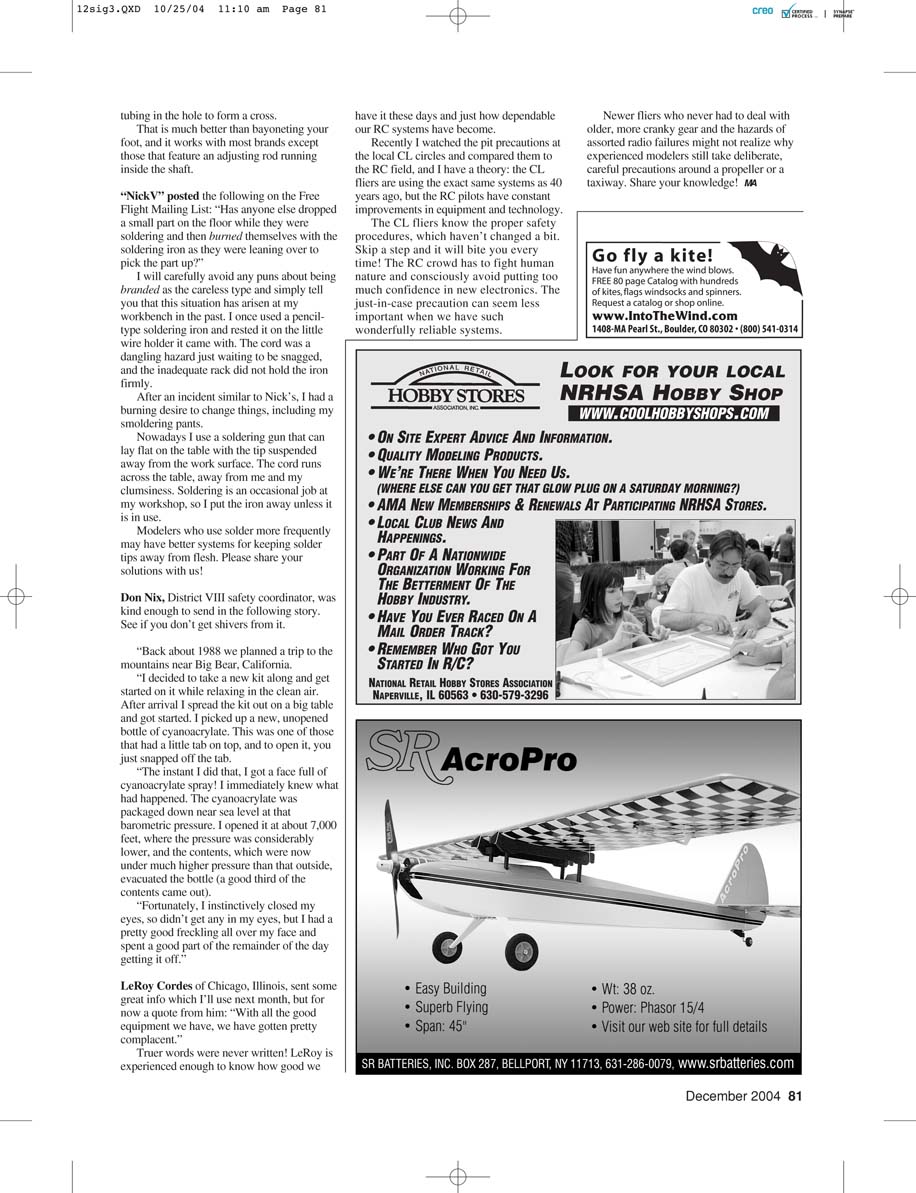
Multiple e-mails have arrived about the same topic: hobby knives rolling off of tabletops. There have been several close calls and some bloodshed.
Once upon a time, little rubber tubes with triangular cross-sections were commonly available. If you slipped one over the handle, the implement wouldn't roll. For some reason, these accessories have become hard to find, so several wise modelers described alternatives:
- Drill a perpendicular hole through the tool and epoxy a length of dowel through the handle; some insert tubing in the hole to form a cross.
- Use short pieces of heat-shrink tubing.
- Use a pen cap.
- Use double-sided tape.
- Mount the knife in a small wooden block with a groove.
Those solutions are much better than bayoneting your foot, and they work with most brands except those that feature an adjusting rod running inside the shaft.
Soldering-iron hazards
"NickV" posted the following on the Free Flight Mailing List: "Has anyone else dropped a small part on the floor while they were soldering and then burned themselves with the soldering iron as they were leaning over to pick the part up?"
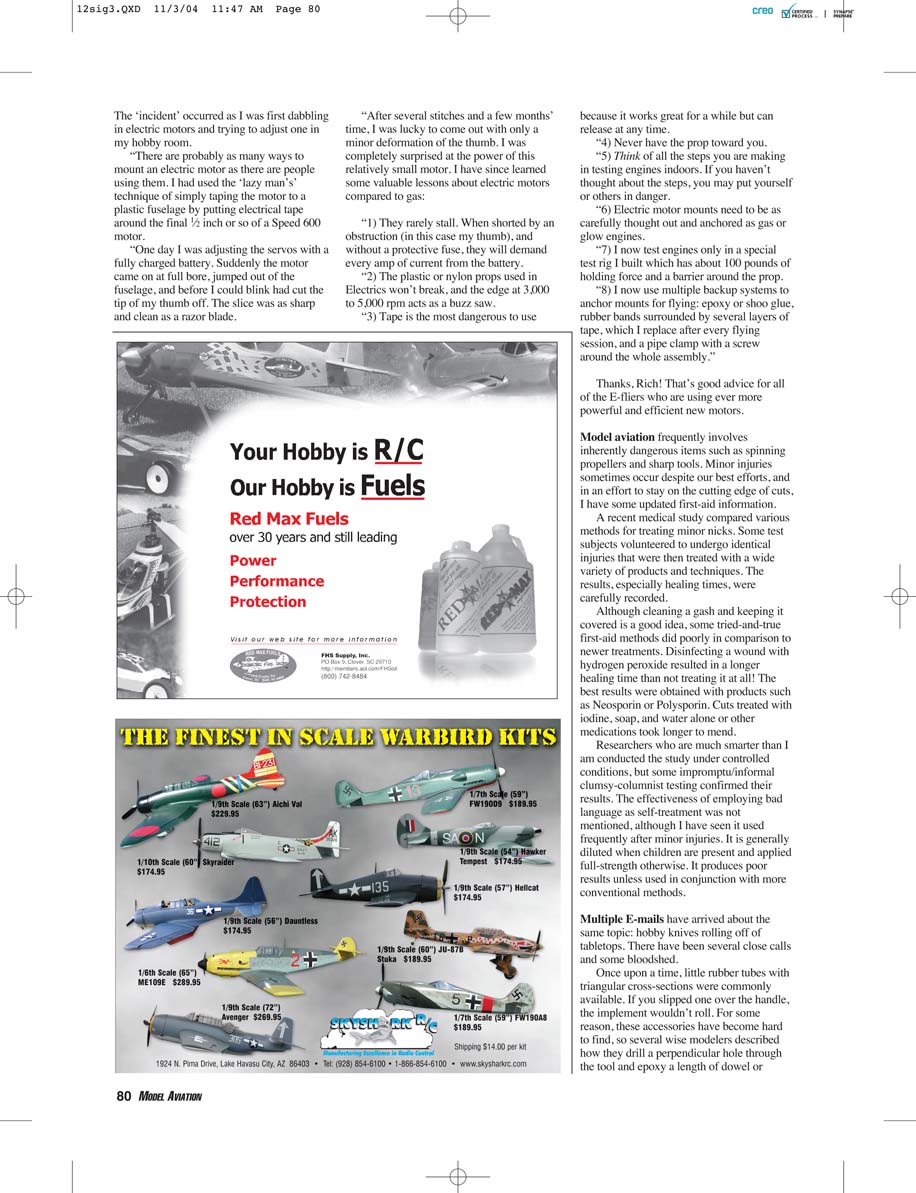
I will carefully avoid any puns about being branded as the careless type and simply tell you that this situation has arisen at my workbench in the past. I once used a pencil-type soldering iron and rested it on the little wire holder it came with. The cord was a dangling hazard just waiting to be snagged, and the inadequate rack did not hold the iron firmly.
After an incident similar to Nick's, I had a burning desire to change things, including my smoldering pants.
Nowadays I use a soldering gun that can lay flat on the table with the tip suspended away from the work surface. The cord runs across the table, away from me and my clumsiness. Soldering is an occasional job at my workshop, so I put the iron away unless it is in use.
Modelers who use solder more frequently may have better systems for keeping solder tips away from flesh. Please share your solutions with us!
Altitude and CA packaging — a scary surprise
Don Nix, District VIII safety coordinator, was kind enough to send in the following story. See if you don't get shivers from it.
"Back about 1988 we planned a trip to the mountains near Big Bear, California.
"I decided to take a new kit along and get started on it while relaxing in the clean air. After arrival I spread the kit out on a big table and got started. I picked up a new, unopened bottle of cyanoacrylate. This was one of those that had a little tab on top, and to open it, you just snapped off the tab.
"The instant I did that, I got a face full of cyanoacrylate spray! I immediately knew what had happened. The cyanoacrylate was packaged down near sea level at that barometric pressure. I opened it at about 7,000 feet, where the pressure was considerably lower, and the contents, which were now under much higher pressure than that outside, evacuated the bottle (a good third of the contents came out).
"Fortunately, I instinctively closed my eyes, so I didn't get any in my eyes, but I had a pretty good freckling all over my face and spent a good part of the remainder of the day getting it off."
A note on complacency
LeRoy Cordes of Chicago, Illinois, sent some great info which I'll use next month, but for now a quote from him: "With all the good equipment we have, we have gotten pretty complacent."
Truer words were never written! LeRoy is experienced enough to know how good we have it these days and just how dependable our RC systems have become.
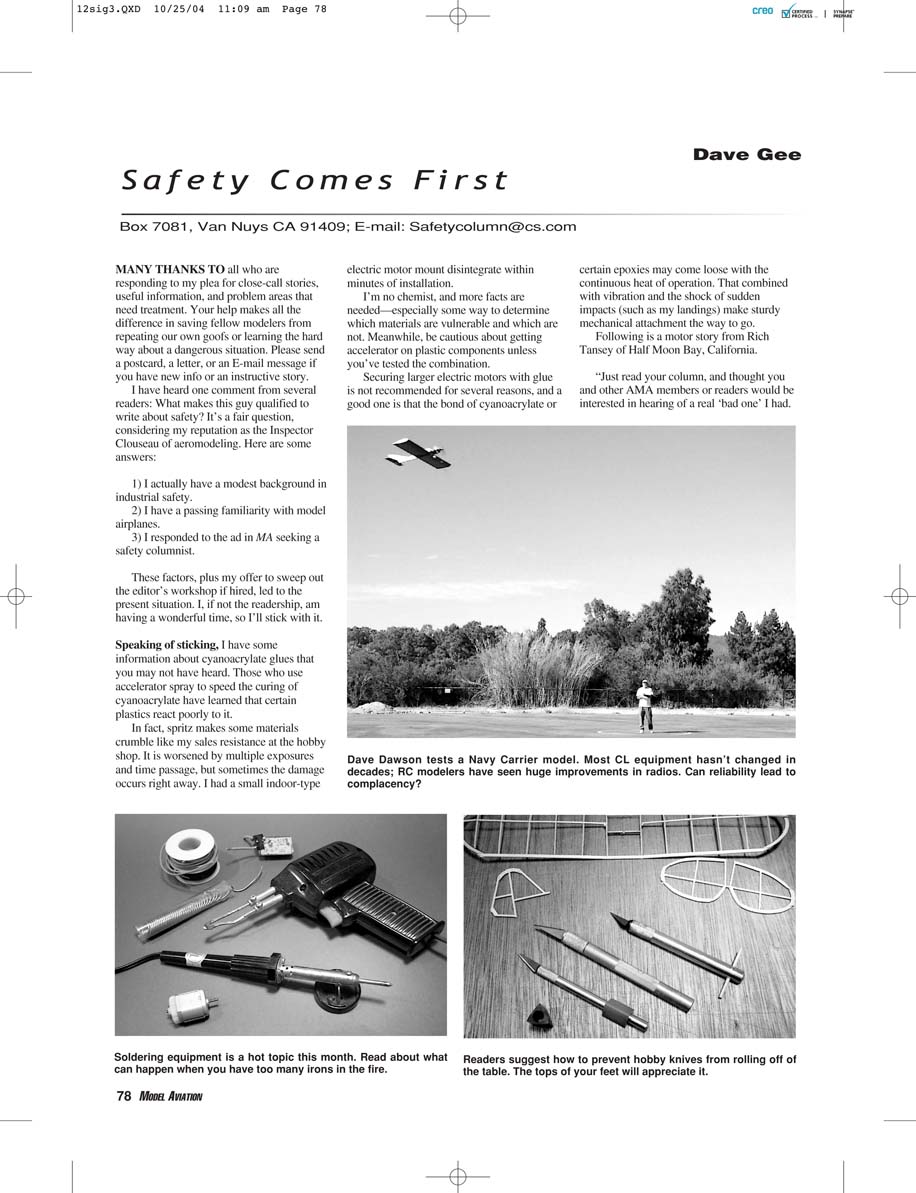
Recently I watched the pit precautions at the local CL circles and compared them to the RC field, and I have a theory: the CL fliers are using the exact same systems as 40 years ago, but the RC pilots have constant improvements in equipment and technology.
The CL fliers know the proper safety procedures, which haven't changed a bit. Skip a step and it will bite you every time! The RC crowd has to fight human nature and consciously avoid putting too much confidence in new electronics. The just-in-case precaution can seem less important when we have such wonderfully reliable systems.
Newer fliers who never had to deal with older, more cranky gear and the hazards of assorted radio failures might not realize why experienced modelers still take deliberate, careful precautions around a propeller or a taxiway. Share your knowledge!
MA
Transcribed from original scans by AI. Minor OCR errors may remain.

