
Safety Comes First
Box 7081, Van Nuys CA 91409; E-mail: Safetycolumn@cs.com
“Give a pilot an airplane and he flies ’til he crashes. Teach a pilot to build and he flies for a lifetime.” Paul K. Johnson sent that fine quote. Although I do not wish to reopen the great ARF vs. Scratch-Built debate, an excellent case can be made that a pilot who has built his or her model has a greater understanding of it, thus an advantage in the safe operation thereof. (Not that there aren’t a few RTF foamies in my hangar. Fun is fun.)
Deepest thanks to the many readers who send information, offers of help, stories, topics, and greetings. I am delighted to address the issues you raise and pass along the tips and advice. Don’t forget that there is a long lead time here, so discussions of a particular topic may re-emerge a couple months later as further data becomes available. Please keep those letters and e-mails coming!
As I promised, here is a story from LeRoy Cordes.
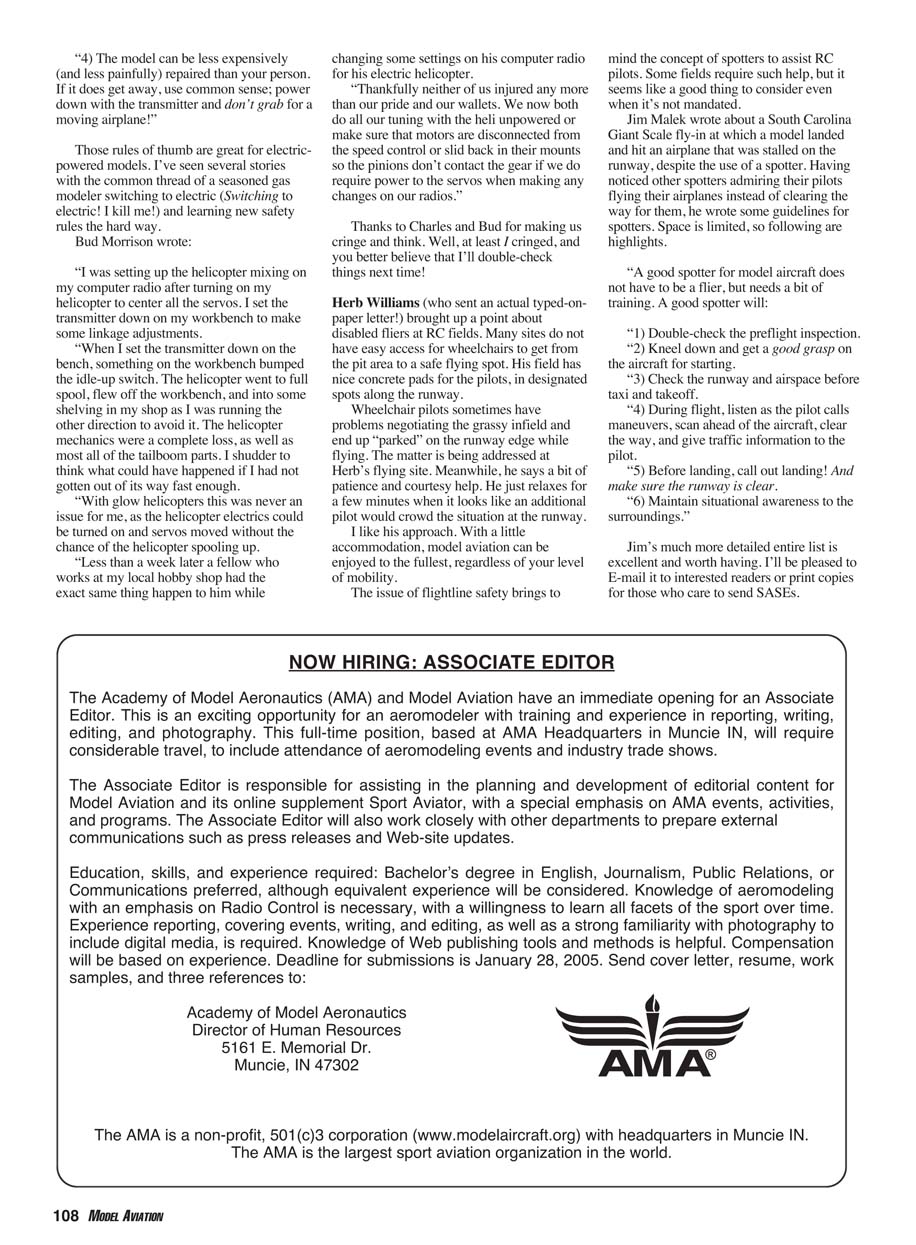
“One of the Sportsman pilots was using a borrowed transmitter and prepping his new model for flight. The radio’s owner was in front starting the 100cc engine when it started up at full throttle.
Only the grace of God and quick reactions prevented a disaster—they had forgotten to change to the new airplane in the transmitter, and all the controls except the throttle worked properly.
“Gad, I seem like a doomsayer, but I don’t think you can harp about safety enough.”
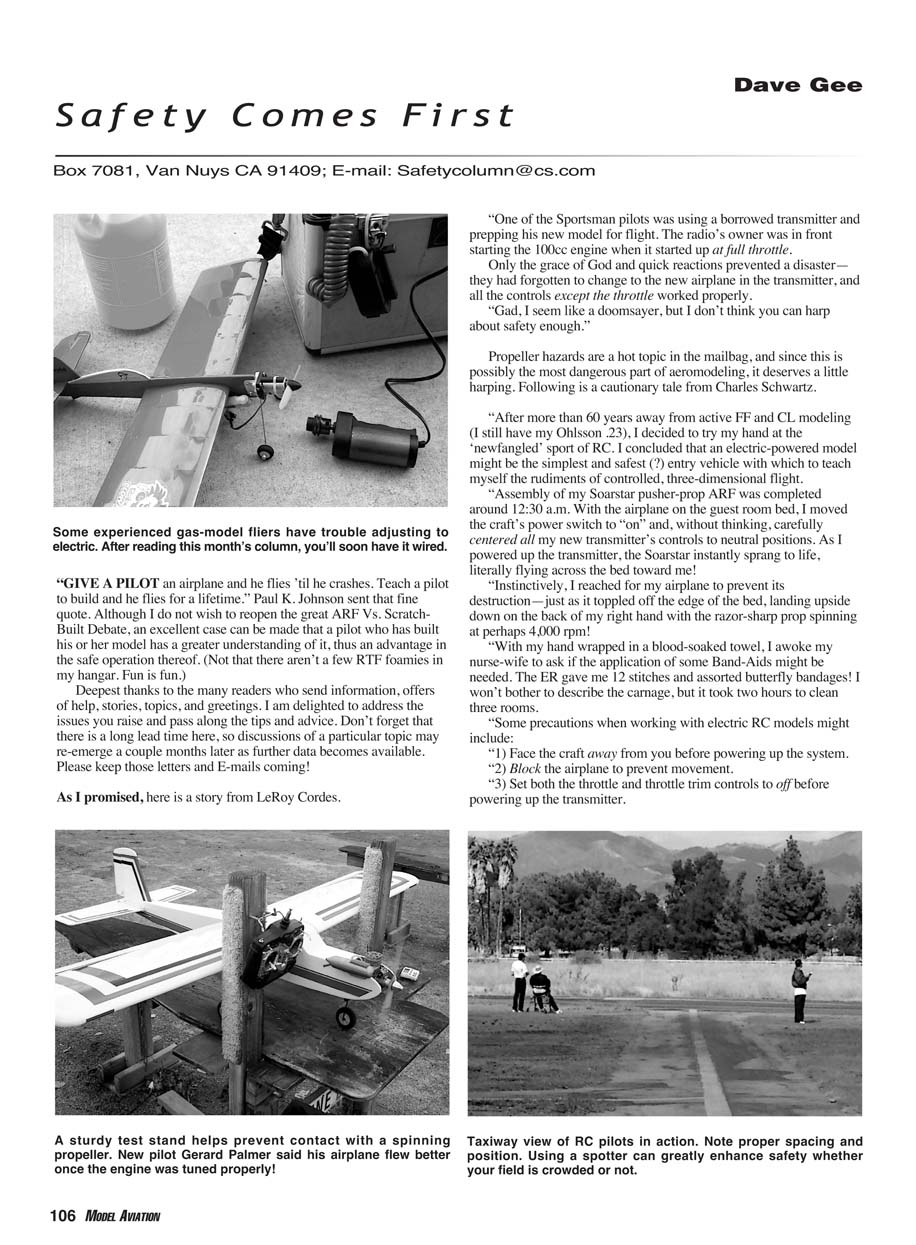
Propeller hazards are a hot topic in the mailbag, and since this is possibly the most dangerous part of aeromodeling, it deserves a little harping. Following is a cautionary tale from Charles Schwartz.
“After more than 60 years away from active FF and CL modeling (I still have my Ohlsson .23), I decided to try my hand at the ‘newfangled’ sport of RC. I concluded that an electric-powered model might be the simplest and safest (?) entry vehicle with which to teach myself the rudiments of controlled, three-dimensional flight.
“Assembly of my Soarstar pusher-prop ARF was completed around 12:30 a.m. With the airplane on the guest room bed, I moved the craft’s power switch to ‘on’ and, without thinking, carefully centered all my new transmitter’s controls to neutral positions. As I powered up the transmitter, the Soarstar instantly sprang to life, literally flying across the bed toward me!
“Instinctively, I reached for my airplane to prevent its destruction—just as it toppled off the edge of the bed, landing upside down on the back of my right hand with the razor-sharp prop spinning at perhaps 4,000 rpm!
“With my hand wrapped in a blood-soaked towel, I awoke my nurse-wife to ask if the application of some Band-Aids might be needed. The ER gave me 12 stitches and assorted butterfly bandages! I won’t bother to describe the carnage, but it took two hours to clean three rooms.
“Some precautions when working with electric RC models might include:
- Face the craft away from you before powering up the system.
- Block the airplane to prevent movement.
- Set both the throttle and throttle trim controls to off before powering up the transmitter.
“The model can be less expensively (and less painfully) repaired than your person. If it does get away, use common sense; power down with the transmitter and don’t grab for a moving airplane!”
Those rules of thumb are great for electric-powered models. I’ve seen several stories with the common thread of a seasoned gas modeler switching to electric (switching to electric! I kill me!) and learning new safety rules.
But Morrison wrote:
“I was setting up the helicopter mixing on my computer radio after turning on my helicopter to center all the servos. I set the transmitter down on my workbench to make some linkage adjustments.
“When I set the transmitter down on the bench, something on the workbench bumped the idle-up switch. The helicopter went to full spool, flew off the workbench, and into some shelving in my shop as I was running the other direction to avoid it. The helicopter mechanics were a complete loss, as well as most all of the tailboom parts. I shudder to think what could have happened if I had not gotten out of its way fast enough.
“With glow helicopters this was never an issue for me, as the helicopter electrics could be turned on and servos moved without the chance of the helicopter spooling up.
“Less than a week later a fellow who works at my local hobby shop had the exact same thing happen to him while changing some settings on his computer radio for his electric helicopter.
“Thankfully neither of us injured any more than our pride and our wallets. We now both do all our tuning with the heli unpowered or make sure that motors are disconnected from the speed control or slid back in their mounts so the pinions don’t contact the gear if we do require power to the servos when making any changes on our radios.”
Thanks to Charles and Bud for making us cringe and think. Well, at least I cringed, and you better believe that I’ll double-check things next time!
Herb Williams (who sent an actual typed-on-paper letter!) brought up a point about disabled pilots at RC fields. Many sites do not have easy access for wheelchairs to get from the pit area to a safe flying spot. His field has concrete pads for the pilots, in designated spots along the runway.
Wheelchair pilots sometimes have problems negotiating the grassy infield and end up “parked” on the runway edge while flying. The matter is being addressed at Herb’s flying site. Meanwhile, he says a bit of patience and courtesy help. He just relaxes for a few minutes when it looks like an additional pilot would crowd the situation at the runway.
I like his approach. With a little accommodation, model aviation can be enjoyed to the fullest, regardless of your level of mobility.
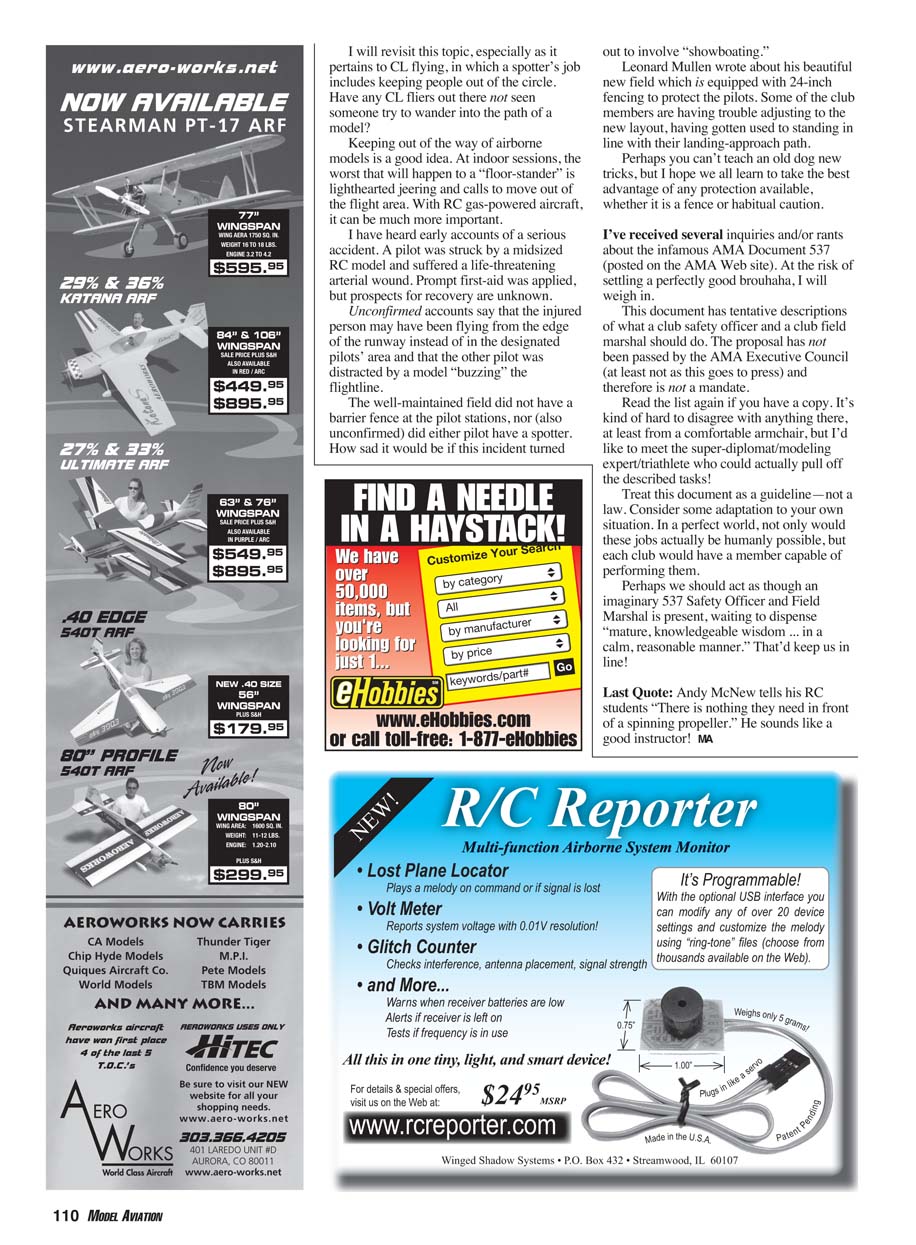
The issue of flightline safety brings to mind the concept of spotters to assist RC pilots. Some fields require such help, but it seems like a good thing to consider even when it’s not mandated.
Jim Malek wrote about a South Carolina Giant Scale fly-in at which a model landed and hit an airplane that was stalled on the runway, despite the use of a spotter. Having noticed other spotters admiring their pilots flying their airplanes instead of clearing the way for them, he wrote some guidelines for spotters. Space is limited, so following are highlights.
A good spotter for model aircraft does not have to be a flier, but needs a bit of training. A good spotter will:
- Double-check the preflight inspection.
- Kneel down and get a good grasp on the aircraft for starting.
- Check the runway and airspace before taxi and takeoff.
- During flight, listen as the pilot calls maneuvers, scan ahead of the aircraft, clear the way, and give traffic information to the pilot.
- Before landing, call out “Landing!” and make sure the runway is clear.
- Maintain situational awareness of the surroundings.
Jim’s much more detailed entire list is excellent and worth having. I’ll be pleased to e-mail it to interested readers or print copies for those who care to send SASEs.
Safety Comes First - 2005/01
I will revisit this topic, especially as it pertains to CL flying, in which a spotter’s job includes keeping people out of the circle. Have any CL fliers out there not seen someone try to wander into the path of a model?
Keeping out of the way of airborne models is a good idea. At indoor sessions, the worst that will happen to a “floor-stander” is the lighthearted jeering and calls to move out of the flight area. With RC gas-powered aircraft, it can be much more serious.
I have heard early accounts of a serious accident. A pilot was struck by a midsized RC model and suffered a life-threatening arterial wound. Prompt first aid was applied, but prospects for recovery are unknown. Unconfirmed accounts say that the injured person may have been flying from the edge of the runway instead of in the designated pilots’ area and that the other pilot was distracted by a model “buzzing” the flightline.
The well-maintained field did not have a barrier fence at the pilot stations, nor (also unconfirmed) did either pilot have a spotter. How sad it would be if this incident turned out to involve “showboating.”
Leonard Mullen wrote about his beautiful new field which is equipped with 24-inch fencing to protect the pilots. Some of the club members are having trouble adjusting to the new layout, having gotten used to standing in line with their landing-approach path.
Perhaps you can’t teach an old dog new tricks, but I hope we all learn to take the best advantage of any protection available, whether it is a fence or habituation.
I’ve received several inquiries and/or rants about the infamous AMA Document 537 (posted on the AMA Web site). At the risk of settling a perfectly good brouhaha, I will weigh in.
This document has tentative descriptions of what a club safety officer and a club field marshal should do. The proposal has not been passed by the AMA Executive Council (at least not as this goes to press) and therefore is not a mandate.
Read the list again if you have a copy. It’s kind of hard to disagree with anything there, at least from a comfortable armchair, but I’d like to meet the super-diplomat/modeling expert/mediator who could actually pull off the described tasks!
Treat this document as a guideline — not a law. Consider some adaptation to your own situation. In a perfect world, not only would these jobs actually be humanly possible, but each club would have a member capable of performing them.
Perhaps we should act as though an imaginary 537 Safety Officer and Field Marshal is present, waiting to dispense “mature, knowledgeable wisdom ... in a calm, reasonable manner.” That’d keep us in line!
Last quote: Andy McNew tells his RC students, “There is nothing they need in front of a spinning propeller.” He sounds like a good instructor!
MA
Transcribed from original scans by AI. Minor OCR errors may remain.

