

Safety Comes First
Dave Gee | Safetycolumn@cs.com
When is a model too powerful to hold in your hand for an engine/motor-run test?
Also included in this column:
- A free plans offer
- Unlabeled battery packs can be a problem
- "Clothespin frequency board" etiquette
- Ralph Gee’s Albatros
- Check that propeller often!
- More workshop and in-flight safety tips
Fairly new AMA member Bill McHarg, who is 53, had an adventure. He wrote:
"I have always wanted to fly RC airplanes. I just couldn't warm up to the foam airplanes so I built a Hobby Lobby Super Cub, with a lot of help from the local hobby shop owner. I put a Park 370 motor in it.
"I was going to test my motor setup and took the wing off to get to the battery. Then I turned on the transmitter and hooked everything up. While holding onto the back of the fuselage with one hand, with my other hand on the power, and watching the wattmeter, I put the power all the way up.
"That little motor has a lot of torque! With no wing to balance it out, it twisted the fuselage in my hand and the brand-new, sharp propeller cut a two-inch-long, half-inch-deep gash in my forearm. I obviously should have either had help or had the model secured somehow."
It was kind of Bill to share his hard-learned lesson. Our hobby can be fun, relaxing, exciting, and challenging, but it should not involve first-aid. How many of us have tested power plants under similar circumstances, inadequately secured or handheld? Show of hands? Yeah, me too. The slightest problem, and suddenly you’re starring in a live scene from Texas Chainsaw Modeler.
There is also a question of degrees. I often casually test my small CO2 motors on my worktable, as I do my smallest indoor electric motors, but what size is too big for handheld tests? Or to put it another way, how would I explain it to my wife Sweet Diedra if she has to come downstairs and bandage me? The rule of gashed thumb around here seems to be that if the propeller will blow stuff around on the table, it’s time to take it outside and strap it down or use a test stand. Bill wrapped up his e-mail with, "Even though I am mostly interested in electric airplanes, I read the magazine cover to cover."
The Model Aviation staff has the impossible task of putting together a magazine to please and inform all the wildly diverse factions of our hobby. Many letters I receive mention a desire to see more coverage of a particular type of model and less space wasted on somebody else's favorite. Since it would take 600 pages each month to meet everyone's desires, compromise is the name of the game. Yes, there are columns and articles that do not directly address your style of modeling, but there is great stuff lurking in every issue, and I recommend taking a look through the whole magazine as a way to broaden your horizons.
I love to see construction articles for rubber free-flight (FF) models. Rather than complaining to the editors, and certainly rather than making the effort to produce an article that is suitable for publication, I offer a freebie to loyal readers of this column. Look at the picture of Sweet Diedra holding a strange-looking model. The Creature Mk IV is the latest in a series of disruptive airplanes that look as though they break the rules of aerodynamics. This stick-and-tissue ROG (rise-off-ground) rubber-powered model is severely asymmetric and features push-pull, off-center propellers. Despite all that, and the fact that I designed it, the thing does fly. My thin justification for writing about it here is that the Creature has a lot to teach us about what makes our models fly. Most RC pilots these days did not work their way through FF and CL, and RTF models get you airborne quickly, but you learn a lot from hands-on building and experimenting.
Send an SASE to Creature Mk IV, Box 7081, Van Nuys, CA 91409, and I will send you a copy of the plans and building instructions. This free plans set may be used, copied, and shared, but not sold.
While you're at it, I'd be glad to get a note with some topic suggestions, safety stories, or handy tips for avoiding calamity.
There have been many messages recently about unlabeled battery packs. We hobbyists are still in the throes of adjusting to Li-Poly batteries, and there are continuing problems with overcharged or damaged packs bursting or catching fire. Some battery packs come with little or no information on the cover. I think they should at least include the manufacturer and the electrical specifications. It's tough to determine what caused a meltdown when the battery pack has nothing on the label except scorch marks!
I'll bet that most modelers would prefer to buy a product with full information on the label instead of a blank "Brand X" pack. I hope those manufacturers who do not provide such labeling will consider doing so.
Another recurring topic has to do with the "clothespin frequency board" system in use at many fields. Occasional mishaps are caused by forgotten pins or misunderstandings of what a pin—or lack of one—means.
I decline to pass judgment on various incidents, but I urge clubs with pin systems to review the protocol at your meetings from time to time and make sure that visitors and new fliers understand the procedures for making sure that each frequency is used by only one transmitter at a time. My experience has been that an occasional discussion of such things keeps everyone on the same page and is worth the effort.
Eric Richardson sent in some "...fodder for your column in Model Aviation." He wrote:
"I made an initial engine run on the 50cc gas engine in my Edge 540. After starting and stopping it three times it ran out of fuel. So I filled it up for another run, and to my shock I noticed the spinner was grossly deformed and had cut 30% into the prop. What happened is the four prop bolts had worked loose and three of them had sheared off.
"What I learned is with a new prop one should retighten the prop, especially after about the first 10 engine runs with a carbon prop and about three engine runs with a wooden prop to ensure the prop seats itself well against the knurled portion of the engine hub. New prop and spinner on the way ..."
This is old information that new modelers may not know. Electric motors do similar things to their propellers, and all propellers need to be checked regularly. Full-scale pilots perform a preflight inspection before each takeoff. Do you do the same?
The incidents I hear about seem to split into three areas of hazards:
- Workshop/construction
- Pit/tuning
- In-flight
The workshop and pit problems overlap, as in an engine test that ought to be conducted at home or at the field. The flight issues include unsafe piloting technique and RC interference. I'll expand on this theory of three divisions in coming months.
For now, an example of a workshop story from Dave Unruh:
"I guess I'm about an average housekeeper; my work area gets pretty cluttered while I'm working, then I stop periodically and muck it out. I had a charger plugged in but I was only charging a receiver battery; the transmitter pigtail was dangling from the bench.
"Somehow, while I was working, the pigtail landed in a box of steel wool in a drawer I had left open. Does anyone think that a 50 mA charger can't start a fire in steel? Think again.
"My eyes popped out of their sockets when I saw the steel wool in the box glowing red and getting ready to burst into flames. Of course there was no sawdust, wood scraps, or old airplane plans laying around, right?"
Dave caught things just in time! We bring so many different types of equipment together that there are bound to be conflicts such as that one. Keep your eyes peeled.
Now for an in-flight incident reported by John Lee:
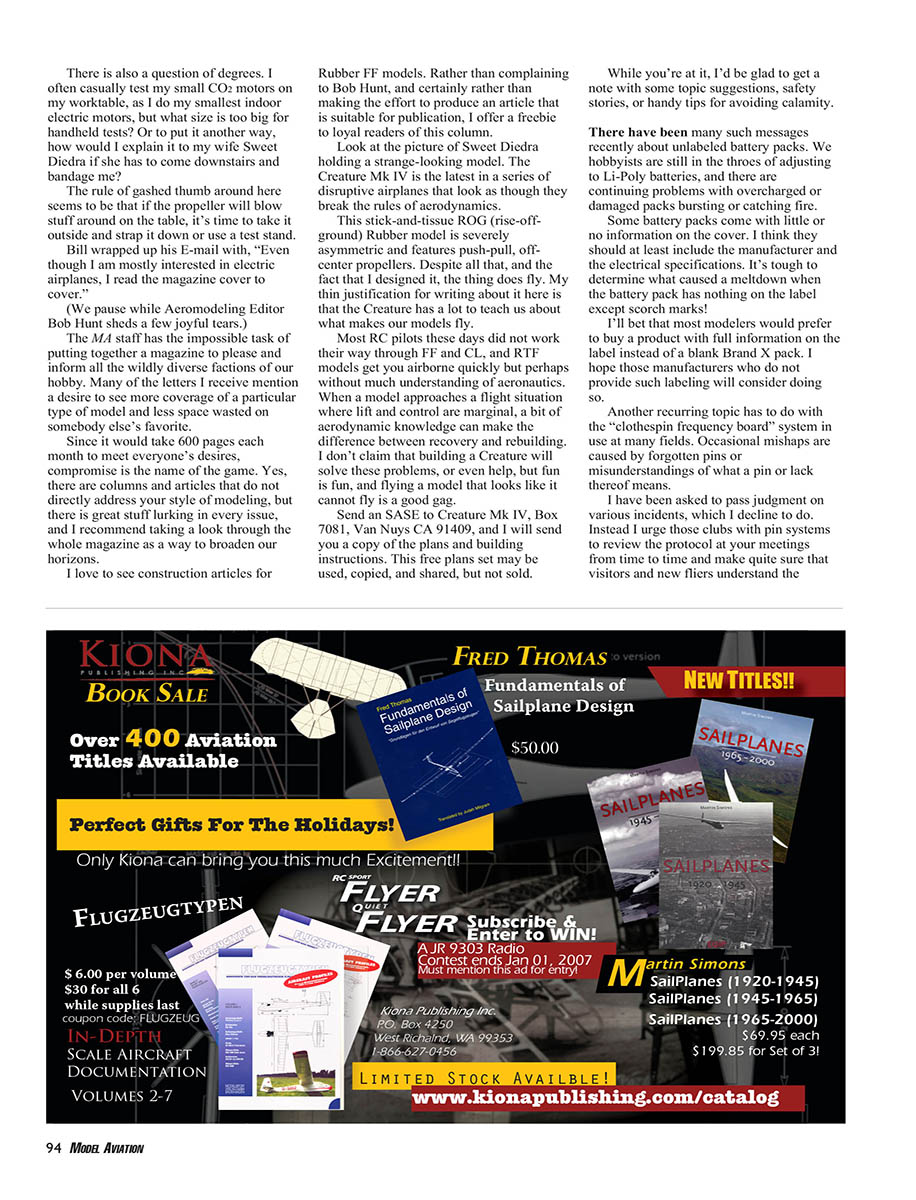
"A friend of mine lost control of his Yak yesterday. As you can see from the attached photo the resulting fire was intense. The test pilot is an accomplished 3-D flier, and he was not the model's owner. About two minutes into the flight he lost control.
"The pictures show the result. Cause of the crash is believed to be due to excessive current draw. The motor was drawing 78 amps. The crash occurred at Condors Field in Arizona."
Electric power systems can be just as volatile as gas engines, so treat them with proper respect. Many thanks to John and his friends for letting me publish this story.
I've got some excellent mail for next month's column, including a swell feed about enforcement of field safety rules. I can't wait.
MA
Transcribed from original scans by AI. Minor OCR errors may remain.

