
Safety Comes First
An in-flight fire extinguisher for jets
Model turbojets are great! I can't afford one, which is probably for the best because of my flying skills, but they are fun to watch.
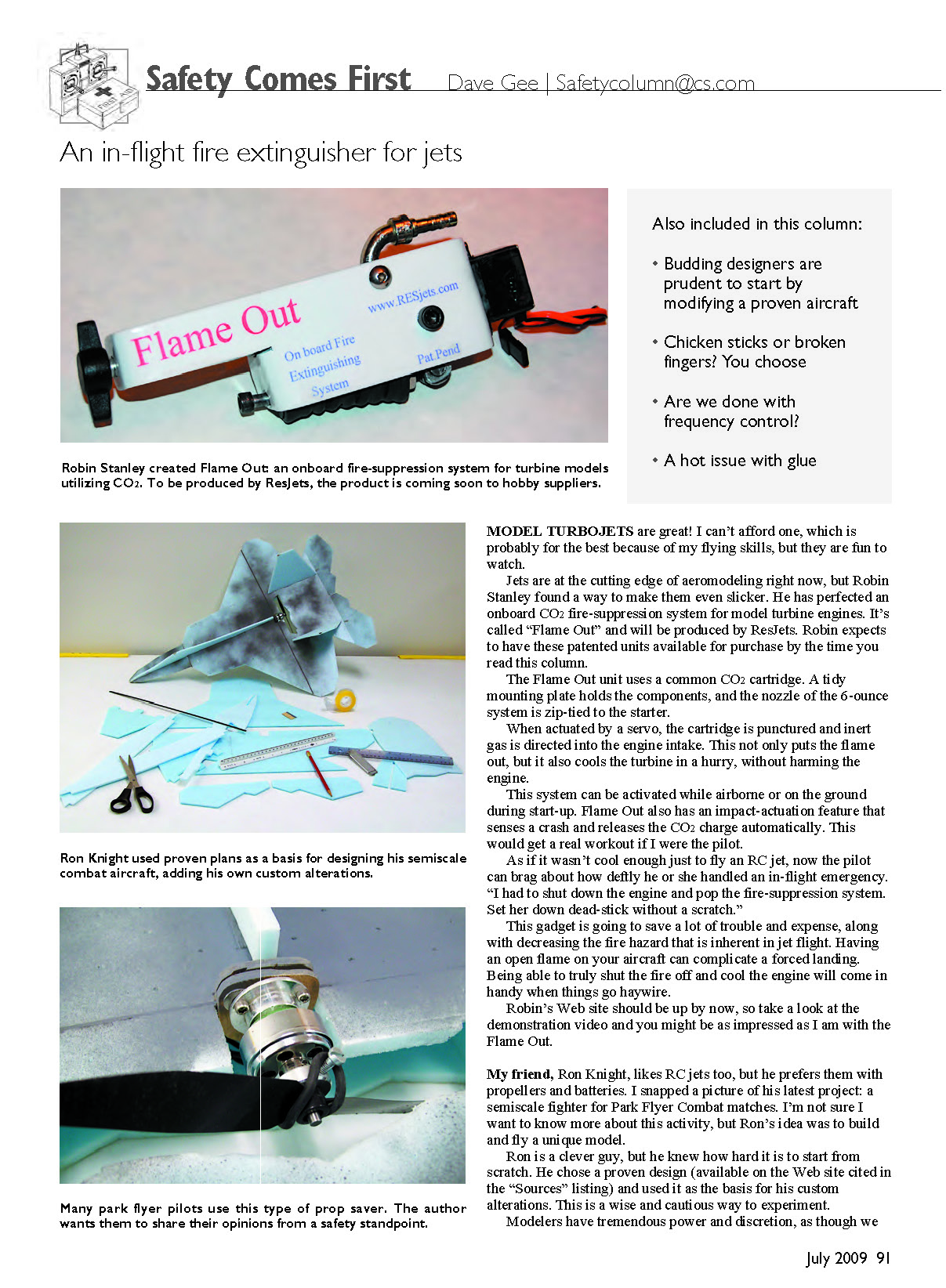
Jets are at the cutting edge of aeromodeling right now, but Robin Stanley found a way to make them even slicker. He has perfected an onboard CO2 fire-suppression system for model turbine engines. It's called "Flame Out" and will be produced by ResJets. Robin expects to have these patented units available for purchase by the time you read this column.
The Flame Out unit uses a common CO2 cartridge. A tidy mounting plate holds the components, and the nozzle of the 6-ounce system is zip-tied to the starter. When actuated by a servo, the cartridge is punctured and inert gas is directed into the engine intake. This not only puts the flame out, but it also cools the turbine in a hurry, without harming the engine.
This system can be activated while airborne or on the ground during start-up. Flame Out also has an impact-actuation feature that senses a crash and releases the CO2 charge automatically. This would get a real workout if I were the pilot.
As if it wasn't cool enough just to fly an RC jet, now the pilot can brag about how deftly he or she handled an in-flight emergency: "I had to shut down the engine and pop the fire-suppression system. Set her down dead-stick without a scratch."
This gadget is going to save a lot of trouble and expense, along with decreasing the fire hazard that is inherent in jet flight. Having an open flame on your aircraft can complicate a forced landing. Being able to truly shut the fire off and cool the engine will come in handy when things go haywire.
Robin's website should be up by now, so take a look at the demonstration video and you might be as impressed as I am with the Flame Out.
Park Flyer Combat and prop-savers
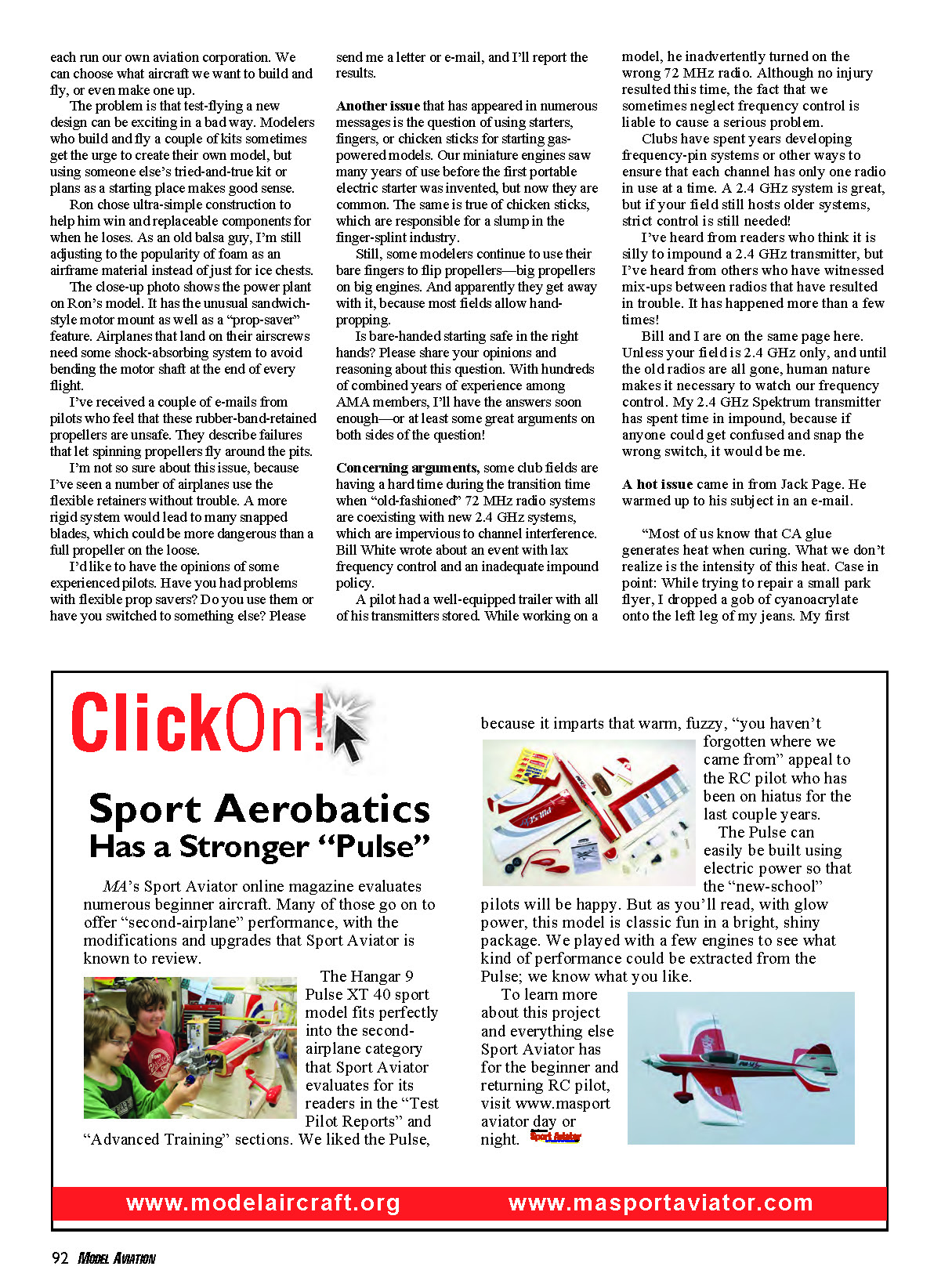
My friend Ron Knight likes RC jets too, but he prefers them with propellers and batteries. I snapped a picture of his latest project: a semiscale fighter for Park Flyer Combat matches. I'm not sure I want to know more about this activity, but Ron's idea was to build and fly a unique model.
Ron is a clever guy, but he knew how hard it is to start from scratch. He chose a proven design (available on the website cited in the "Sources" listing) and used it as the basis for his custom alterations. This is a wise and cautious way to experiment.
Modelers have tremendous power and discretion, as though we each run our own aviation corporation. We can choose what aircraft we want to build and fly, or even make one up. The problem is that test-flying a new design can be exciting in a bad way. Modelers who build and fly a couple of kits sometimes get the urge to create their own model, but using someone else's tried-and-true kit or plans as a starting place makes good sense.
Ron chose ultra-simple construction to help him win and replaceable components for when he loses. As an old balsa guy, I'm still adjusting to the popularity of foam as an airframe material instead of just for ice chests.
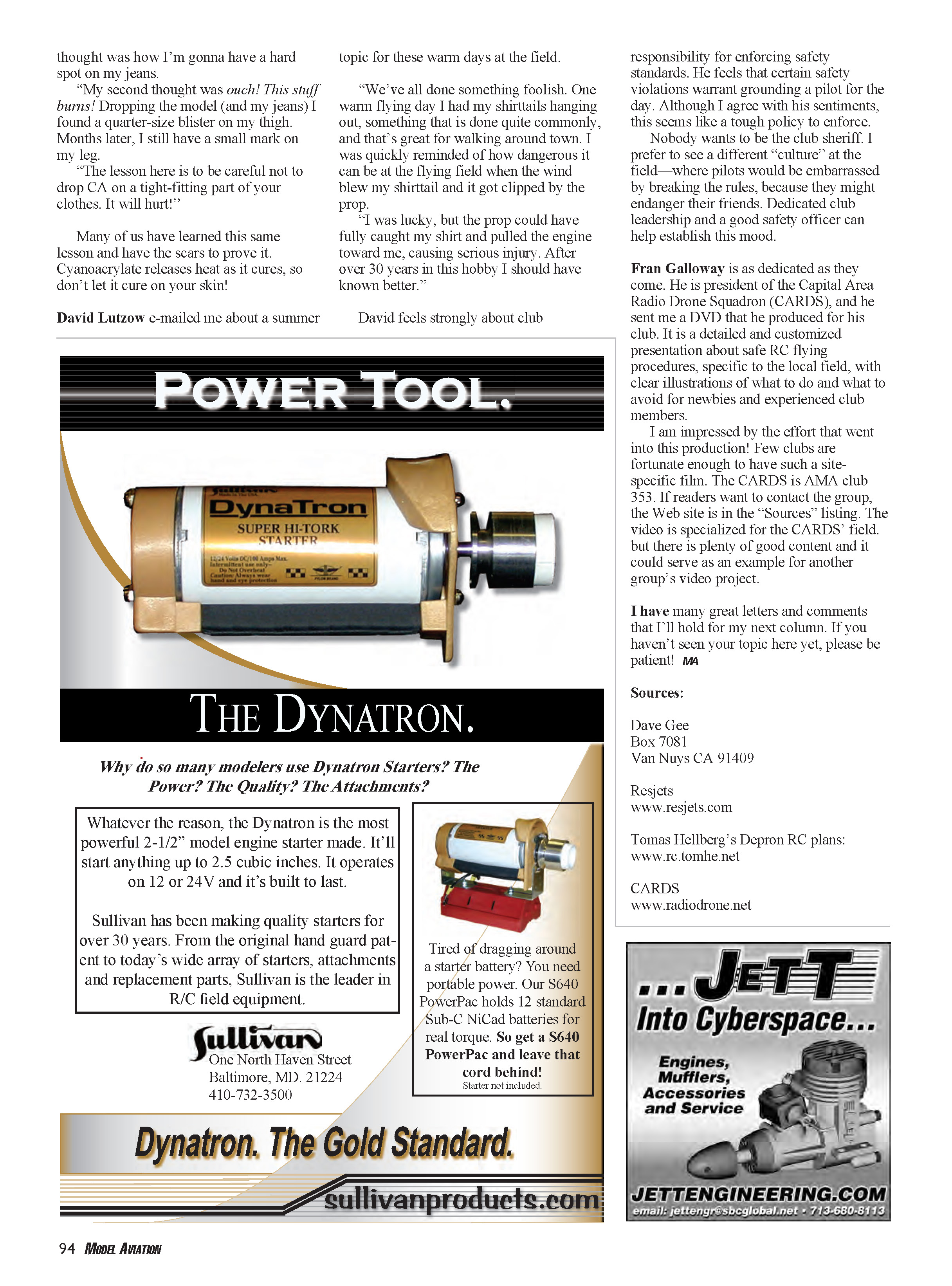
The close-up photo shows the power plant on Ron's model. It has the unusual sandwich-style motor mount as well as a "prop-saver" feature. Airplanes that land on their airscrews need some shock-absorbing system to avoid bending the motor shaft at the end of every flight.
I've received a couple of e-mails from pilots who feel that these rubber-band–retained propellers are unsafe. They describe failures that let spinning propellers fly around the pits. I'm not so sure about this issue, because I've seen a number of airplanes use the flexible retainers without trouble. A more rigid system would lead to many snapped blades, which could be more dangerous than a full propeller on the loose.
I'd like to have the opinions of some experienced pilots. Have you had problems with flexible prop-savers? Do you use them or have you switched to something else? Please send me a letter or e-mail, and I'll report the results.
Starting methods: starters, fingers, and chicken sticks
Another issue that has appeared in numerous messages is the question of using starters, fingers, or chicken sticks for starting gas-powered models. Our miniature engines saw many years of use before the first portable electric starter was invented, but now they are common. The same is true of chicken sticks, which are responsible for a slump in the finger-splint industry.
Still, some modelers continue to use their bare fingers to flip propellers—big propellers on big engines. And apparently they get away with it, because most fields allow hand-propping.
Is bare-handed starting safe in the right hands? Please share your opinions and reasoning about this question. With hundreds of combined years of experience among AMA members, I'll have the answers soon enough—or at least some great arguments on both sides of the question!
Frequency control and impound policies
Concerning arguments, some club fields are having a hard time during the transition time when "old-fashioned" 72 MHz radio systems are coexisting with new 2.4 GHz systems, which are impervious to channel interference. Bill White wrote about an event with lax frequency control and an inadequate impound policy.
A pilot had a well-equipped trailer with all of his transmitters stored. While working on a model, he inadvertently turned on the wrong 72 MHz radio. Although no injury resulted this time, the fact that we sometimes neglect frequency control is liable to cause a serious problem.
Clubs have spent years developing frequency-pin systems or other ways to ensure that each channel has only one radio in use at a time. A 2.4 GHz system is great, but if your field still hosts older systems, strict control is still needed!
I've heard from readers who think it is silly to impound a 2.4 GHz transmitter, but I've heard from others who have witnessed mix-ups between radios that have resulted in trouble. It has happened more than a few times!
Bill and I are on the same page here. Unless your field is 2.4 GHz only, and until the old radios are all gone, human nature makes it necessary to watch our frequency control. My 2.4 GHz Spektrum transmitter has spent time in impound, because if anyone could get confused and snap the wrong switch, it would be me.
The danger of CA glue
A hot issue came in from Jack Page. He warmed up to his subject in an e-mail:
"Most of us know that CA glue generates heat when curing. What we don't realize is the intensity of this heat. Case in point: While trying to repair a small park flyer, I dropped a gob of cyanoacrylate onto the left leg of my jeans. My first thought was how I'm gonna have a hard spot on my jeans.
"My second thought was ouch! This stuff burns! Dropping the model (and my jeans) I found a quarter-size blister on my thigh. Months later, I still have a small mark on my leg.
"The lesson here is to be careful not to drop CA on a tight-fitting part of your clothes. It will hurt!"
Many of us have learned this same lesson and have the scars to prove it. Cyanoacrylate releases heat as it cures, so don't let it cure on your skin!
Shirttails and club safety culture
David Lutzow e-mailed me about a summer topic for these warm days at the field.
"We've all done something foolish. One warm flying day I had my shirttails hanging out, something that is done quite commonly, and that's great for walking around town. I was quickly reminded of how dangerous it can be at the flying field when the wind blew my shirttail and it got clipped by the prop.
"I was lucky, but the prop could have fully caught my shirt and pulled the engine toward me, causing serious injury. After over 30 years in this hobby I should have known better."
David feels strongly about club responsibility for enforcing safety standards. He feels that certain safety violations warrant grounding a pilot for the day. Although I agree with his sentiments, this seems like a tough policy to enforce.
Nobody wants to be the club sheriff. I prefer to see a different "culture" at the field—where pilots would be embarrassed by breaking the rules, because they might endanger their friends. Dedicated club leadership and a good safety officer can help establish this mood.
CARDS safety DVD
Fran Galloway is as dedicated as they come. He is president of the Capital Area Radio Drone Squadron (CARDS), and he sent me a DVD that he produced for his club. It is a detailed and customized presentation about safe RC flying procedures, specific to the local field, with clear illustrations of what to do and what to avoid for newbies and experienced club members.
I am impressed by the effort that went into this production! Few clubs are fortunate enough to have such a site-specific film. The CARDS is AMA club 353. If readers want to contact the group, the website is in the "Sources" listing. The video is specialized for the CARDS' field, but there is plenty of good content and it could serve as an example for another group's video project.
I have many great letters and comments that I'll hold for my next column. If you haven't seen your topic here yet, please be patient!
MA
Sources:
- Dave Gee
Box 7081 Van Nuys, CA 91409
- Resjets
- Tomas Hellberg's Depron RC plans
- CARDS
Transcribed from original scans by AI. Minor OCR errors may remain.

