
Safety Comes First
Safety Alert From the AMA Web Page (www.modelaircraft.org)
An AMA member was recently severely burned when a model fuel can exploded as it was being opened. He received very severe burns, required extensive grafting, and is facing a long recovery period.
The metal can he was trying to open had been in storage for over 20 years. There is no evidence of an external spark or ignition source other than the container itself. Consultation with experts indicates that materials such as ether, propylene oxide, and nitromethane—commonly used in model fuels—may become destabilized and shock-sensitive over time. As best we can determine, this fuel, whose composition included two of these substances, was in a state of change. It is probable that this change, combined with the heat generated by friction (metal on metal) while trying to open the container, initiated the explosion.
AMA advises that it would be unwise to open fuel containing these products that have been stored for some period of time in metal containers. Such fuel should be taken to a hazardous waste disposal facility. (Any fuel stored for over five years would be suspect.)
Always use fresh fuel!
Columnist's Note
Although I'm unaware of any similar accidents to date, I've written before about things to consider when storing fuel and accidents that occurred because of leaking fuel vapors that caught fire.
I was told of a modeler who was refilling a flight-box fuel can near a gas water heater when vapors found the heater's pilot light, causing an explosion, fire, and injuries to the modeler.
In another instance, vapors from a leaking field-box fuel can ignited when a loose field-box tool touched the can and the field-box battery. An arc formed, then the fire touched off an explosion that destroyed the field box, spraying burning fuel on nearby modelers. Several were injured and a grass fire ensued.
Another story involved a full fuel can that exploded when a spark from connectors on an exterior fuel pump somehow ignited freshly pumped fuel on the top of the can. Burning methanol caught the ground around the flight box on fire, and one person received minor burns while trying to put it out.
In all those cases, an interesting point was the lack of mention of fire extinguishers being employed.
Methanol is an interesting substance in that it burns, as alcohol does, very hot and almost invisible. I've had many scorched modelers tell me that during accidents they felt severe burning but saw no flame.
One modeler saw the plastic on his watch melt as he hurriedly tried to remove it. At that point he realized much of his hand was on fire, and he wrapped it in a coat to smother the flames. Although he received third-degree burns, quick thinking prevented more serious injuries.
Fuel does extremely well what it was designed to do: it burns. As a result, it should be stored in areas where, if it leaks, it can be cleaned up; or if a fire starts, it can be extinguished quickly with minimal damage. I don't think extra room in the house or the bedroom closet will work.
I store my fuel on an upper shelf in a shed that is vented and free of solvents, rags, paints, chargers, etc. I usually have on hand only what I plan to use for the season, although in years past I probably had as much as 50 gallons or more at a time.
The club sometimes gets together and buys a big can (50 gallons) of fuel; all who are interested show up and buy their share. People such as myself get greedy and end up with more than they'll need.
If I notice leaks or anything wrong with the containers, I transfer the contents to a new container if possible, or discard them.
My rule of thumb: when in doubt, throw it out.
Unless I'm burning up the sky for an approaching event, I really don't use that much fuel. I don't need to keep much on hand. It would be wiser to get it when I need it and let the people who manufacture it deal with the hazard. 'Nuff said.
Buddy Box Flying
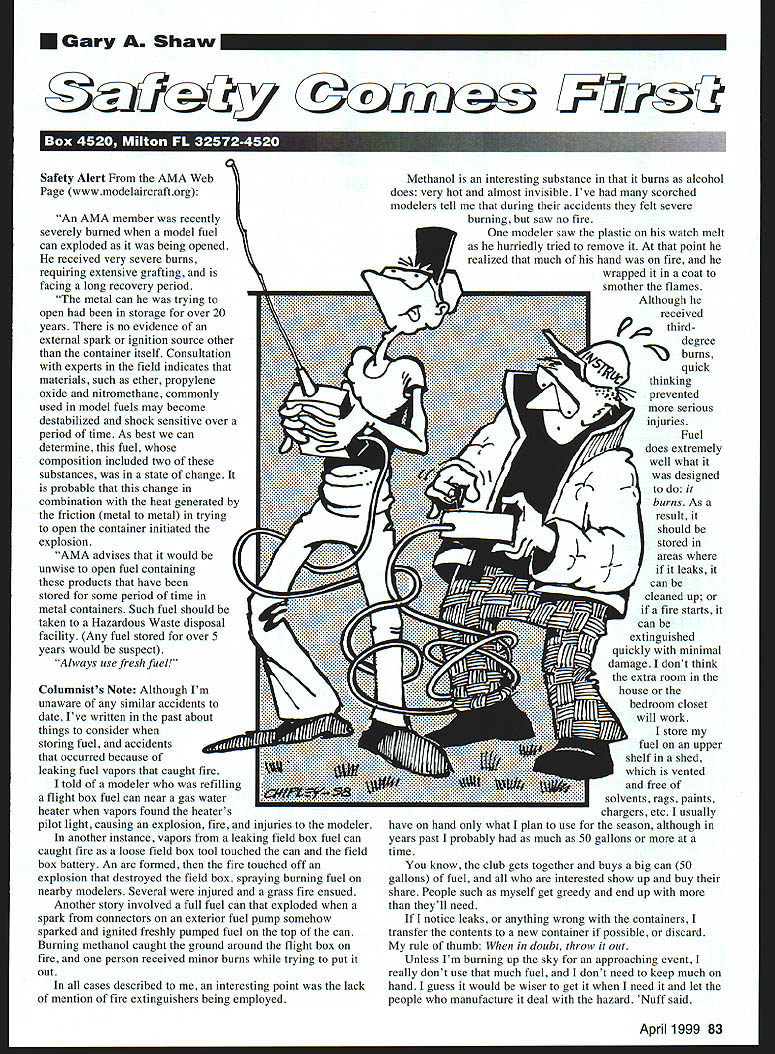
One of the best ways to learn to fly is with the assistance of a patient instructor and a good buddy-box system. Although most transmitters manufactured have the feature built in, care must be taken to ensure compatibility before heading off to the flying field.
Once compatibility is determined and both transmitters are properly set up, the student can fly with confidence and the knowledge that, with the flip of a switch, the instructor can quickly recover from a bad maneuver.
Be aware that trainer cords are long, and if not kept away from feet, can quickly entangle someone or cause a trip or a disconnect. To prevent becoming entangled or disconnected during flight, check to make sure that the slack is in your hands and not on the ground. An ounce of prevention in this case can be worth a pound of cure.
Servo Flutter — Electronic or Mechanical
Symptoms: the airplane seems to be getting "hit" or isn't responding to commands appropriately. Doing the safe thing, you land and notice the ailerons jittering back and forth. Radio interference is suspected. Is it interference, a bad radio, pot, transmitter, or possibly receiver problems?
Having had similar experiences, Clay Ramskill described what affected his airplane and the solution:
"The problem is servo 'flutter'—my term for when you move a servo to one side or the other, and let go of the stick, the servo doesn't stop at center but goes back and forth for a few cycles. When connected to a control surface, this looks like the servo making the control surface 'flutter' around its trim position.
This phenomenon had happened to me before, and one of my current airplanes was afflicted in the ailerons. I had crashed a delta model (elevator failure) some time ago after it had developed a case of elevator servo flutter, but had never figured out the real cause."
Howard asked me one day what caused this flutter—one of his models was doing it, ailerons also. I was unable to give a decent answer.
"Sometime later, Howard observed that he was able to 'cure' the flutter problem by plugging and unplugging the aileron extension plug to the servo. We surmised that if the contacts in the plug were dirty or corroded, plugging several times might tend to clean the contacts enough that the problem would be temporarily cured. We don't know enough about the electronics involved to really pin down the exact cause and effect. But it was obvious that Howard was on to something.
Recent events proved Howard's theory. After rainy weather (corrosion-inducing?), my aileron servo flutter entered a worse stage—the servo was super-slow, it slowly fluttered, and sometimes did not work at all. Replugging the aileron plug four or five times improved the situation—the servo worked normally! Later, replacing the aileron extension completely solved the problem.
Discussing this with Howard, it all comes together:
- All the servo flutter problems occurred in conjunction with an aileron extension (including my delta's elevons).
- Both of us had aileron extensions in use which could be considered "ancient."
- We both tended to use a good newer servo for ailerons but never paid much attention to the extension.
- Nothing lasts forever!
In retrospect, think about it—the plug to your aileron extension is the most used, except for the charging plug. It gets wrenched around, jerked, and quite often is left to vibrate in the plane as you fly. So the possibility of it failing after years of use, be it dirt, corrosion, or wire breakage, is high.
And the 'flutter'? Thank goodness—again, your airplane's trying to tell you there's a problem!
That's the month. Be safe and fly responsibly.
Transcribed from original scans by AI. Minor OCR errors may remain.

