
Gary A. Shaw
Safety Comes First
Box 4520, Milton FL 32572-4520
CHECKLISTS
- The weather report predicts that the day will be calm and sunny—check!
- The wife says she'll be out most of the day with the kids—check!
- The airplane is charged and loaded in the car—check!
- A quick call to your ol' flying buddy reveals that he'll be at the field by the time you get there—check!
Ahh—life's good.
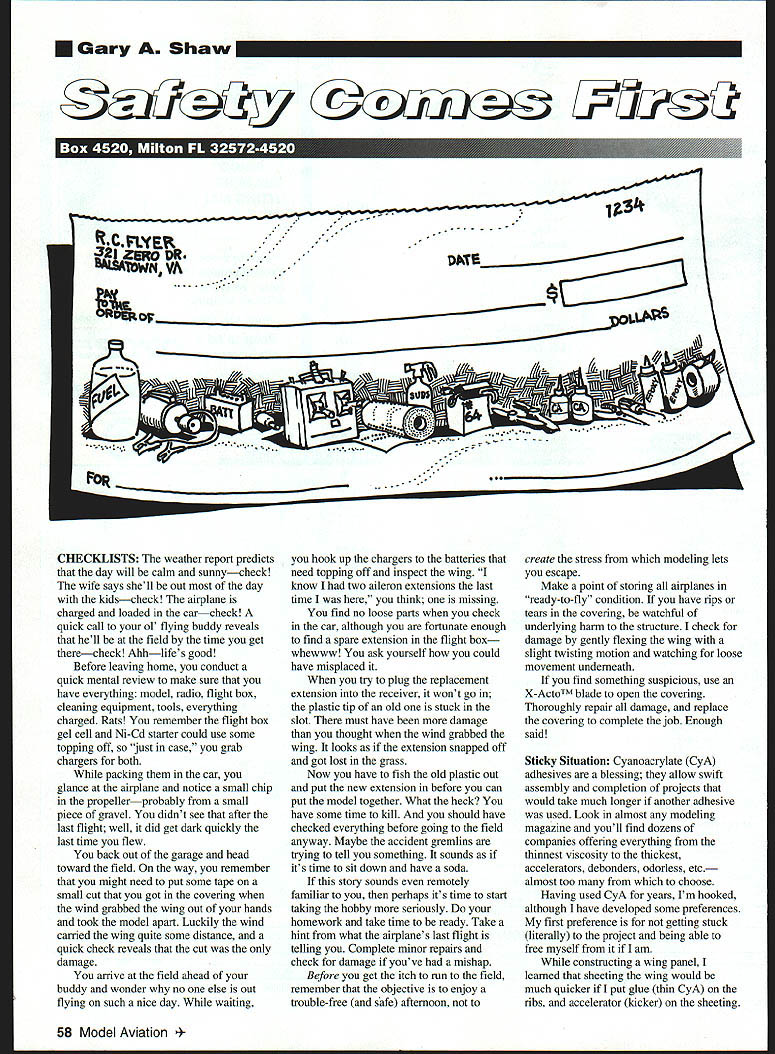
Before leaving home, you conduct a quick mental review to make sure that you have everything: model, radio, flight box, cleaning equipment, tools—everything charged. Rats! You remember the flight-box gel-cell and Ni-Cd starter could use some topping off, so "just in case," you grab chargers for both.
While packing them in the car, you glance at the airplane and notice a small chip in the propeller—probably from a small piece of gravel you didn't see after the last flight; well, it did get dark quickly the last time you flew.
You back out of the garage and head toward the field. On the way, you remember that you might need to put some tape on a small cut that you got in the covering when the wind grabbed the wing out of your hands and took the model apart. Luckily the wind carried the wing quite some distance, and a quick check reveals that the cut was the only damage.
You arrive at the field ahead of your buddy and wonder why no one else is out flying on such a nice day. While waiting, you hook up the chargers to the batteries that need topping off and inspect the wing. "I know I had two aileron extensions the last time I was here," you think; one is missing.
You find no loose parts when you check in the car, although you are fortunate enough to find a spare extension in the flight box—whew! You ask yourself how you could have misplaced it.
When you try to plug the replacement extension into the receiver, it won't go in; the plastic tip of an old one is stuck in the slot. There must have been more damage than you thought when the wind grabbed the wing. It looks as if the extension snapped off and got lost in the grass.
Now you have to fish the old plastic out and put the new extension in before you can put the model together. What the heck! You have some time to kill. And you should have checked everything before going to the field anyway. Maybe the accident gremlins are trying to tell you something. It sounds as if it's time to sit down and have a soda.
If this story sounds even remotely familiar to you, then perhaps it's time to start taking the hobby more seriously. Do your homework and take time to be ready. Take a hint from what the airplane's last flight is telling you. Complete minor repairs and check for damage if you had a mishap.
Before you get the itch to run to the field, remember that the objective is to enjoy a trouble-free (and safe) afternoon, not to create the stress from which modeling lets you escape.
Make a point of storing all airplanes in "ready-to-fly" condition. If you have rips or tears in the covering, be watchful of underlying harm to the structure. I check for damage by gently flexing the wing with a slight twisting motion and watching for loose movement underneath.
If you find something suspicious, use an X-Acto blade to open the covering. Thoroughly repair all damage, and replace the covering to complete the job. Enough said!
Sticky Situation: Cyanoacrylate (CyA)
Cyanoacrylate (CyA) adhesives are a blessing; they allow swift assembly and completion of projects that would take much longer if another adhesive was used. Look in almost any modeling magazine and you'll find dozens of companies offering everything from the thinnest viscosity to the thickest, accelerators, debonders, odorless, etc.—almost too many from which to choose.
Having used CyA for years, I'm hooked, although I have developed some preferences. My first preference is for not getting stuck (literally) to the project and being able to free myself from it if I am.
While constructing a wing panel, I learned that sheeting the wing would be much quicker if I put thin CyA on the ribs and accelerator (kicker) on the sheeting. I must have gotten some accelerator on the tip of the thin CyA bottle which caused a plug. No problem, thought I; I'll shove a pin through the tip. I'll be ready to continue. I made a strong effort to penetrate the clog and dislodge it. A pressurized spurt of thin CyA shot over my face. The glue missed my eyes but hit the area where my hat met my forehead. I spent the next 30 minutes trying to get the hat off; there was still a remnant of glue stuck to my forehead. After that week I should have been wearing goggles or glasses. I know, if you squeeze a full bottle of anything too tightly, something's going to give sooner or later. The thought of being in the emergency room with eyes glued shut still sends shivers down my back.
There isn't much out regarding CyA precautions. Warnings say to use adequate ventilation. From the brands I've used, the effect on my eyes and sinuses is similar to onions; after long use I can usually count on a headache and/or red eyes. Manufacturers recommend adequate ventilation, and I've provided it.
What's beginning to concern me, though, is that I've gotten older and am less tolerant of vapors. I wonder if others are experiencing similar things. I'd like to receive some mail regarding health effects associated with long periods of CyA use. Write and describe your concerns regarding exposure to CyA to: Roy McGuckin, San Diego.
Sometime in the early seventies I was one of the first modelers to be hit with a devastating allergic reaction to CyA glue.
My back and chest were covered with an unbearable itchy rash. My dermatologist couldn't diagnose it until I deduced what was causing it by process of elimination. I remember stripping to my shorts and rolling in the snow to get relief—that's how bad it was. With cortisone and antihistamines it slowly subsided.
I didn't use CyA glue again until the fall of 1997, when I tried the odorless type ... same problem, only this time it won't go away and it's been over a year now. My dermatologist says I have Grover's disease, a chronic itchy skin condition of unknown origin, but statistically associated with outside allergic factors. Luckily, antihistamines control the itching to a bearable degree, but not completely.
I have collected some medical research papers on Grover's disease, and as far as I can tell, the medical profession doesn't know what causes it, or how to cure it. They don't even seem interested in the fact that I had the exact same problem previously with CyA glue. They don't even know what CyA glue is. I had to explain what it was.
I'm writing to ask if any other modelers out there have had, or are having chronic allergic problems with CyA glues, particularly if they have had a more chronic recurrence. I would prefer a letter, but a phone call would be acceptable:
Roy McGuckin 11686 Orilla Dr. San Diego, CA 92128 Tel: (619) 673-8123
I'd appreciate a copy of letters sent to Roy. Until we know what more hazards exist, follow the label directions and manufacturer warnings that may apply. When using anything that produces mists, fumes, or vapors, ventilation is the key. If you feel that a respirator is in order, call the manufacturer for guidance in selection.
That's all for this month.
Transcribed from original scans by AI. Minor OCR errors may remain.

