

Safety Comes First
Box 33094, Pensacola FL 32508-3094
Spring Cleaning
By the time you read this column, spring should be in full swing and clear skies will be luring modelers out to the fields. If you haven't done so already, it's time to get models ready for another flying season: clean out the field box, throw the old out, put in the new, and find the bug repellant.
Things to keep an eye out for include:
- Old or used rubber bands
- Chipped props
- Semi-working glow plugs
- Dead batteries
- Old fuel
- Rock-hard cyanoacrylate (CyA) bottles
- Stiff or cracked fuel tubing
Use the old rule of thumb: when in doubt, throw it out. You'll enjoy many more trouble-free flying days.
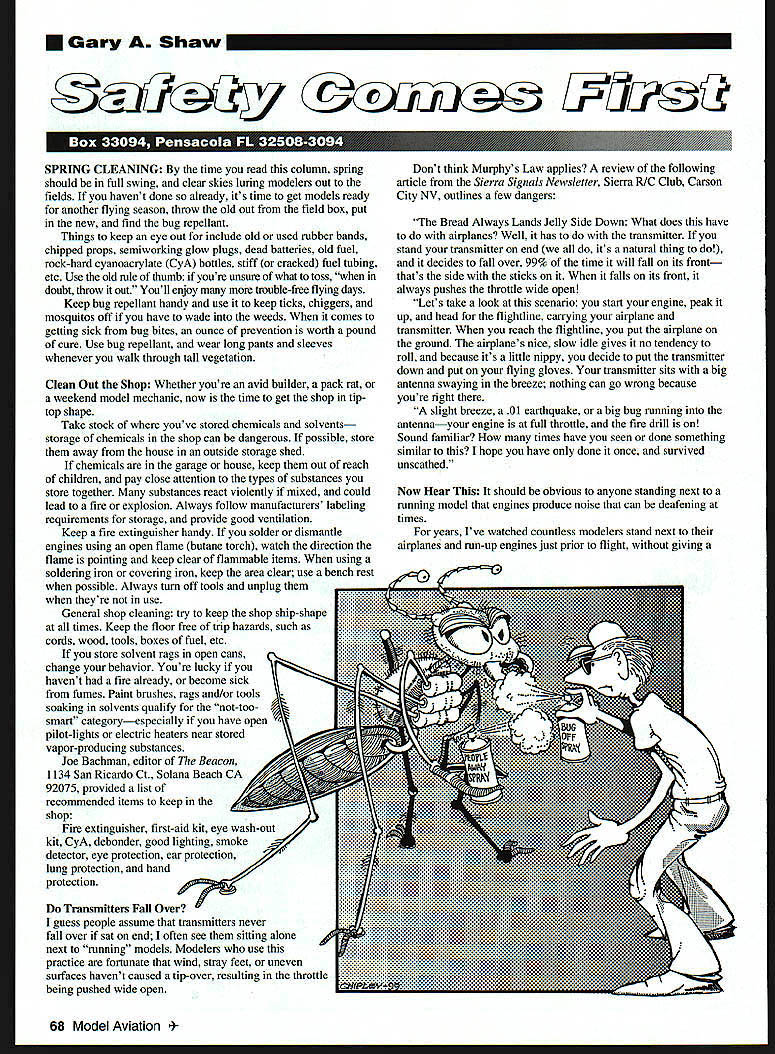
Keep bug repellant handy and use it to keep ticks, chiggers, and mosquitoes off if you have to wade into the weeds. An ounce of prevention is worth a pound of cure: use bug repellant and wear long pants and sleeves whenever you walk through tall vegetation.
Clean Out the Shop
Whether you're an avid builder, a pack rat, or a weekend model mechanic, now is the time to get the shop in tip-top shape.
Take stock of where you've stored chemicals and solvents—storage of chemicals in the shop can be dangerous. If possible, store them away from the house in an outside storage shed. If chemicals are in the garage or house, keep them out of reach of children, and pay close attention to the types of substances you store together. Many substances react violently if mixed and could lead to a fire or explosion. Always follow manufacturers' labeling requirements for storage and provide good ventilation.
Keep a fire extinguisher handy. If you solder or dismantle engines using an open flame (butane torch), watch the direction the flame is pointing and keep clear of flammable items. When using a soldering iron or covering iron, keep the area clear; use a bench rest when possible. Always turn off tools and unplug them when they're not in use.
General Shop Cleaning
Try to keep the shop ship-shape at all times. Keep the floor free of trip hazards such as cords, wood, tools, boxes, fuel, etc.
If you store solvent-soaked rags in open cans, change your behavior. You're lucky if you haven't had a fire already or become sick from fumes. Paint brushes, rags, and tools soaking in solvents qualify for the "not-too-smart" category—especially if you have open pilot lights or electric heaters near stored vapor-producing substances.
Joe Bachman, editor of The Beacon, 1134 San Ricardo Ct., Solana Beach CA 92075, provided a list of recommended items to keep in the shop:
- Fire extinguisher
- First-aid kit
- Eye-wash kit
- CyA debonder
- Good lighting
- Smoke detector
- Eye protection
- Ear protection
- Lung protection (mask/respirator)
- Hand protection (gloves)
Do Transmitters Fall Over?
Some modelers stand their transmitters on end next to running models. This is risky: wind, stray feet, or uneven surfaces can cause a transmitter to tip over and unintentionally push the throttle wide open.
From the Sierra Signals Newsletter (Sierra R/C Club, Carson City NV):
"The bread always lands jelly side down: what does this have to do with airplanes? Well, it has to do with the transmitter. If you stand your transmitter on end (we all do, it's a natural thing to do!), and it decides to fall over, 99% of the time it will fall on its front—that's the side with the sticks on it. When it falls on its front, it always pushes the throttle wide open!
"Let's take a look at this scenario: you start your engine, peak it up, and head for the flightline carrying your airplane and transmitter. When you reach the flightline, you put the airplane on the ground. The airplane's nice slow idle gives it no tendency to roll, and because it's a little nippy, you decide to put the transmitter down and put on your flying gloves. Your transmitter sits with a big antenna swaying in the breeze; nothing can go wrong because you're right. Suddenly, a .01 earthquake, or a big bug running into the antenna—your engine is at full throttle, and the fire drill is on! Sound familiar? How many times have you seen or done something similar to this? I hope you have only done it once, and survived unscathed."
Do not assume transmitters are safe standing on end; place them flat, in a holder, or on a stable surface where sticks cannot be moved accidentally.
Hearing Protection (Now Hear This)
It should be obvious to anyone standing next to a running model that engines produce noise that can be very loud and, over time, can cause severe hearing loss.
For years I've seen modelers run engines just prior to flight without giving a thought to hearing protection. Many people don't realize that Noise-Induced Hearing Loss (NIHL) is often gradual and cumulative. Hearing involves processes that turn sound waves into electrical nerve impulses interpreted by the brain. NIHL results when loud noises damage the parts of the ear that perform this conversion.
Ed Van Reet, of the Midland Hi-Sky R/C Club, Midland TX, writes: "There are lots of safety hazards associated with our hobby. Many of these we know about (a spinning prop is a good example), and we take certain precautions to avoid injury. A potential hazard that we probably do not pay enough attention to, though, is the danger of damaging our hearing. The reason that NIHL is not the focal point of people's conversations is that it is often a gradual injury that occurs over a long period.
"Hearing involves a series of processes that turn sound waves into electrical nerve impulses. These impulses are eventually interpreted by the brain. NIHL results when loud noises damage the parts of the ear that convert the vibrations into signals for the brain to interpret.
"NIHL can be caused by a one-time loud sound, as well as by repeated exposure to loud sounds. How loud is too loud? Any sound above 75 decibels can cause damage if you are exposed for a long period; normal conversation is about 60 decibels. A busy city street may have an average of 80 decibels. Keep in mind the damage is cumulative — it all adds up. Five minutes of exposure this week, seven minutes next week, and ten minutes next month add up over time to permanent hearing loss.
"Protect your hearing. Wear hearing protection whenever you are working around running engines or noisy equipment. Inexpensive foam earplugs are a good first step and are practically invisible. Earmuff-type protectors provide more protection and are reusable. Be sure to wear them whenever you are around full-scale aircraft, motorcycles, chain saws, or loud engines and equipment. If you can't stand the noise, get away from it. Hearing is precious, and once it's gone, it's gone."
Exposure to very loud noises (120+ decibels) — like gunfire, firecrackers, some power tools, and some model airplane engines — can cause immediate damage. Some symptoms of NIHL include ringing or buzzing in one or both ears, trouble hearing people when they talk, and distorted or muffled sounds. These could be signs that your hearing is deteriorating. About one-third of those with hearing disorders have been affected by noise.
The good news is that NIHL can be prevented:
- Know that loud noises can cause damage.
- Wear ear protection (foam earplugs or earmuffs) around running engines and noisy equipment.
- Protect young children from loud noises until they can protect themselves.
- Consult an audiologist or physician for appropriate hearing-protection devices if you need guidance.
That's all for this month. Hope you use ear plugs or muffs the next time you're at the field—your family and friends will be glad you did. If you're wondering where or how to obtain appropriate hearing-protection devices, consult an audiologist in your area or your physician. If neither is available, visit your local builder's store—numerous options are available. Follow manufacturers' recommendations to ensure the level of protection you need.
Transcribed from original scans by AI. Minor OCR errors may remain.

