


Gary A. Shaw
Safety Comes First
Sticky Situation
In the May column, I wrote about the precautions you should take when using cyanoacrylate (CyA) glues, and highlighted a few of the ills that could potentially develop if used carelessly.
It appears that many readers have experienced a few of these ills firsthand—I received numerous pieces of mail requesting additional information, common-sense solutions, or asking me to provide my own experience.
Almost all of the readers described symptoms that occurred after being exposed to CyA without using personal protective equipment. Their symptoms included:
- severe hives
- bloody nose
- severe cough
- runny eyes and nose
- insomnia
Joseph Micalizzi of Fajardo, PR, described his frustration with the inability to determine what was causing his breathing problems and subsequent sleepless nights. Through a long process of elimination, Joseph feels he's finally discovered the source of his suffering:
"I just finished reading your column in the May issue of Model Aviation and found it very interesting. In the summer of 1991, I got to the point where I couldn't sleep at night; the problem was breathing. I went to see a nose specialist and after spending about $600, the problem went away.
"In October of 1997, our club started a model aviation program at the Roosevelt Roads Naval Base, in Ceiba, PR. The school gave us a classroom to use after school. The classes were held three times a week and were one hour long. To keep the costs down, and to teach the students the most about building, most of the models were scratch-built and most were made with epoxy and CyA.
"At the beginning of 1998, I started having problems breathing at night. By this time we had about 25 students and were using quite a lot of CyA and kicker. Since I'd had this problem once before, I went back to the same doctor and started treatment all over again.
"The treatment started with a series of pinpricks along each arm, twice a week. Once the doctor found out what was causing the problem, he made a vaccine that I would take once a week. The next week I would get different dosages, until the vial was finished. Then I would go back and he would make a different vaccine to be taken the same way—I didn't get any better.
"Before I knew it, it was June and school was over here in Puerto Rico, which meant no more building. Before I knew it, I started getting better without going to the doctor (and without spending any money). I finally figured out that the problem was being caused by the CyA we were using for building.
"As of today, I have not had any problems breathing at night. As for 1991, I cannot remember whether or not I was building any models or using CyA, or if that caused my problem at the time. All I know is that I no longer use it and can breathe."
"I have not stated any brand, because we were using two different kinds."
Although Joseph was fortunate enough to discover the source of his problems over time, Russel Mobley (Thompson, GA) found that mixing CyA fumes with medications could be very concerning. After several severe nosebleeds, Russel decided to pass on a warning of his own:
"I read with much interest the letter from Roy McGuckin. I, too, am highly allergic to CyA, although in a different way than Roy.
"I have an extremely bad nosebleed and cough, and it doesn't seem to matter at all if I use the new odorless type or not—they both have the same effect. I have written Roy with information about my reactions, and since I don't have access to a copy machine without going into town some 15 miles away, I thought I would just type another letter.
"What compounds my case is that I have had two heart attacks and open-heart surgery; consequently I'm on blood thinners and it is impossible to stop a nosebleed once it starts. I also have to be careful with some of the sanding sealers; most of the effects of these are burning in my eyes and the initiation of a cough.
"This situation became worse about four years ago, and I have had a time with it ever since—I guess I am just getting old and worn out."
Robert Bartz, Green Bay, WI, experienced several symptoms mentioned in the letters above. Rather than go through a lengthy process of elimination, Robert was able to focus right away on what he thought was bothering him and begin the search to find solutions and answers. Offering some insight into the dilemma and a possible solution to exposure using CyA products, Robert reveals the following:
"I've just read your column in the May issue of Model Aviation, section CyAs, entitled 'Sticky Situation,' particularly interesting. I don't believe the modeling community pays enough attention to the health effects glue can cause. I got into RC modeling about 10 years ago and just took it for granted that I'd use this wonderful glue. About three years ago it finally dawned on me that my runny nose and irritated sinuses was due to CyA. After talking with other club members, and not getting any particular solutions (except to have plenty of ventilation), I now use an exhaust fan.
"I called 3M and they were very cooperative and understood what I meant by CyA. They recommended the 3M 5000 series dual-cartridge mask, specifically the 5201 (medium). This is a very comfortable mask and appears to do the job (I'll have to admit that I cheat a little when it's just a minor amount of gluing). I believe the mask cost around $20 and the filters are replaceable.
"I don't use accelerators, but about a year ago some CyA fumes got into my left eye. You can't see the stuff, then suddenly your eye burns. After a week I went to a doctor and no damage was found.
"Anyway, I'd like to see more about the use of CyAs, especially pointed toward those just getting into the hobby. It may not cut your finger like a whirling prop, but once you're allergic to it, it doesn't go away."
It should come as no surprise to those who use glues that they are nothing more than combinations of substances, and have the potential to harm people if not used according to the labels. Most product labels provide warnings that should be followed. Unfortunately, over the years, I've noted most individuals don't read or heed what's said.
Do yourself a favor—use ventilation when it's recommended, whether it's fresh air brought in through an open window or ventilation (overhead plenum) that carries CyA fumes away.
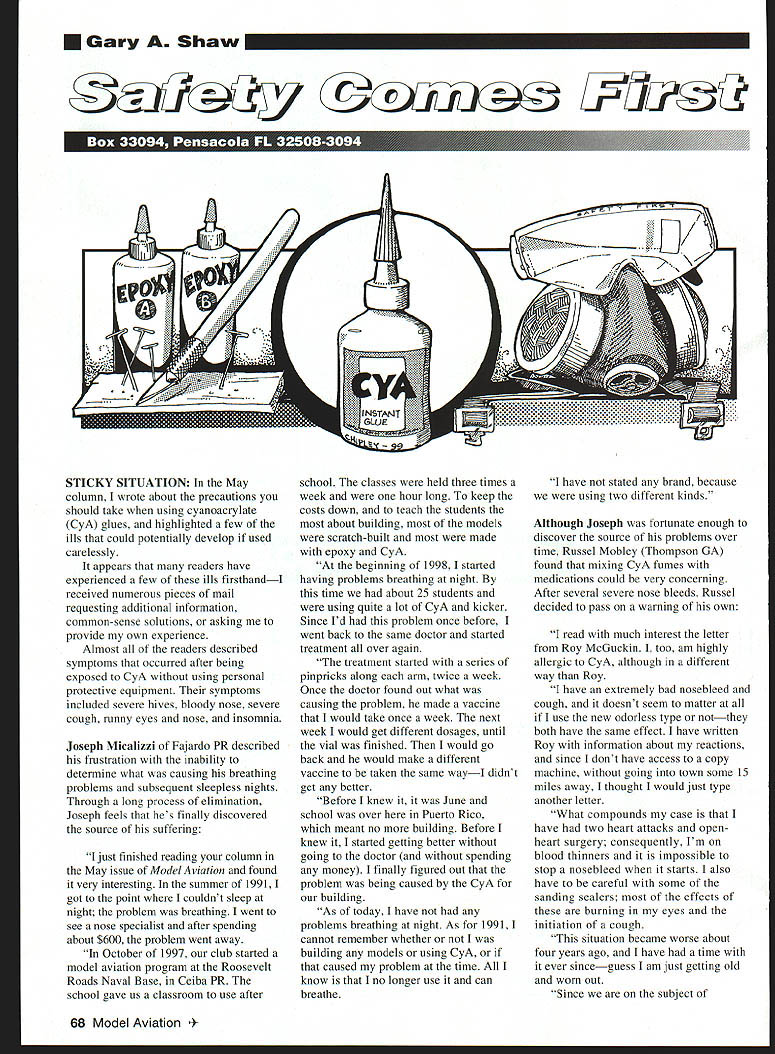
Additionally, invest a few dollars in a good respirator that uses cartridges for organic and inorganic substances. For the right cartridge type, and to find a store near you that carries the appropriate cartridge(s), call the manufacturer or consult a nearby hardware store. Describe the product that you desire to be protected from—whether it's a mist, fumes, vapors, or dust—there's a cartridge available to help keep exposure to a minimum.
Until then:
- Open the windows.
- Use small quantities.
- Take breaks often.
- Have fun!
Keep 'em level until next month.
Transcribed from original scans by AI. Minor OCR errors may remain.

