
Safety Comes First
Gary A. Shaw
Box 4520, Milton FL 32572
More Than You Can Handle
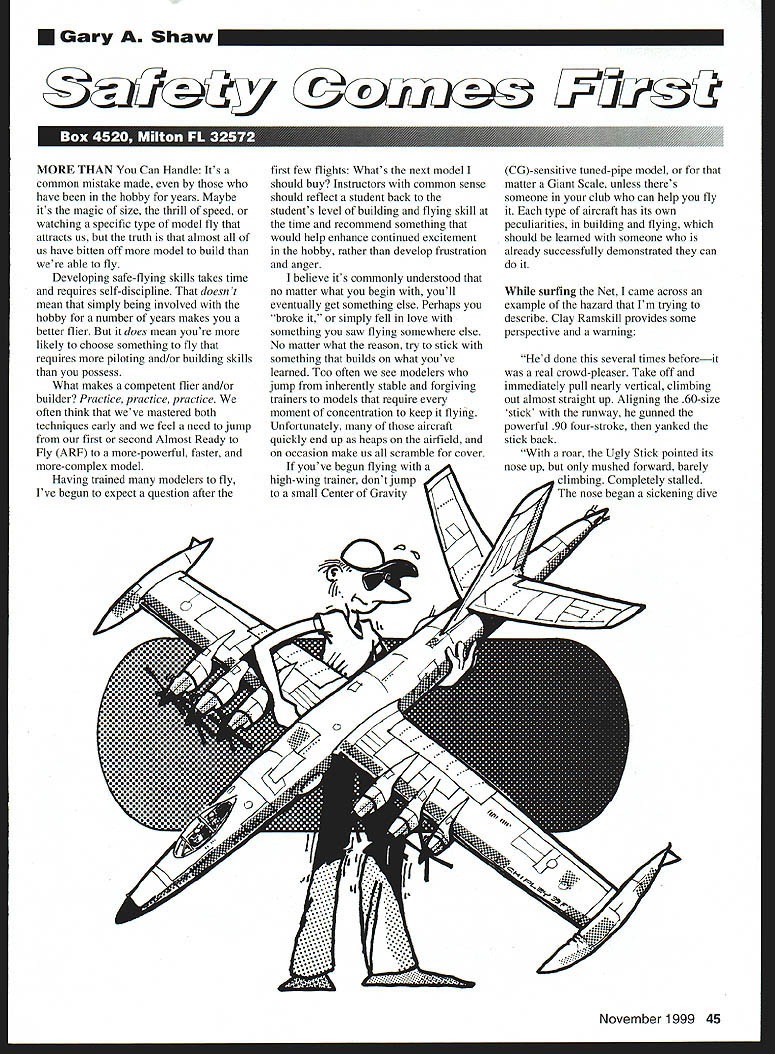
More Than You Can Handle: It's a common mistake made, even by those who have been in the hobby for years. Maybe it's the magic of size, the thrill of speed, or watching a specific type of model fly that attracts us, but the truth is that almost all of us have bitten off more model to build than we're able to fly.
Developing safe-flying skills takes time and requires self-discipline. That doesn't mean that simply being involved with the hobby for a number of years makes you a better flier. But it does mean you're more likely to choose something to fly that requires more piloting and/or building skills than you possess.
What makes a competent flier and/or builder? Practice, practice, practice. We often think that we've mastered both techniques early and we feel a need to jump from our first or second Almost Ready to Fly (ARF) to a more powerful, faster, and more complex model.
Having trained many modelers to fly, I've begun to expect a question after the first few flights: What's the next model I should buy? Instructors with common sense should reflect a student back to the student's level of building and flying skill at the time and recommend something that would help enhance continued excitement in the hobby, rather than develop frustration and anger.
I believe it's commonly understood that no matter what you begin with, you'll eventually get something else. Perhaps you "broke it," or simply fell in love with something you saw flying somewhere else. No matter what the reason, try to stick with something that builds on what you've learned. Too often we see modelers who jump from inherently stable and forgiving trainers to models that require every moment of concentration to keep them flying. Unfortunately, many of those aircraft quickly end up as heaps on the airfield, and on occasion make us all scramble for cover.
If you've been flying with a high-wing trainer, don't jump to a small Center of Gravity (CG)-sensitive tuned-pipe model, or a giant-scale plane, unless there's someone in your club who can help you fly it. Each type of aircraft has its own peculiarities, in building and flying, which should be learned with someone who has already successfully demonstrated they can do it.
While surfing the Net, I came across an example of the hazard that I'm trying to describe. Clay Ramskill provides some perspective and a warning:
"He'd done this several times before — it was a real crowd-pleaser. Take off and immediately pull nearly vertical, climbing out almost straight up. Aligning the .60-size 'stick' with the runway, he gunned the powerful .90 four-stroke, then yanked the stick back.
"With a roar, the Ugly Stick pointed its nose up, but only mushed forward, barely climbing. Completely stalled. The nose began a sickening dive to the left. 'I ain't got it,' he shouted as the airplane crashed."
Radio problem? CG problem? No. All too often we see the above scenario: after the trainer, a relatively "hot" airplane, with lots of power. And often as not, the appropriate warning sign is there—the trainer was crashed, not worn out or sold. Then the relatively inexperienced pilot gets a "hot" plane, or an appropriate intermediate plane, but overpowered.
"Perhaps there should be an intermediate training program, too. So that a pilot knows that he must be able to use appropriate rudder with a strong engine. So that he knows what the stall characteristics of an Extra are not the same as on his trusty Eagle 3. So that he knows how to recover from a deep-stalled attitude. So that he knows not to get into that deep stall ten feet above the runway. It's bad enough that some individuals end up crashing some awfully nice hardware before they even get the chance to appreciate it properly.
There is a safety factor involved, also. The fewer crashes, the less likely a crash will occur in the pits, on a car, or on someone's head. Newer pilots need a bit of coaching; sometimes they need the brutal hard facts: "Son, that plane's too much for you right now." They need some patience—to take some time to really learn flying on a trainer or intermediate plane before moving up to "heavy iron."
"More-experienced fliers need to be more involved with the less-experienced—help them get the skills they need before they get into trouble."
'Nuff said!
Sticky Situation
In several recent columns I wrote about CyA glues and the potential health effects that can be encountered if not used appropriately. Mail quickly began arriving, describing many of the ill effects encountered after product use.
A modeler from Las Vegas described another concern and personal-use history. While reading the following, remember two key words:
- ventilation
- respirator
"I have had serious problems with CyA and am unable to use it, be in the same room when it is used, or be downwind when it is used outside. I belong to the Sun City Modelers in Las Vegas, NV.
"We have a wonderful workshop (now two large rooms) to work in. You can imagine the CyA fumes. Lots of the members complain of burning eyes, breathing problems, and itchy skin. I contacted manufacturers. They all said no real problem; a few might be a little sensitive to CyA. Model builders here said the speed of glue was worth burning eyes and etc.
"I got our club to vote once to switch to odorless, but because of cost differences they changed back. Needless to say, I work when there is no one else there or I open the doors (40 or 110 degrees). Next, I am going to take in a fan.
"Enough of personal problems; let's get to a solution. No matter what people tell you, regular CyA and odorless are two entirely different things. Regular is ethyl cyanoacrylate and odorless is butyl cyanoacrylate. Butyl is not near as harmful as ethyl. Personally, I have had no problems with odorless CyA from Satellite City.
"Let's take burning eyes first, as you cannot get new eyes. I talked to an eye surgeon about the enclosed Material Safety Data Sheet (MSDS), which says CyA has an acid component that can damage eyes. He said the burning you feel is not minor. It is the acid in CyA that is etching the lens of your eyes, slowly destroying your eyes and vision. He said this is very serious and if you insist on using this product, use a fan to blow the fumes away. The report backs this up.
"Lungs are also kind of important to staying alive; I checked this out, too. The acid vapor again gets you in the long run. It burns the air sacs in your lungs. When you feel it is a little hard to breathe when using, or after using, CyA, it is because the CyA vapors work with the moisture in your lungs and start sealing things up. I have had so much trouble this way; it is like a bad asthma attack. The last time was the last straw and I decided 'no more.'
"The enclosed report also shows possible nerve damage. This makes you wonder sometimes whether builders who have used CyA for many years have come down with Parkinson's disease. Is that what they really have, or is it an effect of CyA?
"The skin problem doesn't seem to be as severe as Roy's, but a lot of builders, including myself, have itchy forearms above their wrists. Could it again be from CyA fumes? I have seen this in people building full-size fiberglass airplanes who don't wear gloves and become sensitized to epoxy, which reoccurs if they get near epoxy months or years later—polyester is worse.
"We are all in a hurry to get finished with what is supposed to be a relaxing hobby, to jeopardize our health? What's wrong with Titebond II and epoxies? After talking with people in the medical profession, they say adults should have better sense, but children should not use CyA! We didn't know what the bad side effects were on lots of products for many years until it was too late. This product is giving us lots of warnings.
"Like many products we use in the hobby today, how you protect yourself from exposure may determine whether or not you'll be able to continue using it over time. In the case of CyA glue, plenty of ventilation and the use of a respirator are the key to ensuring minimal exposure to fumes.
What kind of respirator and cartridge can reduce exposure?
- 3M R-6211 Dual Cartridge Paint Spray Respirator
- #6001 Organic Vapor Cartridges
- 3M 5010 Pre-Filters
- Cost: about $36.95 at Sherwin-Williams for a complete set
Until next month—sand, sand, glue, glue!
Transcribed from original scans by AI. Minor OCR errors may remain.

