
Safety Comes First
Gary A. Shaw Box 4520, Milton FL 32572
It's been just a few weeks since John F. Kennedy Jr.'s tragic plane crash; media speculation about what caused the crash seems to be revolving around pilot error. What actually caused the crash may never be known, but preliminary statements from several agency officials speculate that a chain of events was set into motion long before the actual flight took place, probably leading to the crash.
People in general aviation and model aviation (especially radio control, RC) share common ground: both kinds of pilots often learn only after an accident that if one link in the chain hadn't been broken, the accident might not have happened at all.
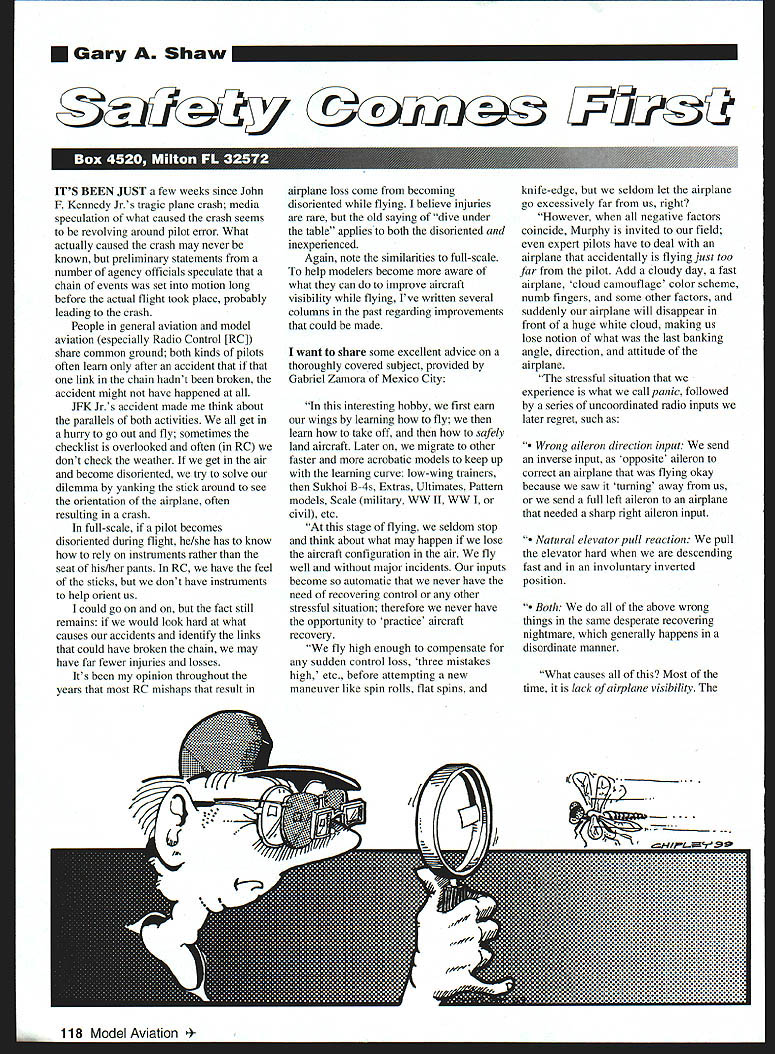
JFK Jr.'s accident made me think about the parallels between both activities. We all get in a hurry to go out and fly; sometimes the checklist is overlooked and often (in RC) we don't check the weather. If we get in the air and become disoriented, we try to solve our dilemma by yanking the stick around to see the orientation of the airplane, often resulting in a crash.
In full-scale flying, if a pilot becomes disoriented during flight, he or she has to know how to rely on instruments rather than the seat of the pants. In RC, we have the feel of the sticks, but we don't have instruments to help orient us.
If we look hard at what causes our accidents and identify the links that could have broken the chain, we may have far fewer injuries and losses. It's been my opinion throughout the years that most RC mishaps resulting in airplane loss come from becoming disoriented while flying. Injuries are rare, but the old saying "dive under the table" applies to both the disoriented and the inexperienced.
To help modelers become more aware of what they can do to improve aircraft visibility while flying, I've written several columns in the past. I want to share some excellent advice on this thoroughly covered subject, provided by Gabriel Zamora of Mexico City.
From Gabriel Zamora
In this interesting hobby, we first earn our wings by learning how to fly; we then learn how to take off and how to safely land aircraft. Later on, we migrate to faster and more acrobatic models to keep up with the learning curve: low-wing trainers, Sukhoi B-4s, Extras, Ultimates, pattern models, scale, WWII, WWI, or civil models, etc.
At this stage of flying, we seldom stop and think about what may happen if we lose the aircraft's configuration in the air. We fly well and without major incidents. Our inputs become so automatic that we never have the need to recover control in a stressful situation; therefore we never have the opportunity to practice aircraft recovery.
We fly high enough to compensate for any sudden control loss—“three mistakes high,” etc.—before attempting a new maneuver like spin rolls, flat spins, or knife-edge. We seldom let the airplane go excessively far from us, right?
However, when all negative factors coincide, Murphy is invited to our field; even expert pilots have to deal with an airplane that accidentally is flying just too far from the pilot. Add a cloudy day, a fast airplane, a cloud-camouflage color scheme, numb fingers, and some other factors, and suddenly our airplane will disappear in front of a huge white cloud, making us lose notion of the last banking angle, direction, and attitude of the airplane.
The stressful situation we experience is what we call panic, followed by a series of uncoordinated radio inputs we later regret, such as:
- Wrong aileron direction input: sending an inverse aileron input because the airplane appeared to be “turning” away from us, or sending full left aileron to an airplane that needed a sharp right aileron input.
- Natural elevator pull reaction: pulling the elevator hard when we are descending fast and are involuntarily inverted.
- Both: doing all of the above wrong things in the same desperate recovery attempt, which generally happens in a disoriented manner.
What causes all of this? Most of the time, it is lack of airplane visibility. The causes may include:
- A gray day coupled with a white or light-gray aircraft.
- Bottom wing color matching the top wing color.
- The plane went too far from the pilot.
- A faster-than-usual airplane (for example, a fixed tuned-pipe or a known airframe with increased engine size).
- A pilot's defective vision (pilot needs corrective glasses to fly and didn't know).
- Lack of adequate sunglasses (too dark or poor quality).
- Excessive flight confidence.
- Lack of recovery skills.
How to decrease visibility-related losses
According to this preliminary analysis, we can decrease, eliminate, or control these causes and therefore reduce the possibility of crashing our expensive investment by following these recommendations:
- Stay home on cloudy or foggy days. Sometimes this can save your airplane from crashing.
- Add bright colored trim to risky-colored aircraft: neon orange or green squares or stripes over the bottom covering of the aircraft's wings.
- Fly new, faster-than-normal airplanes at 50% throttle initially to get used to the speed/feel gradually. Consider that a tuned pipe or header can boost speed by about 15–20%.
- In cloudy conditions, try to keep your model high but near you; do not extend an approach turn too far.
- Visit the ophthalmologist for a vision check and wear prescription glasses if needed.
- Buy top-quality sunglasses: one pair for bright sun and one pair of yellow lenses for cloudy days. Take them to the field.
- Practice with an RC flight simulator. Use a cloudy setting and simulate the whitest, fastest, and smallest airplane possible to replicate a real situation and acquire recovery skills without wrecking aircraft.
Additional flying and recovery tips
- Always keep your eyes on your airplane, no matter what happens around you. Never look at another airplane or get distracted while flying. Many accidents happen when pilots divert attention from their aircraft—for example, a friend crashed after losing sight of his airplane while watching a falling scale bomb he had released.
- If you have white airplanes, fly your most brightly colored models on cloudy days and leave the white ones grounded until weather improves. Avoid flying on very densely clouded days.
- Never panic in strange configuration situations. Let the airplane fly for a couple of seconds while you test and think. Most of the time, the airplane is still flying.
- The proper way to recover from involuntary inverted flight is to roll out (half roll). Use your ailerons first to recover from the attitude, then use elevator and throttle to adjust attitude and altitude. Never try to recover with elevator inputs alone—train yourself to prioritize aileron roll recovery.
- If you don't know whether the airplane is coming toward or going away from you, give a small left or right aileron input and observe the response; then act accordingly.
- If you don't know whether the airplane is inverted, give a down elevator input and see what happens. If it dives, it was upright—then pull elevator to recover. If it climbs, the airplane was inverted—perform a half roll and stabilize level flight.
- Never fly alone; many accidents could be avoided if an experienced buddy were nearby to grab the radio and help an overstressed or panicked pilot recover the airplane. Experience shows that panicked pilots with shivering hands and feet are often not capable of recovering their aircraft.
- Try to save your airplane! If you lose configuration and anticipate an immediate, unavoidable ground crash, cut the engine and pull the elevator stick so the airplane goes out of sight or near the ground (or push elevator if the airplane is flying inverted). This is especially important if your field is surrounded by canyons.
After a crash
- If you crash, ask for help from additional searchers and try to remember the airplane's last direction and distance from the runway, and the airplane's attitude and altitude. You will be surprised at the distance misjudgments we often make.
- Start searching an area at double the distance you think the airplane fell; always overestimate distance. The last two airplanes I searched for were about one mile away from the spot I thought they had crashed.
I hope these brief words will help you reduce or eliminate the possibility of crashing your airplane due to lack of visibility.
If you'd like to send comments to Gabriel, you can reach him via the Internet at zamora.gabriel@adllittle.com.
From my family to yours, we wish you a safe and happy holiday season. Until next month, use good ventilation when gluing, be safe, and have fun!
Transcribed from original scans by AI. Minor OCR errors may remain.

