
SAFETY COMES FIRST!
More thoughts on what an RC club can do to increase its safety of operations. — John Preston
Field layout and example
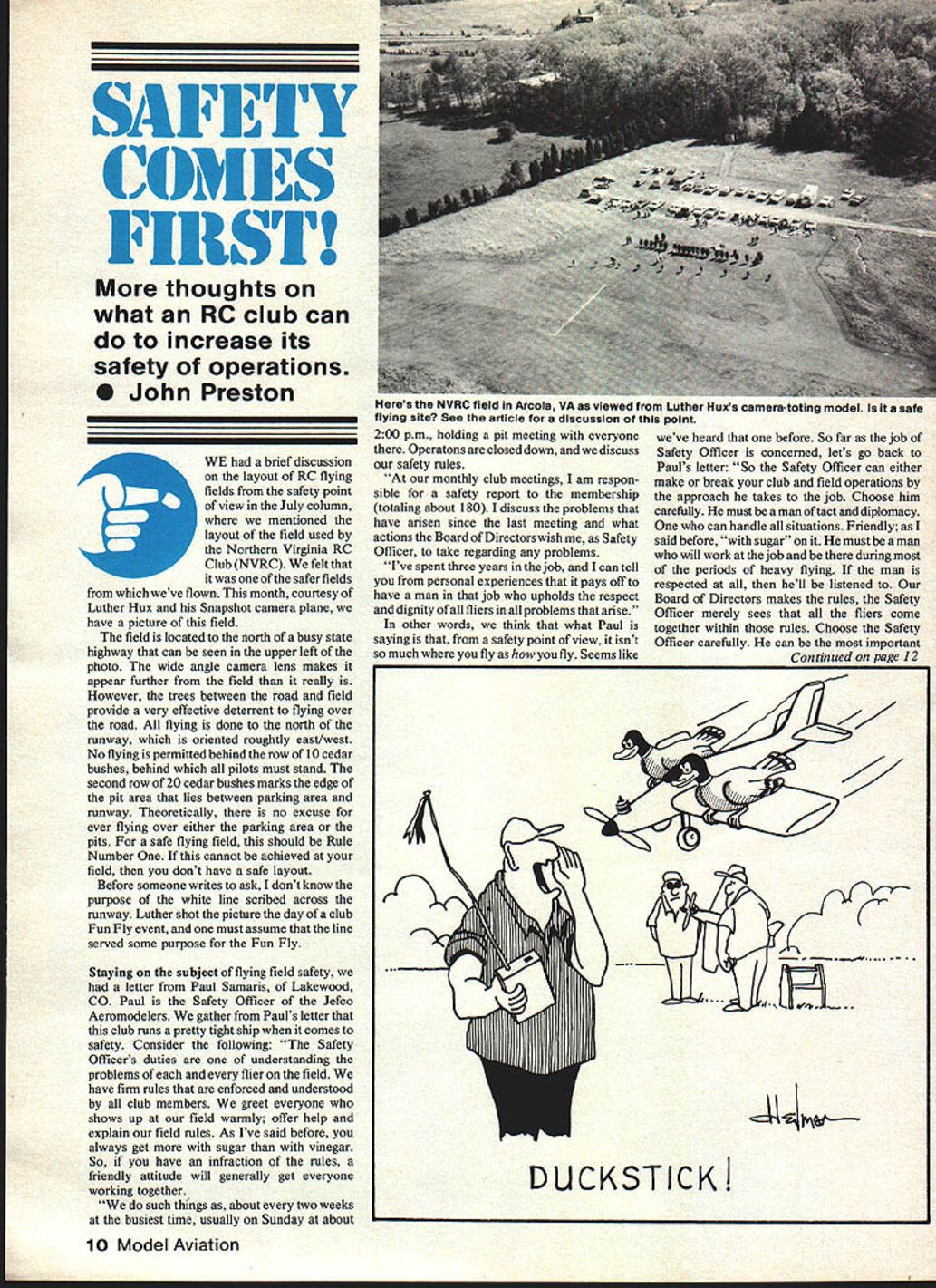
We had a brief discussion on the layout of RC flying fields from the safety point of view in the July column, where we mentioned the layout of the field used by the Northern Virginia RC Club (NVRC). We felt that it was one of the safer fields from which we've flown. This month, courtesy of Luther Hux and his Snapshot camera plane, we have a picture of this field.
The field is located to the north of a busy state highway that can be seen in the upper left of the photo. The wide-angle camera lens makes the road appear further from the field than it really is. However, the trees between the road and field provide a very effective deterrent to flying over the road. All flying is done to the north of the runway, which is oriented roughly east/west. No flying is permitted behind the row of 10 cedar bushes, behind which all pilots must stand. The second row of 20 cedar bushes marks the edge of the pit area that lies between the parking area and the runway.
Theoretically, there is no excuse for ever flying over either the parking area or the pits. For a safe flying field, this should be Rule Number One. If this cannot be achieved at your field, then you don't have a safe layout.
Before someone writes to ask, I don't know the purpose of the white line scribed across the runway. Luther shot the picture the day of a club Fun Fly event, and one must assume that the line served some purpose for the Fun Fly.
The Safety Officer — duties and approach
We received a letter from Paul Samaris of Lakewood, CO. Paul is the Safety Officer of the Jefco Aeromodelers. We gather from Paul's letter that this club runs a pretty tight ship when it comes to safety. Consider the following from his letter:
"The Safety Officer's duties are one of understanding the problems of each and every flier on the field. We have firm rules that are enforced and understood by all club members. We greet everyone who shows up at our field warmly; offer help and explain our field rules. As I've said before, you always get more with sugar than with vinegar. So, if you have an infraction of the rules, a friendly attitude will generally get everyone working together."
"We do such things as, about every two weeks at the busiest time, usually on Sunday at about 2:00 p.m., holding a pit meeting with everyone there. Operations are closed down, and we discuss our safety rules.
"At our monthly club meetings, I am responsible for a safety report to the membership (totaling about 180). I discuss the problems that have arisen since the last meeting and what actions the Board of Directors wish me, as Safety Officer, to take regarding any problems.
"I've spent three years in the job, and I can tell you from personal experiences that it pays off to have a man in that job who upholds the respect and dignity of all fliers in all problems that arise."
In other words, from a safety point of view, it isn't so much where you fly as how you fly.
Choose the Safety Officer carefully. Paul adds: "So the Safety Officer can either make or break your club and field operations by the approach he takes to the job. Choose him carefully. He must be a man of tact and diplomacy. One who can handle all situations. Friendly, as I said before, 'with sugar' on it. He must be a man who will work at the job and be there during most of the periods of heavy flying. If the man is respected at all, then he'll be listened to. Our Board of Directors makes the rules, the Safety Officer merely sees that all the fliers come together within those rules. Choose the Safety Officer carefully. He can be the most important man the club has."
Traits of an effective Safety Officer:
- Tactful and diplomatic
- Friendly and helpful (use "sugar" rather than "vinegar")
- Present during peak flying periods
- Respected by the membership
- Willing to enforce Board-established rules
Handling rule infractions
We wonder how many clubs have an officer whose sole job is to ensure safe operation at the flying field. It's not the kind of job that many would want to undertake. As a suggestion to clubs without such a person:
- If a flier needs to be reminded of a safety rule — whether due to a willful or inadvertent infraction — have several members get together and speak to him.
- If two or more club members suggest that the flier should change his bad habits, it is much less likely to result in a shouting match or to be misinterpreted as a personal attack.
Runways and concurrent operations
Unlike the flying field in the photograph, the Jefco club's field features two runways — definitely an advantage if you have the space. However, crossed runways or an L layout can bring additional problems in keeping models from overflying the pit, spectator and parking areas. Again, Rule Number One is to prevent models from flying over these areas.
As with a full-scale airport, a model field with more than one runway can only hope to achieve safe operation if one runway is active at any given time. Which runway and direction to use may be the responsibility of a flight line director, safety officer, or, as at Jefco, may be left to the majority of the fliers. That doesn't mean a few brave souls fly from the inactive runway. Whether you have one or more runways, all pilots must conduct their takeoffs and landings in the same direction and on the same runway at any given time.
Changing direction mid-operations
Assume it's a hot, muggy day with little wind and the fliers have agreed on runway and direction. While several models are in the air, a breeze comes up from the opposite direction. Logic says we should reverse the direction of the active runway to keep landings into the wind. Can this be done safely in the middle of operations at your field? It should be possible if the fliers are located correctly in the designated pilot areas, enabling them to communicate with each other while flying. If you don't have such a setup, then you have something lacking from a safety point of view.
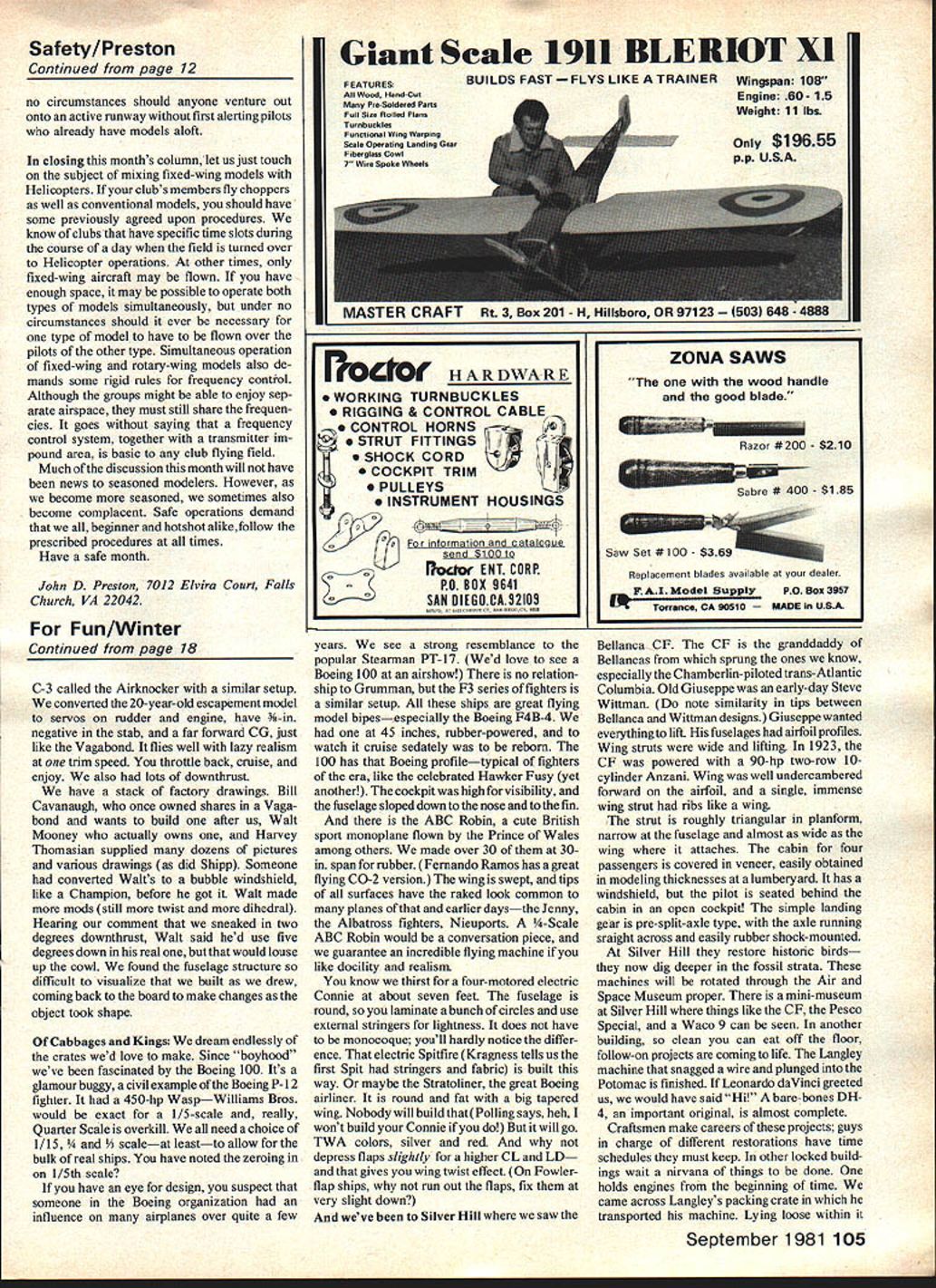
There will also be occasions when someone loses an engine and must make a deadstick approach. All other fliers should be warned by a loud call of "Deadstick!" If pilots are strung out in a haphazard pattern, someone may miss the call and a collision could occur.
Pilot positioning and takeoff procedures
Referencing Jefco's Flight Operations Rules: "Except during takeoff and landing operations, all persons will stand in the pilot areas as determined by the tethered area." Ideally, pilots should be located at the downwind end of the runway.
Most of us prefer to be behind a model during takeoff, especially beginners. Some like to stand immediately behind the model for takeoff, which can only be safely facilitated with the aid of a helper who can watch other models. In such a case, the flier and helper must move to the designated pilot area immediately after takeoff is completed. Under no circumstances should anyone venture out onto an active runway without first alerting pilots who already have models aloft.
Mixing fixed-wing models with helicopters
If your club's members fly helicopters as well as conventional models, you should have previously agreed procedures. Options include:
- Designated time slots when the field is turned over to helicopter operations.
- At other times, only fixed-wing aircraft may be flown.
- If you have enough space, operating both types simultaneously may be possible, but under no circumstances should one type of model be flown over the pilots of the other type.
Simultaneous operation of fixed-wing and rotary-wing models also demands rigid frequency-control rules. Although groups might enjoy separate airspace, they must still share frequencies. A frequency-control system together with a transmitter impound area is basic to any club flying field.
Conclusion
Much of the discussion above will not be news to seasoned modelers. However, as we become more seasoned, we sometimes also become complacent. Safe operations demand that we all — beginner and hotshot alike — follow the prescribed procedures at all times.
Have a safe month.
John D. Preston 7012 Elvira Court, Falls Church, VA 22042.
Transcribed from original scans by AI. Minor OCR errors may remain.

